Anaerobic Ammonium Oxidation in Coastal Sediments: Microbial Mechanisms, Environmental Drivers, and Biogeochemical Significance
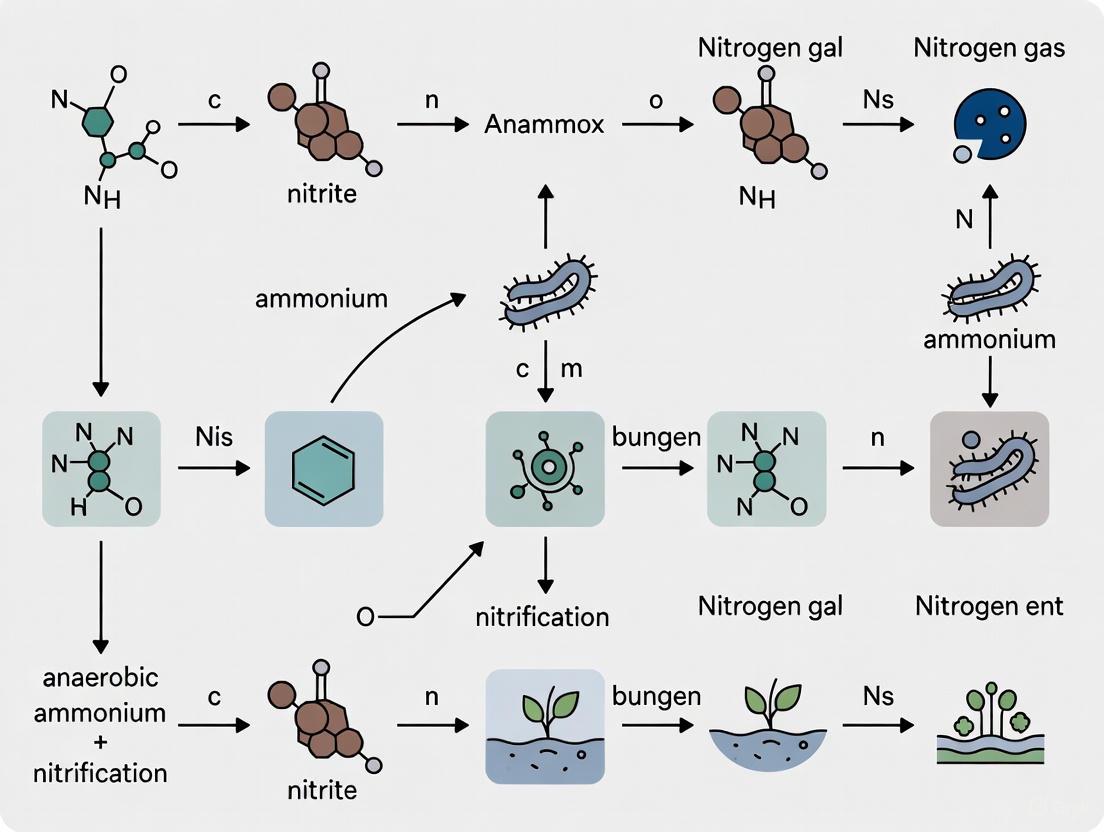
Anaerobic ammonium oxidation (anammox) is a critical microbial process responsible for significant nitrogen loss in coastal ecosystems, converting reactive nitrogen into inert dinitrogen gas and thereby mitigating eutrophication.
Anaerobic Ammonium Oxidation in Coastal Sediments: Microbial Mechanisms, Environmental Drivers, and Biogeochemical Significance
Abstract
Anaerobic ammonium oxidation (anammox) is a critical microbial process responsible for significant nitrogen loss in coastal ecosystems, converting reactive nitrogen into inert dinitrogen gas and thereby mitigating eutrophication. This article synthesizes current research on the foundational microbiology, novel pathways like manganammox, and key genera such as Candidatus Scalindua and Brocadia. It explores advanced methodological approaches for quantifying rates, examines the complex ecological interactions between anammox and denitrifying bacteria, and addresses challenges in process optimization. Through comparative analysis of diverse coastal environments, we evaluate the relative contributions of anammox to net nitrogen loss and its response to global change, providing a comprehensive resource for researchers and environmental professionals.
Unveiling the Anammox Process: From Microbial Core to Global Significance
Anaerobic ammonium oxidation (anammox) is a microbially mediated process that constitutes a key sink for fixed nitrogen in global biogeochemical cycles, particularly in coastal marine sediments [1] [2]. This process, performed by specialized bacteria within the phylum Planctomycetota, converts ammonium and nitrite directly into dinitrogen gas under anoxic conditions [3] [2]. The anammox reaction is a unique form of chemolithoautotrophic metabolism that provides a significant ecological service by removing bioavailable nitrogen from aquatic ecosystems, thereby helping to mitigate eutrophication resulting from anthropogenic nitrogen inputs [1] [4]. Understanding the precise stoichiometry and energetics of this reaction is fundamental for quantifying its contribution to nitrogen losses in coastal sediments and for harnessing its potential in wastewater treatment technologies [5] [6]. This technical guide provides an in-depth analysis of the anammox biochemical reaction, with a specific focus on its stoichiometric relationships, thermodynamic properties, and the enzymatic machinery that facilitates this ecologically critical process.
Core Reaction Stoichiometry and Energetics
The anammox process is a redox comproportionation where ammonium serves as the electron donor and nitrite as the electron acceptor. The widely accepted stoichiometry, first established by Strous et al. (1998) and confirmed by subsequent studies, is as follows [5] [3] [2]:
NH4+ + 1.32 NO2- + 0.066 HCO3- + 0.13 H+ → 1.02 N2 + 0.26 NO3- + 0.066 CH2O0.5N0.15 + 2.03 H2O
This overall reaction represents the net result of catabolic energy generation and anabolic carbon fixation. The standard Gibbs free energy change (ΔG°') for this overall process is approximately -357 kJ/mol, making it thermodynamically favorable [3] [2]. A slightly revised stoichiometry was later proposed by Lotti et al. (2014) based on kinetic experiments and elemental analysis [5]:
1 NH4+ + 1.146 NO2- + 0.071 HCO3- + 0.057 H+ → 0.986 N2 + 0.161 NO3- + 0.071 CH1.74O0.31N0.20 + 2.002 H2O
Table 1: Comparison of Anammox Stoichiometric Coefficients
| Component | Strous et al. (1998) Stoichiometry | Lotti et al. (2014) Revised Stoichiometry |
|---|---|---|
| NH4+ | 1.00 | 1.00 |
| NO2- | 1.32 | 1.15 |
| HCO3- | 0.07 | 0.07 |
| H+ | 0.13 | 0.06 |
| N2 | 1.02 | 0.99 |
| NO3- | 0.26 | 0.16 |
| Biomass | 0.07 CH2O0.5N0.15 | 0.07 CH1.74O0.31N0.20 |
| H2O | 2.03 | 2.00 |
Energetic Considerations
The anammox process consists of two coupled partial reactions: the energy-generating catabolic reaction and the energy-consuming anabolic reaction for carbon fixation [3]. The catabolic reaction alone:
NH4+ + NO2- → N2 + 2H2O
has a ΔG°' of -357 kJ/mol, which provides the energetic drive for the process [3]. The nitrate produced (0.26 mol per mol NH4+ consumed) results from the oxidation of nitrite to generate reducing equivalents (electrons) necessary for carbon fixation [6]. This partial reaction:
0.27 NO2- + 0.066 HCO3- → 0.26 NO3- + 0.066 CH2O0.5N0.15
is endergonic with a ΔG°' of +82 kJ/mol and is driven by the energy released from the catabolic reaction [3]. The overall favorable thermodynamics enable anammox bacteria to thrive in various anoxic environments, including coastal sediments where they contribute significantly to nitrogen removal.
Biochemical Mechanism and Key Enzymes
Metabolic Pathway
The anammox catabolism occurs within a specialized organelle called the anammoxosome, which is surrounded by membrane lipids known as ladderanes that limit the diffusion of toxic intermediates [2]. The current model of the anammox biochemical pathway involves three coupled redox reactions with nitric oxide (NO) and hydrazine (N2H4) as intermediates [6] [3] [2]:
Reduction of nitrite to nitric oxide: Catalyzed by nitrite reductase (Nir) NO2- + 2H+ + e- → NO + H2O (E0' = +0.38 V)
Condensation of ammonium and NO to form hydrazine: Catalyzed by hydrazine synthase (HZS) NO + NH4+ + 2H+ + 3e- → N2H4 + H2O (E0' = +0.06 V)
Oxidation of hydrazine to dinitrogen gas: Catalyzed by hydrazine dehydrogenase (HDH) N2H4 → N2 + 4H+ + 4e- (E0' = -0.75 V)
The electrons generated from hydrazine oxidation (step 3) are used to drive the initial reduction of nitrite to NO (step 1), creating a cyclic electron flow [6]. Additionally, some electrons are diverted for carbon fixation, which requires supplemental oxidation of nitrite to nitrate:
- Nitrite oxidation to nitrate: Catalyzed by nitrite oxidoreductase (NXR) NO2- + H2O → NO3- + 2H+ + 2e- (E0' = +0.43 V)
This final reaction replenishes electrons withdrawn from the quinone pool for biosynthetic purposes, explaining the nitrate byproduct in the overall stoichiometry [6].
Diagram 1: Anammox Metabolic Pathway in the Anammoxosome
Role of Trace Hydrazine
Research has demonstrated that adding trace amounts of hydrazine can enhance the anammox process by increasing the yield of anammox bacteria and reducing nitrate production [5]. The kinetic parameters for hydrazine utilization were determined to be:
- Maximum specific substrate utilization rate: 25.09 mg N/g VSS/d
- Half-saturation constant: 10.42 mg N/L
- Inhibition constant: 1393.88 mg N/L
This enhancement occurs because the oxidation of externally added hydrazine partly substitutes for the oxidation of nitrite to nitrate for generating electrons required for cellular synthesis [5].
Anammox in Coastal Sediment Environments
Ecological Significance
In coastal sediments, anammox represents a crucial mechanism for nitrogen removal, working in concert with denitrification to convert reactive nitrogen into inert N2 gas [1]. Global measurements indicate that anammox can contribute 24-67% of total N2 production in continental shelf sediments [2], with some studies reporting contributions of up to 50% in specific marine ecosystems [4]. A recent global database of actual nitrogen loss rates documented through intact core incubations reported 255 measurements specifically for anammox across various coastal and marine systems [1]. The process is particularly significant in coastal regions receiving high anthropogenic nitrogen inputs, where it helps mitigate eutrophication effects [7] [1].
Microbial Community Structure
Molecular analyses of coastal sediments have revealed distinct spatial distribution patterns of anammox bacteria across different estuaries along the Chinese coastline [7] [8]. The predominant anammox genus in marine environments is Candidatus Scalindua, while Candidatus Brocadia and Candidatus Kuenenia are more abundant in estuarine sediments [7] [8]. Recent research has highlighted the critical ecological roles of rare species in maintaining the stability and function of anammox bacterial communities in coastal sediments, with these low-abundance taxa being more susceptible to dispersal limitations and environmental selection than their abundant counterparts [7] [8].
Table 2: Anammox Bacterial Distribution in Coastal Sediments
| Location | Predominant Genera | Species Richness | Environmental Factors |
|---|---|---|---|
| South China Sea (SCS) | Candidatus Scalindua | Lowest Shannon diversity | Marine conditions, lower ammonium |
| Jiulong River Estuary (JLE) | Candidatus Brocadia, Candidatus Kuenenia | Highest Shannon diversity | Higher ammonium concentration |
| Changjiang Estuary (CJE) | Mixed community | Highest species richness | Estuarine gradient conditions |
| Oujiang Estuary (OJE) | Transitional community | Moderate diversity | Intermediate conditions |
Alternative Electron Acceptors
Beyond the conventional anammox process using nitrite, recent evidence indicates that anammox bacteria in coastal sediments can utilize alternative electron acceptors. One significant discovery is the manganammox process, where Mn(IV)-oxide serves as the terminal electron acceptor [4]:
2NH4+ + 3MnO2 + 4H+ → 3Mn2+ + N2 + 6H2O (ΔG°' = -552.9 kJ/mol)
This reaction is thermodynamically more favorable than conventional anammox and has been documented in coastal sediments from Baja California, where it demonstrated a nitrogen loss rate of 4.2 ± 0.4 μg ³⁰N2/g-day - 17-fold higher than the feammox process (anaerobic ammonium oxidation linked to Fe(III) reduction) measured in the same sediments [4]. Several clades of Desulfobacterota have been identified as potential microorganisms catalyzing the manganammox process [4].
Experimental Methodologies
Stoichiometry Determination
The precise stoichiometry of the anammox process has been established through carefully controlled chemostat experiments and titration methods [5]. Key methodological approaches include:
Fixed-endpoint titration: Used to measure proton (H+) consumption during the anammox reaction, providing critical data for stoichiometric calculations [5].
Mass balancing: Tracking changes in substrates (NH4+, NO2-) and products (N2, NO3-) over time in closed systems, allowing for the calculation of stoichiometric coefficients [5] [2].
Isotope pairing technique (IPT): Using ¹⁵N-labeled substrates (e.g., ¹⁵NH4+ with ¹⁴NO2- or vice versa) to distinguish N2 produced specifically from anammox versus denitrification in environmental samples [1].
Intact core incubations: Maintaining the natural structure of sediment cores during laboratory incubations to preserve the natural gradients of substrates and redox conditions, thereby providing more ecologically relevant rate measurements [1].
Diagram 2: Experimental Workflow for Anammox Stoichiometry
Molecular Detection Methods
Characterizing anammox bacterial communities in coastal sediments involves several molecular techniques:
DNA extraction: Using commercial kits (e.g., FastDNA SPIN Kit for soil) to extract total community DNA from sediment samples [7] [9].
PCR amplification: Employing anammox-specific primers targeting the 16S rRNA gene (e.g., Brod541F/Amx820R) or functional genes such as hzo (hydrazine oxidase) [7] [9].
High-throughput sequencing: Utilizing platforms such as Illumina to sequence amplified genes, followed by bioinformatic analysis using tools like QIIME 2 to determine microbial diversity and community structure [7].
Phylogenetic analysis: Constructing phylogenetic trees based on aligned sequences using software such as MEGA to determine evolutionary relationships among anammox bacteria [9].
Quantitative PCR (qPCR): Quantifying anammox bacterial abundance using specific gene markers [9].
Research Reagent Solutions
Table 3: Essential Research Reagents for Anammox Studies
| Reagent/Chemical | Function/Application | Technical Specifications |
|---|---|---|
| ¹⁵N-labeled ammonium (¹⁵NH₄⁺) | Isotope pairing technique to quantify anammox rates | >98% atomic enrichment; used at environmentally relevant concentrations (μM range) |
| Sodium nitrite (NaNO₂) | Anammox substrate | Anoxic stock solutions; typical concentration range: 10-500 mg N/L |
| Hydrazine (N₂H₄) | Intermediate studies and process enhancement | Trace additions (kinetic parameters: Ks = 10.42 mg N/L) |
| FastDNA SPIN Kit | DNA extraction from sediment samples | Optimized for difficult environmental matrices |
| Anammox-specific primers | Molecular detection of anammox bacteria | Brod541F/Amx820R for 16S rRNA gene; hzo gene primers for functional detection |
| Vernadite (δ-MnO₂) | Manganammox studies | Nano-crystal size ~15 Å; electron acceptor in alternative anammox |
| HCO₃⁻/CO₂ source | Carbon source for anammox growth | Typically NaHCO₃; 0.066 mol per mol NH₄⁺ consumed |
| Resazurin | Redox indicator for anoxic conditions | Visual confirmation of anaerobic conditions |
Factors Influencing Stoichiometry and Energetics
Environmental Conditions
The stoichiometry and energetic efficiency of the anammox process are influenced by various environmental factors prevalent in coastal sediments:
Temperature: Anammox activity has been documented across a wide temperature range from 20°C to 85°C, with optimal activity typically between 20°C and 43°C [9] [2]. However, specialized populations exist in thermophilic environments, including oil reservoirs (55-75°C) and hydrothermal vents (60-85°C) [9] [2].
pH: The anammox process consumes protons (H+), with stoichiometric coefficients ranging from 0.057 to 0.13 mol H+ per mol NH4+ consumed [5]. This proton consumption can influence local pH conditions in sediments.
Organic carbon: While anammox bacteria are autotrophic, the presence of organic matter can influence the competitive dynamics between anammox and heterotrophic denitrifiers in coastal sediments [6] [3].
Heavy metals: Ionic forms of heavy metals (e.g., Cu²⁺, Zn²⁺) can inhibit anammox activity, with Cu²⁺ causing up to 85% decrease in specific anammox activity [10]. Nanoparticulate forms generally show less inhibition than ionic forms [10].
Kinetic Parameters
Understanding the kinetics of the anammox process is essential for modeling its contribution to nitrogen cycling in coastal sediments. Key kinetic parameters include:
- Maximum specific substrate utilization rate: Ranges from 25.09 mg N/g VSS/d for hydrazine to higher values for the overall process [5]
- Half-saturation constant (Ks): Typically in the sub-micromolar range, reflecting the high affinity of anammox bacteria for their substrates [2]
- Inhibition constants: For various potential inhibitors including substrates (NO2-), heavy metals, and other environmental toxins [5] [10]
The Monod equation, Haldane model, and pseudo-first order reaction models have all been applied to describe the kinetics of the anammox process under different conditions [5].
The anammoxosome is a unique and defining intracellular compartment found in anaerobic ammonium-oxidizing (anammox) bacteria, representing a remarkable example of prokaryotic cellular complexity. This specialized organelle is the exclusive site of the energy metabolism that converts ammonium and nitrite into dinitrogen gas (N₂), a process of critical importance to the global nitrogen cycle [11] [12]. Anammox bacteria belong to the phylum Planctomycetes and perform the anammox process under anoxic conditions, making substantial contributions to nitrogen loss in various environments, particularly in coastal and marine sediments [13] [14].
The ecological significance of the anammox process has been extensively documented in estuarine and coastal sediments, where it can contribute substantially to nitrogen removal. Studies in Chinese estuaries, including the Changjiang, Oujiang, and Jiulong River Estuaries, have revealed that anammox bacterial communities, particularly those dominated by genera like Candidatus Scalindua, play crucial roles in nitrogen cycling [13]. Similarly, research in the Indus Estuary has demonstrated that anammox bacteria contribute approximately 21.9% to total nitrogen loss on average [15]. Beyond its environmental significance, the anammoxosome has recently attracted attention for its potential applications in biotechnology and medicine, particularly due to its unique ladderane lipid membrane [11].
This review provides a comprehensive examination of the anammoxosome, focusing on its structural properties, biochemical functions, and ecological roles. We present detailed experimental protocols for studying this unique compartment and analyze quantitative data on its distribution and activity across different environments, with particular emphasis on coastal sediment ecosystems.
Structural and Biochemical Characteristics of the Anammoxosome
Unique Ladderane Lipid Membrane
The most distinctive structural feature of the anammoxosome is its membrane, composed of ladderane lipids. These remarkable molecules consist of three to five concatenated cyclobutane rings with unusual ladder-like structures [11]. The ladderane lipids form a dense and exceptionally impermeable membrane that serves critical physiological functions:
- Containment of toxic intermediates: The anammox process generates highly reactive and toxic intermediates, including hydrazine (N₂H₄). The ladderane membrane acts as a barrier, preventing the diffusion of these compounds into the cytoplasm and protecting other cellular components [12].
- Maintenance of proton gradients: The low permeability of the ladderane membrane enables the establishment and maintenance of proton gradients across the anammoxosome membrane, which is essential for energy conservation through ATP synthesis [11].
- Structural stability: The unique arrangement of cyclobutane rings provides structural rigidity to the membrane, potentially contributing to the overall stability of the anammoxosome compartment [11].
Recent research has explored the biotechnological applications of ladderane lipids, particularly in the creation of artificial liposomes for drug delivery. Studies have demonstrated that liposomes incorporating ladderane lipids exhibit increased colloidal stability at elevated concentrations compared to those made solely of conventional phospholipids [11].
Anammox Metabolic Pathway and Key Enzymes
The anammoxosome houses the complete enzymatic machinery for the anaerobic oxidation of ammonium, a process that involves multiple steps and specialized enzymes:
- Nitrite reduction: Nitrite (NO₂⁻) is reduced to nitric oxide (NO) by the enzyme nitrite reductase (NirS).
- Hydrazine synthesis: Ammonium (NH₄⁺) and nitric oxide (NO) are condensed to form hydrazine (N₂H₄) by hydrazine synthase (HZS).
- Hydrazine oxidation: Hydrazine (N₂H₄) is oxidized to dinitrogen gas (N₂) by hydrazine dehydrogenase (HDH) [12].
The overall stoichiometry of the anammox process can be represented by the following equation: NH₄⁺ + 1.32 NO₂⁻ + 0.066 HCO₃⁻ + 0.13 H⁺ → 1.02 N₂ + 0.26 NO₃⁻ + 0.066 CH₂O₀.₅N₀.₁₅ + 2.03 H₂O [16]
All these catabolic reactions occur within the anammoxosome, generating a proton gradient across the anammoxosome membrane that drives ATP synthesis [12]. This compartmentalization of energy metabolism is unusual among prokaryotes and represents a significant evolutionary adaptation.
Figure 1: The anammox metabolic pathway localized within the anammoxosome compartment. Key enzymes catalyze the step-wise conversion of ammonium and nitrite to dinitrogen gas, with hydrazine as a toxic intermediate contained by the ladderane membrane. Notably, the pathway bypasses nitrous oxide production, unlike denitrification.
Research Methodologies for Anammoxosome Studies
Anammoxosome Isolation Protocol
The isolation of intact anammoxosomes is crucial for detailed biochemical and structural studies. Recent methodological advances have improved the efficiency of this process, particularly for aggregate cultures that were previously challenging to work with. The following protocol, adapted from studies on Candidatus Brocadia sapporoensis, provides a reliable approach for anammoxosome isolation [11]:
Sample Preparation:
- Start with an aggregated anammox biomass cultivated in a fed-batch reactor under anoxic conditions.
- Maintain the reactor at 30°C and pH 7.2, with continuous sparging using a CO₂/N₂ mixture (5%/95%) to ensure anoxic conditions.
- Feed the reactor with a synthetic substrate containing ammonium chloride and sodium nitrite in a 1:1 molar ratio, along with essential minerals and trace elements.
Isolation Procedure:
- Cell disruption: Gently disrupt the aggregated biomass to release intracellular components while preserving anammoxosome integrity.
- Enzymatic treatment: Apply a cocktail of enzymes including cellulase Onozuka R-10 and Macerozyme R-10 to degrade the extrapolymeric substances (EPS) matrix that surrounds anammox cells in aggregates.
- Extended EDTA treatment: Prolong the application of EDTA to enhance the disruption of the EPS and cell walls.
- Differential centrifugation: Perform sequential centrifugation steps to separate anammoxosomes from other cellular debris.
- Sucrose density gradient centrifugation: Replace traditional Percoll with a sucrose gradient for better separation efficiency and cost-effectiveness. Layer the sample on a discontinuous sucrose gradient and centrifuge at high speed.
- Anammoxosome collection: Carefully collect the anammoxosome-rich layer from the gradient and wash to remove residual sucrose.
Validation:
- Confirm the success of isolation through transmission electron microscopy (TEM), which should reveal intact anammoxosomes with characteristic membrane structures.
- Verify the presence of ladderane lipids using lipid extraction and analysis techniques.
This enhanced protocol efficiently removes EPS and other debris, yielding a purified fraction of anammoxosomes suitable for further analysis [11].
Molecular Detection of Anammox Bacteria
The study of anammox bacteria in environmental samples typically relies on molecular techniques targeting specific gene markers:
DNA Extraction:
- Use the FastDNA SPIN Kit for soil or similar protocols to extract genomic DNA from sediment samples.
- Quantify DNA concentration and purity using fluorometric methods and spectrophotometry.
PCR Amplification:
- Amplify the anammox bacterial 16S rRNA gene using specific primers such as Brod541F and Amx820R.
- Perform reactions with 35 cycles of denaturation (95°C, 45 s), annealing (56°C, 30 s), and extension (72°C, 50 s).
High-Throughput Sequencing:
- Sequence amplicons using platforms such as Illumina.
- Process raw sequences through quality filtering, chimera removal, and operational taxonomic unit (OTU) clustering at 97-98% similarity.
- Classify sequences against specialized anammox bacteria databases [13].
Quantitative PCR (qPCR):
- Quantify anammox bacterial abundance using primers targeting the 16S rRNA gene or functional markers like hydrazine synthase (hzsB).
- Perform reactions in triplicate with appropriate standard curves for absolute quantification [17] [15].
Metagenomic Analysis:
- Sequence total community DNA to recover metagenome-assembled genomes (MAGs) of anammox bacteria.
- Assess genome completeness and contamination using single-copy marker genes.
- Annotate genes involved in the anammox metabolism, particularly those encoding key enzymes [18].
Activity Measurements Using Isotope Tracing
The anammox process can be quantified in environmental samples and enrichment cultures using ¹⁵N isotope tracing techniques:
Sample Preparation:
- Collect intact sediment cores or anammox biomass and pre-incubate under in situ conditions to stabilize metabolic activity.
- Prepare parallel samples with ¹⁵N-labeled ammonium (¹⁵NH₄⁺) or ¹⁵N-labeled nitrite (¹⁵NO₂⁻).
Incubation and Analysis:
- Incubate samples anaerobically in gas-tight vials for specified periods.
- Terminate reactions by adding appropriate preservatives.
- Analyze the produced N₂ gases for ²⁹N₂ and ³⁰N₂ using gas chromatography coupled to isotope ratio mass spectrometry.
- Calculate anammox rates based on the production of ²⁹N₂ from ¹⁵NH₄⁺ and ¹⁴NO₂⁻, or ³⁰N₂ from ¹⁵NH₄⁺ and ¹⁵NO₂⁻ [14] [15].
This sensitive method allows researchers to distinguish anammox from denitrification and quantify their respective contributions to N₂ production in environmental samples.
Ecological Distribution and Activity in Coastal Sediments
Diversity and Community Composition
Anammox bacteria exhibit distinct distribution patterns across different coastal environments, with community composition strongly influenced by environmental factors. The table below summarizes the diversity and abundance of anammox bacteria in various estuarine and coastal sediments:
Table 1: Anammox Bacterial Diversity and Abundance in Coastal Sediments
| Location | Dominant Genera | Abundance (16S rRNA gene copies/g) | Key Environmental Drivers | Reference |
|---|---|---|---|---|
| Jiulong River Estuary | Ca. Brocadia, Ca. Kuenenia | Not specified | Ammonium concentration | [13] |
| South China Sea | Ca. Scalindua | Not specified | Dispersal limitation | [13] |
| Hangzhou Bay | Ca. Scalindua, Ca. Jettenia, Ca. Brocadia, Ca. Kuenenia, Ca. Anammoxoglobus | 2.34×10⁵ - 9.22×10⁵ | Salinity, depth, pH | [17] |
| Indus Estuary | Ca. Kuenenia, Ca. Brocadia, Ca. Scalindua, Ca. Jettenia | 1.64×10⁶ - 8.21×10⁸ | Temperature, sediment sulfide, Fe(II) | [15] |
| Global Inland Waters | Ca. Brocadia, Ca. Kuenenia | 3.1×10⁴ - 3.3×10⁷ copies/g | Moisture content, organic matter | [14] [19] |
Recent studies have expanded the known diversity of anammox bacteria with the discovery of novel lineages. A newly proposed family, Candidatus Bathyanammoxibiaceae, represents a deep-branching lineage within the order Candidatus Brocadiales. Members of this family contain the genetic potential for anammox metabolism and have been detected in both marine and terrestrial environments, suggesting that the diversity and ecological distribution of anammox bacteria may be broader than previously recognized [18].
Environmental Controls on Anammox Activity
The activity of anammox bacteria in coastal sediments is regulated by a complex interplay of environmental factors:
Salinity: Anammox bacteria exhibit niche partitioning along salinity gradients. The genus Candidatus Scalindua typically dominates in marine environments, while Candidatus Brocadia and Candidatus Kuenenia are more abundant in estuarine and low-salinity regions [13] [15]. Salinity influences the community composition and activity of anammox bacteria, with different genera showing distinct salinity optima.
Organic Matter: The availability of organic carbon indirectly affects anammox bacteria by influencing the activity of heterotrophic denitrifiers that compete for nitrite. However, high concentrations of organic matter can inhibit anammox activity, as observed in continuous acetate addition experiments that reduced the abundance of Candidatus Kuenenia by 8.00% and its activity by 66.80% [16].
Temperature: Anammox bacteria are sensitive to temperature fluctuations, which directly affect their metabolic rates and growth. Temperature optima vary among different species, but generally fall within the mesophilic range (20-40°C). A decline in temperature from 17.9°C to 15.1°C resulted in decreased abundance of anammox bacteria, with Candidatus Brocadia declining from 4.30% to 1.80% and Candidatus Kuenenia from 0.25% to 0.03% of the microbial community [16].
Dissolved Oxygen: Anammox bacteria are strictly anaerobic and sensitive to oxygen exposure. Increasing dissolved oxygen from 0.3 to 1.0 mg/L led to a sharp decline in the relative abundances of Candidatus Brocadia and Candidatus Kuenenia, decreasing from 1.63% and 1.32% to 0.83% and 0.09%, respectively [16].
Substrate Availability: The anammox process requires both ammonium and nitrite as substrates. The concentration of these compounds strongly influences anammox activity, with inhibitory effects observed at high concentrations. The half-saturation constant (Kₛ) for ammonium is generally below 5 μM, while values for nitrite range from 0.2-0.3 μM for Candidatus Kuenenia to less than 5 μM for Candidatus Brocadia, giving anammox bacteria a competitive advantage in low-nutrient environments [14].
Table 2: Anammox Process Contributions to Nitrogen Loss in Different Ecosystems
| Ecosystem Type | Anammox Rate Range | Contribution to N-loss | Primary Environmental Controls | Reference |
|---|---|---|---|---|
| Coastal Sediments | 0.01 - 0.32 μmol N kg⁻¹ h⁻¹ | Up to 21.9% (average) | Salinity, Fe(II), TOC | [15] |
| Global Inland Waters | 1.0 - 975.9 μmol N m⁻² h⁻¹ | 0.9 - 82.2% | Moisture content, NH₄⁺, NO₂⁻ | [14] [19] |
| Oxygen Minimum Zones | Not specified | Significant contribution | Nitrate, dissolved oxygen | [19] |
| Global Wetlands | Not specified | 2.0 Tg N yr⁻¹ (China) | Soil moisture content | [19] |
| Paddy Fields | Not specified | 32.0 Tg N yr⁻¹ (global) | Flooding duration, fertilizer input | [19] |
The Scientist's Toolkit: Essential Research Reagents and Materials
Table 3: Key Research Reagents and Materials for Anammoxosome Studies
| Reagent/Material | Application | Function | Example Product References |
|---|---|---|---|
| FastDNA SPIN Kit | DNA extraction | Efficient lysis and purification of genomic DNA from complex matrices like sediments | [13] |
| Brod541F/Amx820R primers | PCR amplification | Specific detection of anammox bacterial 16S rRNA genes | [13] |
| Cellulase Onozuka R-10 | Anammoxosome isolation | Degrades cellulose in extrapolymeric substances (EPS) for better cell disruption | [11] |
| Macerozyme R-10 | Anammoxosome isolation | Digests plant cell walls, helpful for degrading complex EPS matrices | [11] |
| Proteinase K | Enzyme treatment | General protease for degrading protein components in EPS and cell walls | [11] |
| DNase I | Enzyme treatment | Degrades extracellular DNA in EPS matrices | [11] |
| Sucrose gradient | Density centrifugation | Separates anammoxosomes based on buoyant density; alternative to Percoll | [11] |
| ¹⁵N-labeled ammonium/nitrite | Isotope tracing | Quantifying anammox rates through ¹⁵N pairing technique | [14] [15] |
| Carlo-Erba EA 2100 analyzer | Elemental analysis | Measures organic carbon and nitrogen content in sediments | [13] |
| OX 50 oxygen microsensor | Microprofiling | High-resolution dissolved oxygen measurements in sediments | [13] |
Research Workflow and Experimental Design
Figure 2: Integrated research workflow for comprehensive anammoxosome studies, encompassing molecular ecology, activity measurements, and biochemical characterization.
The anammoxosome represents a remarkable example of prokaryotic subcellular compartmentalization, housing the complete enzymatic machinery for the anaerobic oxidation of ammonium. Its unique ladderane lipid membrane serves critical functions in containing toxic intermediates and maintaining proton gradients for energy conservation. In coastal sediments, anammox bacteria containing this specialized organelle contribute significantly to nitrogen removal, with their diversity, abundance, and activity shaped by complex interactions between environmental factors and ecological processes.
Future research on anammoxosomes should focus on several promising directions:
- Cultivation of novel lineages: The recent discovery of deep-branching anammox bacteria like Candidatus Bathyanammoxibiaceae highlights the need for improved cultivation strategies to isolate these novel lineages and characterize their anammosome structures [18].
- Biotechnological applications: The unique properties of ladderane lipids warrant further exploration for pharmaceutical applications, particularly in drug delivery systems where membrane stability is crucial [11].
- Integration of multi-omics approaches: Combining metagenomics, metatranscriptomics, and metaproteomics will provide comprehensive insights into the function and regulation of anammoxosomes in natural environments.
- Engineering applications: Optimizing anammox-based wastewater treatment systems requires better understanding of how environmental factors affect anammoxosome function and overall process efficiency [16].
As research methodologies continue to advance, particularly in the areas of single-cell analysis and high-resolution imaging, our understanding of the anammoxosome's structure-function relationships will deepen, potentially revealing new insights into prokaryotic cellular complexity and evolutionary biology.
Anaerobic ammonium oxidation (anammox) is a critical microbial process responsible for a significant portion of nitrogen loss in natural and engineered ecosystems. This whitepaper examines the niche partitioning of key anammox genera, focusing on the dominance of Candidatus Scalindua in marine environments compared to the prevalence of Candidatus Brocadia and Candidatus Kuenenia in estuarine and freshwater systems. Through a synthesis of genomic, molecular, and biogeochemical evidence, we elucidate the environmental drivers, metabolic adaptations, and competitive mechanisms underlying this distribution pattern. Understanding these distinctions is paramount for modeling global nitrogen fluxes and developing biotechnological applications for nitrogen removal from saline wastewaters.
The anammox process, the anaerobic oxidation of ammonium with nitrite as the electron acceptor to yield dinitrogen gas, represents a major pathway in the global nitrogen cycle [20]. This process is exclusively mediated by a monophyletic group of bacteria within the phylum Planctomycetes [21] [22]. Among the described anammox genera, a clear biogeographical pattern has emerged: the genus Scalindua is the primary and often sole representative in open marine ecosystems, while genera such as Brocadia and Kuenenia dominate freshwater and terrestrial systems, with estuarine environments representing a critical transitional zone where these communities mix and shift [23] [24] [25]. This distribution is not random but is governed by a complex interplay of environmental gradients, physiological constraints, and genomic adaptations. This technical guide delves into the mechanisms behind this niche differentiation, framing it within the broader context of anaerobic ammonium oxidation in the dynamic and environmentally critical realm of coastal sediments.
Ecological Distribution and Environmental Drivers
Estuarine and coastal sediments are hotspots for nitrogen cycling, where anammox can contribute substantially to the removal of fixed nitrogen. The community composition of anammox bacteria in these sediments is highly sensitive to key environmental variables.
Biogeographical Partitioning
The global distribution of anammox bacteria is primarily governed by salinity, which acts as a master filter selecting for specific genera [23] [24].
- Marine Environments: Open marine waters and sediments worldwide are dominated by members of the genus Scalindua [21] [22]. In the marine water columns and sediments of oxygen minimum zones (OMZs), Scalindua is responsible for up to 50% of total nitrogen loss [21] [23]. Its near-exclusive presence in these stable, saline habitats indicates a high degree of specialization.
- Freshwater and Estuarine Environments: In contrast, non-saline ecosystems, including wastewater treatment systems, freshwater lakes, and terrestrial soils, are primarily inhabited by the genera Brocadia, Kuenenia, Jettenia, and Anammoxoglobus [23] [24] [26]. Estuaries, characterized by steep salinity gradients, serve as natural laboratories to observe the transition between these communities. Studies in the Cape Fear River Estuary [25] and the Indus Estuary [15] have demonstrated a shift in community composition along the salinity gradient, with Scalindua abundance increasing with salinity and Brocadia/Kuenenia dominating the freshwater and low-salinity stations.
Table 1: Key Environmental Drivers of Anammox Bacterial Distribution
| Environmental Factor | Effect on Anammox Community | Key Genera Impacted |
|---|---|---|
| Salinity | Primary driver; determines community composition at a global scale. | Scalindua (high salinity); Brocadia/Kuenenia (low/no salinity) [15] [23] [25] |
| Temperature | Influences activity and community distribution. | All genera; distribution linked to temperature in estuaries [15] |
| Substrate Availability (NH₄⁺, NO₂⁻) | Affects bacterial abundance and anammox rates. | All genera; Scalindua has high-affinity transport systems [21] |
| Sediment Sulfide | Correlates with community distribution in estuaries. | All genera, particularly in sulfidic environments [15] |
| Organic Matter | Can inhibit anammox or favor heterotrophic denitrifiers. | All genera [15] |
Quantitative Community Analysis
Molecular studies using quantitative PCR (qPCR) and 16S rRNA gene sequencing provide quantitative evidence for these distribution patterns. In the Indus Estuary, the abundance of anammox bacteria based on 16S rRNA gene copies varied between 1.64 × 10⁶ and 8.21 × 10⁸ copies g⁻¹ of sediment [15]. Furthermore, a study of the Cape Fear River Estuary found that the highest anammox rate occurred at the site where Scalindua dominated and anammox bacterial abundance was highest [25]. In terrestrial ecosystems, while Scalindua can be detected, Kuenenia and Brocadia are the most common representatives, indicating a higher diversity of anammox bacteria in terrestrial than in marine ecosystems [26].
Genomic and Metabolic Adaptations
The distinct habitats of marine and non-marine anammox bacteria have driven specific genomic and metabolic adaptations that underpin their competitive fitness.
Core Anammox Metabolism
All anammox bacteria share a core metabolic pathway that occurs within a specialized, membrane-bound organelle called the anammoxosome [27] [22]. The pathway involves three key steps:
- Reduction of nitrite (NO₂⁻) to nitric oxide (NO) by a cd₁ nitrite reductase (NirS) [21] [27].
- Condensation of ammonium (NH₄⁺) and NO to hydrazine (N₂H₄) by hydrazine synthase (HzsAB) [21] [27].
- Oxidation of hydrazine to dinitrogen gas (N₂) by hydrazine oxidoreductase (HZO) [21] [27].
Energy conservation is proposed to occur via a chemiosmotic mechanism involving an electron transport chain located on the anammoxosome membrane [21].
Diagram 1: Core anammox metabolic pathway in the anammoxosome.
Specialized Adaptations of Scalindua
Comparative genomics of "Candidatus Scalindua profunda" and the freshwater "Candidatus Kuenenia stuttgartiensis" reveal significant genetic divergence, with approximately 2,000 genes in S. profunda not found in K. stuttgartiensis and a similar number unique to K. stuttgartiensis [21]. These genomic differences translate to key adaptive features for Scalindua:
- Adaptation to Substrate Limitation: The marine water column is characterized by low and stable concentrations of ammonium and nitrite. Scalindua possesses highly expressed ammonium, nitrite, and oligopeptide transport systems, allowing it to effectively scavenge substrates and other nutrients (e.g., amino acids) from a dilute environment [21].
- Versatile Carbon Metabolism: Scalindua has genetic pathways for the transport, oxidation, and assimilation of small organic compounds, potentially allowing for a more versatile lifestyle that supplements its primary chemolithoautotrophic metabolism [21]. This may provide a competitive advantage in the marine realm where resources are limited.
- Salinity Tolerance: The fundamental partitioning suggests fundamental physiological adaptations to high osmotic pressure, though the specific genetic mechanisms are still under investigation [23] [24].
Adaptations of Brocadia and Kuenenia
Freshwater anammox bacteria like Brocadia and Kuenenia thrive in environments with higher and more fluctuating substrate concentrations, such as wastewater treatment plants and estuaries with significant terrestrial input.
- Interaction with Flanking Community: In non-saline bioreactors, Brocadia and Kuenenia often coexist in syntrophy with bacteria from phyla like Chloroflexi and Ignavibacteriae [23] [24]. These flanking communities may perform critical functions such as reducing nitrate to nitrite, which is then used by the anammox bacteria, creating a cooperative metabolic network [24].
- Kinetic Characteristics: While kinetic data can vary, it is postulated that differences in substrate affinity and growth rates between genera contribute to their distribution, with freshwater species potentially being more competitive in high-substrate environments [23].
Table 2: Comparative Genomic and Physiological Features of Key Anammox Genera
| Feature | Scalindua (Marine) | Brocadia / Kuenenia (Freshwater/Estuarine) |
|---|---|---|
| Primary Habitat | Marine water columns, sediments, OMZs [21] [22] | Freshwater sediments, wastewater treatment, soils [23] [26] |
| Genomic Distinctness | ~2000 unique genes not in K. stuttgartiensis [21] | ~2000 unique genes not in S. profunda [21] |
| Key Adaptations | High-affinity transport systems; use of organic compounds [21] | Syntrophy with nitrate-reducing community [23] [24] |
| Salinity Preference | High (Marine, ~3.5%) [23] [22] | Low/None (Freshwater) [23] |
| Tolerance to Oxygen | Inhibited by oxygen > 2 μM [22] | Inhibited by oxygen [20] |
Experimental Methodologies for Sediment Research
Research on anammox bacteria in coastal sediments relies on a combination of molecular techniques to detect the organisms and isotope tracer methods to quantify their activity.
Molecular Detection and Community Analysis
- DNA Extraction: Microbial biomass is first collected from sediment samples. Due to the slow growth of anammox bacteria and their often low abundance, efficient and unbiased DNA extraction is critical. The under-representation of anammox sequences in metagenomic studies can be caused by incomplete DNA extraction [21].
- PCR Amplification: Specific primer sets targeting the 16S rRNA gene or functional genes (e.g., hzsA) unique to anammox bacteria are used. A nested PCR approach is often employed to successfully detect anammox bacteria in all sediment samples, even when abundance is low [15].
- Community Analysis: After PCR amplification, several techniques are used:
- Cloning and Sequencing: Provides detailed information on the diversity and phylogenetic identity of anammox bacteria present [15] [25].
- Terminal Restriction Fragment Length Polymorphism (T-RFLP): A fingerprinting method used to rapidly analyze temporal and spatial variations in anammox community structure [25].
- Quantitative PCR (qPCR): Used to determine the abundance (gene copy number) of anammox bacteria in the sediment, which can be correlated with environmental parameters and process rates [15] [25].
Activity Measurements and Isotope Tracing
The contribution of anammox to total N₂ production is quantified using stable isotope tracing.
- Incubation Setup: Sediment slurries or intact cores are incubated under strictly anoxic conditions with ¹⁵N-labeled substrates (either ¹⁵NH₄⁺ or ¹⁵NO₂⁻) [15] [25].
- Gas Chromatography-Mass Spectrometry (GC-MS): The production of labeled dinitrogen gas (²⁹N₂ and ³⁰N₂) is measured over time using GC-MS.
- Rate Calculation: The anammox rate is calculated based on the production of ²⁹N₂ from ¹⁵NH₄⁺, as anammox produces N₂ from one ¹⁵N-atom and one ¹⁴N-atom. Simultaneously, denitrification rates can be estimated from the production of ³⁰N₂ and ²⁹N₂ [15]. Studies in the Indus Estuary reported potential anammox rates in the range of 0.01–0.32 μmol N kg⁻¹ h⁻¹ [15].
Diagram 2: Integrated workflow for anammox community and activity analysis.
The Scientist's Toolkit: Essential Research Reagents and Materials
Table 3: Key Reagents and Materials for Anammox Research in Sediments
| Reagent / Material | Function / Application | Specific Examples / Notes |
|---|---|---|
| Specific PCR Primers | Amplification of anammox-specific 16S rRNA or functional genes (hzsA, hzo) for detection and diversity analysis. | Brocadia- or Scalindua-specific 16S rRNA primers; nested PCR primers for low-abundance samples [15] [25]. |
| ¹⁵N-Labeled Substrates | Tracer for quantifying anammox activity and contribution to N₂ production in incubation experiments. | ¹⁵NH₄⁺ (e.g., (¹⁵NH₄)₂SO₄) or ¹⁵NO₂⁻; used in isotope pairing techniques [15] [25]. |
| Fluorescence In Situ Hybridization (FISH) Probes | Visual identification, enumeration, and spatial localization of anammox cells in sediment samples or biofilms. | Oligonucleotide probes targeting the 16S rRNA of specific anammox genera (e.g., Amx368 for most anammox bacteria, Sca1309 for Scalindua) [21]. |
| Metagenomic Assembly Kits | Preparation of high-quality DNA for sequencing to reconstruct genomes and analyze metabolic potential from complex sediment communities. | Used for community sequencing and assembly of genomes from enrichment cultures (e.g., for "Ca. Scalindua profunda") [21] [23]. |
| Membrane Filtration Systems | Biomass retention in enrichment cultures; concentration of cells from water samples for DNA extraction. | Critical for enriching slow-growing anammox bacteria in membrane bioreactors (MBRs) [21] [23]. |
Implications for Research and Biotechnology
The niche differentiation between anammox genera has profound implications for both environmental science and environmental biotechnology.
- Global Nitrogen Modeling: The dominance of Scalindua in marine systems means that its activity and response to environmental change (e.g., expansion of OMZs due to climate change) must be accurately parameterized in global nitrogen cycle models [21].
- Biotechnological Applications: The discovery that Scalindua is uniquely adapted to saline environments signifies its potential application for treating nitrogen-rich saline wastewaters, such as those from seafood processing, aquaculture, and certain industrial processes [23] [24]. Inoculating bioreactors with marine anammox bacteria could avoid the need for costly dilution of saline wastewater.
- Functional Redundancy: Despite the phylogenetic differences between marine and freshwater anammox communities, there is functional redundancy in the nitrogen removal process. Both systems achieve the same goal—the conversion of fixed nitrogen to N₂ gas—through the core anammox metabolism, even if the flanking microbial communities that support them differ [24].
The partitioning of anammox bacterial genera along the marine-estuarine-freshwater continuum is a paradigm of microbial biogeography. Scalindua's dominance in the marine realm is underpinned by genomic adaptations for life in a stable, saline, and nutrient-poor environment, including sophisticated transport systems and metabolic versatility. In contrast, Brocadia and Kuenenia prevail in freshwater and estuarine systems where they interact with a syntrophic microbial network. This fundamental understanding, derived from advanced molecular and isotopic techniques, is critical for predicting the response of the nitrogen cycle to anthropogenic change and for harnessing the power of these unique microorganisms in sustainable wastewater treatment technologies. Future research, particularly leveraging long-read metagenomic sequencing to obtain high-quality genomes from complex environments, will continue to unveil the intricate details of their ecophysiology.
Within the framework of anaerobic ammonium oxidation research in coastal sediments, the discovery of novel pathways beyond the conventional anammox process represents a paradigm shift. For decades, anaerobic ammonium oxidation coupled to nitrite reduction (anammox) was considered the primary biological process responsible for nitrogen loss in anoxic marine environments. However, emerging evidence now confirms that ammonium can be oxidized using a broader range of electron acceptors, particularly metals like manganese and iron [28]. These processes, termed manganammox (Mn-ANAMMOX) and feammox (Fe-ANAMMOX), constitute non-canonical anammox pathways that significantly expand our understanding of the nitrogen cycle in coastal ecosystems [29]. Their discovery challenges traditional nitrogen cycle models and reveals complex interconnections between nitrogen, manganese, and iron biogeochemical cycles. This technical guide provides a comprehensive examination of these novel pathways, their mechanisms, quantitative significance, and methodologies for their investigation in coastal sediment research.
Biochemical Foundations and Stoichiometry
Manganammox: Ammonium Oxidation Coupled to Mn(IV) Reduction
The manganammox process involves the anaerobic oxidation of ammonium coupled to the reduction of Mn(IV) oxides. The thermodynamically favorable complete oxidation to dinitrogen gas follows this stoichiometry [4]:
[2NH4^+ + 3MnO2 + 4H^+ \rightarrow 3Mn^{2+} + N2 + 6H2O \quad \Delta G°' = -552.9 \, KJ/mol]
Experimental studies with coastal sediments from San Quintin Bay (Mexico) demonstrated a ratio of ∆[Mn(II)]/∆[NH₄⁺] of 1.8, closely aligning with the theoretical stoichiometric value of 1.5 for the complete oxidation of ammonium to N₂ [4]. The process can also proceed through partial oxidation pathways producing nitrite or nitrate, though the complete oxidation to N₂ appears dominant in coastal systems [29].
Feammox: Ammonium Oxidation Coupled to Fe(III) Reduction
Feammox represents the anaerobic oxidation of ammonium linked to Fe(III) reduction, with three potential transformation pathways identified [30] [31]:
Complete oxidation to N₂: [3Fe(OH)3 + 5H^+ + NH4^+ \rightarrow 3Fe^{2+} + 9H2O + 0.5N2 \quad \DeltarGm = -245 \, kJ/mol]
Partial oxidation to nitrite: [6Fe(OH)3 + 10H^+ + NH4^+ \rightarrow 6Fe^{2+} + 16H2O + NO2^-]
Partial oxidation to nitrate: [8Fe(OH)3 + 14H^+ + NH4^+ \rightarrow 8Fe^{2+} + 21H2O + NO3^-]
The complete oxidation to N₂ is thermodynamically most favorable and dominates at neutral pH, while partial oxidation becomes more significant under acidic conditions [32].
Table 1: Comparative Stoichiometry and Energetics of Anaerobic Ammonium Oxidation Pathways
| Process | Electron Acceptor | Stoichiometric Reaction | Energy Yield (ΔG°') |
|---|---|---|---|
| Conventional Anammox | Nitrite (NO₂⁻) | NH₄⁺ + 1.32NO₂⁻ + 0.066HCO₃⁻ + 0.13H⁺ → 1.02N₂ + 0.26NO₃⁻ + 0.06CH₂O₀.₅N₀.₁₅ + 2.03H₂O | -275 kJ/mol [28] |
| Manganammox | Mn(IV) oxide | 2NH₄⁺ + 3MnO₂ + 4H⁺ → 3Mn²⁺ + N₂ + 6H₂O | -552.9 kJ/mol [4] |
| Feammox (N₂ pathway) | Fe(III) hydroxide | 3Fe(OH)₃ + 5H⁺ + NH₄⁺ → 3Fe²⁺ + 9H₂O + 0.5N₂ | -245 kJ/mol [32] |
Quantitative Significance in Coastal Sediments
Process Rates and Environmental Contributions
Recent quantitative assessments reveal both manganammox and feammox contribute significantly to nitrogen removal in coastal sediments:
Manganammox in San Quintin Bay sediments demonstrated a nitrogen loss rate of 4.2 ± 0.4 μg ³⁰N₂/g·day, approximately 17-fold higher than the feammox rate measured in the same sediments (0.24 ± 0.02 μg ³⁰N₂/g·day) [4].
Spatial distribution studies across a coastal lagoon system (Bahia de San Quintin) showed potential NC-anammox rates ranging from 0.04 to 0.71 μg N g⁻¹ day⁻¹, with generally higher rates in vegetated sediments compared to adjacent bare sediments [29].
Integrated nitrogen loss attributed to these NC-anammox pathways in the investigated area was estimated at 32.3 ± 3.6 t N annually, accounting for 2.9-4.7% of the gross total import of reactive nitrogen from the ocean into Bahia de San Quintin [29].
In wastewater treatment systems designed to mimic these natural processes, feammox achieved ammonium removal efficiencies exceeding 95% under optimal conditions [30].
Comparative Performance in Engineered Systems
Table 2: Performance Metrics of Manganammox and Feammox in Natural and Engineered Systems
| System Type | Process | Electron Donor | Ammonium Removal Rate/Loading | Key Environmental Factors |
|---|---|---|---|---|
| Coastal Sediments (San Quintin Bay) | Manganammox | Vernadite (δ-MnO₂) | 4.2 ± 0.4 μg ³⁰N₂/g·day [4] | Bioavailable Mn(IV), organic carbon, presence of vegetation [29] |
| Coastal Sediments (San Quintin Bay) | Feammox | Fe(III) oxides | 0.24 ± 0.02 μg ³⁰N₂/g·day [4] | Bioavailable Fe(III), organic carbon, pH, redox potential [31] |
| SADA Bioreactor (Wastewater) | Feammox | Pyrite (FeS₂) | >95% removal efficiency [30] | Hydraulic retention time, NH₄⁺ loading, Fe(III) availability [30] |
| SBR System (Saline Wastewater) | Marine Feammox | Fe(II) addition | 0.85 kg NH₄⁺/(m³·d) removal rate [33] | Salinity, temperature, Fe(II) concentration (optimal 25 mg/L) [33] |
Microbial Mechanisms and Key Microorganisms
Microbial Catalysts and Community Structure
The microbial communities driving these novel pathways represent diverse phylogenetic groups with distinct metabolic capabilities:
Manganammox-associated microorganisms in coastal sediments are primarily within the Desulfobacterota phylum, with several specific clades potentially responsible for the process [4]. These organisms likely possess the enzymatic machinery to simultaneously oxidize ammonium and reduce Mn(IV).
Feammox-performing communities are more diverse, including Geobacteraceae and Acidomicrobiaceae A6 as key dissimilatory metal-reducing bacteria (DMRB) [29]. These iron-reducing bacteria have been identified as potential catalysts coupling their reductive dissimilatory iron metabolism with ammonium oxidation [31] [29].
Anammox bacteria (Brocadiales) themselves have demonstrated extracellular electron transfer (EET) capability, transferring electrons from ammonium oxidation to insoluble extracellular electron acceptors including electrodes and graphene oxide [34]. This suggests that some anammox bacteria may directly participate in metal-coupled ammonium oxidation.
In engineered feammox systems, Thiobacillus (for denitrification and sulfur oxidation) and Candidatus_Brocadia (for anammox and potentially feammox) have been identified as key genera [30].
Molecular and Metabolic Pathways
The metabolic pathways for manganammox and feammox differ fundamentally from conventional anammox:
Conventional anammox occurs in the anammoxosome through a specialized metabolism involving nitrite reduction to nitric oxide (NO), followed by the combination of NO and ammonium to form hydrazine (N₂H₄), which is then oxidized to N₂ [28] [6]. This process generates electrons for carbon fixation through nitrite oxidation to nitrate.
EET-dependent anammox bypasses the need for nitrite, with anammox bacteria oxidizing ammonium to N₂ via hydroxylamine (NH₂OH) as an intermediate while transferring electrons to extracellular acceptors [34]. This pathway involves cytochrome c proteins homologous to those in Geobacter and Shewanella species [34].
Metal-reducing bacteria likely facilitate feammox and manganammox through different mechanisms, potentially acting as intermediaries that link metal reduction to ammonium oxidation, though the exact biochemical pathways remain under investigation [29].
Diagram 1: Proposed biochemical pathways for Feammox and Manganammox processes showing ammonium oxidation coupled to metal reduction via extracellular electron transfer. Based on experimental evidence from [4] [34].
Research Methodologies and Experimental Protocols
Core Experimental Approaches
Investigating manganammox and feammox in coastal sediments requires specialized methodological approaches:
Sediment Sampling and Core Processing
- Collect intact sediment cores using manual corers (e.g., acrylic cores) from representative locations including vegetated (seagrass) and non-vegetated areas [29].
- Process cores under anaerobic conditions (glove bag with N₂ atmosphere) to maintain original redox conditions [4].
- Section cores at different depth intervals (typically 0-20 cm at 5 cm intervals) to resolve vertical stratification of processes [29].
- Determine basic sediment characteristics: granulometry, moisture content, pH, organic carbon content, and natural metal concentrations [29].
Anoxic Incubation Experiments
- Prepare serum bottles or vials with sediment slurries or intact core sections under strict anoxic conditions [4].
- Add appropriate electron acceptors: vernadite (δ-MnO₂) for manganammox studies [4] or Fe(III) compounds (Fe₂O₃, Fe(OH)₃, ferrihydrite) for feammox studies [31].
- Include controls without electron acceptors and abiotic controls (e.g., sterilized with gamma radiation or azide) to account for non-biological processes [4].
- Maintain anoxic conditions by repeatedly flushing headspace with helium or argon and using oxygen scavengers if necessary [4].
¹⁵N Isotope-Tracing and Rate Measurements
- Add ¹⁵N-labeled ammonium (¹⁵NH₄⁺) to sediment incubations to track its transformation [4] [29].
- Measure produced ²⁹N₂ and ³⁰N₂ over time using gas chromatography-mass spectrometry (GC-MS) [4] [29].
- Calculate process rates from the linear accumulation of ³⁰N₂ (from ¹⁵NH₄⁺ oxidation) over time, normalized to sediment dry weight [4].
- Parallel monitoring of metal reduction: Mn(II) production for manganammox [4] and Fe(II) production for feammox [31].
Microbial Community Analysis
- Extract DNA from sediment samples before and after incubations using commercial kits with modifications for sediment matrices [4] [29].
- Perform 16S rRNA gene sequencing (Illumina MiSeq platform) to characterize overall bacterial community composition [4].
- Target functional genes for more specific analysis: dsrB for sulfate reducers, mtrC for metal reducers [4].
- Apply FISH (Fluorescence In Situ Hybridization) with specific probes for anammox bacteria (Pla46, Amx368) to visualize abundance and distribution [34].
Diagram 2: Experimental workflow for investigating manganammox and feammox in coastal sediments, integrating geochemical and microbiological approaches. Based on methodologies from [4] [29].
The Scientist's Toolkit: Essential Research Reagents and Materials
Table 3: Essential Research Reagents and Materials for Manganammox and Feammox Investigations
| Category | Specific Reagents/Materials | Function/Application | Key Considerations |
|---|---|---|---|
| Electron Acceptors | Vernadite (δ-MnO₂; nano-crystal size ~15 Å) [4] | Terminal electron acceptor for manganammox | High purity, specific surface area critical for reactivity |
| Fe(III) compounds: Fe₂O₃, Fe(OH)₃, ferrihydrite [31] | Terminal electron acceptor for feammox | Fe₂O₃ shows highest ammonium removal efficiency [31] | |
| Isotopic Tracers | ¹⁵N-labeled ammonium (¹⁵NH₄⁺) [4] [29] | Quantifying N₂ production pathways | Enables distinction from other N-cycling processes |
| Analytical Standards | Certified reference materials for Mn(II), Fe(II), NH₄⁺, NO₂⁻, NO₃⁻ | Calibration of analytical instruments | Essential for accurate quantification of process rates |
| Molecular Biology | DNA extraction kits (adapted for sediments) [4] | Microbial community analysis | Must efficiently lyse diverse bacterial groups |
| PCR primers for 16S rRNA, functional genes [4] | Target gene amplification | Specificity for metal-reducing and anammox bacteria | |
| Process Monitoring | GC-MS with Precon unit [4] | ²⁹N₂ and ³⁰N₂ quantification | High sensitivity required for sediment slurries |
| ICP-MS/AAS [4] | Metal (Mn, Fe) concentration | Distinguishes oxidation states where possible |
Environmental Controls and Co-factors
The occurrence and rates of manganammox and feammox in coastal sediments are governed by several key environmental factors:
Bioavailable metal oxides: The presence of microbiologically reducible Fe(III) and Mn(IV) is a primary prerequisite. Crystalline structure, surface area, and accessibility significantly influence process rates [4] [31].
Organic carbon content: Moderate organic matter supports metal-reducing bacterial communities, but excessive organic carbon may favor competing processes like denitrification or sulfate reduction [29].
Sediment characteristics: Seagrass vegetation enhances both feammox and manganammox rates by modifying sediment biogeochemistry through root exudates and oxygen release [29]. Sediment texture (silt vs. sand content) influences permeability and metal availability.
pH conditions: Near-neutral pH favors the complete oxidation of ammonium to N₂ in feammox, while acidic conditions shift the pathway toward nitrite or nitrate production [32].
Salinity and temperature: These processes occur across diverse salinity regimes from freshwater to marine systems [33]. Temperature optima vary, with some marine feammox activity observed at temperatures as low as 15°C [33].
Competing electron acceptors: The presence of oxygen, nitrate, or sulfate may suppress metal reduction by supporting thermodynamically more favorable microbial processes [31].
Research Gaps and Future Directions
Despite significant advances, several critical knowledge gaps remain in understanding these novel pathways:
Genetic markers and biomarkers: Specific functional genes for feammox and manganammox remain unidentified, hindering the development of molecular detection tools [29].
Pure culture verification: No isolated pure cultures have been confirmed to perform these processes, limiting mechanistic studies [4].
Environmental significance quantification: The relative contribution of these pathways to total nitrogen removal across different coastal ecosystems remains poorly constrained [29].
Interspecies interactions: The potential synergistic relationships between metal-reducing bacteria and anammox bacteria in natural communities warrant further investigation [34].
Response to global change: How these processes will respond to anthropogenic pressures including nitrogen loading, climate change, and coastal development is essentially unknown.
Future research should prioritize isolating key microorganisms, identifying genetic markers, developing isotopic techniques to distinguish these pathways in complex systems, and integrating these processes into ecosystem models of coastal nitrogen cycling.
Manganammox and feammox represent scientifically significant novel pathways that expand our understanding of anaerobic ammonium oxidation in coastal sediments. These processes directly couple the nitrogen cycle with metal redox transformations, creating previously unrecognized sinks for reactive nitrogen. With manganammox rates exceeding feammox by an order of magnitude in some coastal systems, and both processes contributing measurably to total nitrogen removal, they demand consideration in coastal nitrogen budgets. The experimental methodologies outlined here provide a foundation for further investigation, while the identified research gaps highlight productive avenues for future study. As research progresses, these novel pathways may also inspire innovative biotechnological applications for wastewater treatment and environmental remediation.
Global Distribution and Database Synthesis of Actual Nitrogen Loss Rates
The global nitrogen cycle has been profoundly altered by human activities, leading to an overabundance of reactive nitrogen (Nr) in coastal and marine ecosystems. This Nr enrichment drives serious environmental issues including eutrophication, hypoxia, and harmful algal blooms [1]. Within this context, the microbial processes of denitrification and anaerobic ammonium oxidation (anammox) serve as critical natural filters. These processes permanently remove reactive nitrogen by converting it to inert dinitrogen gas (N₂), thereby mitigating the adverse effects of excessive nitrogen inputs [1] [35].
Despite decades of research, studies on sedimentary nitrogen loss have typically been limited to local or regional scales. A comprehensive understanding of global patterns and the environmental drivers regulating these processes has remained elusive. This whitepaper synthesizes findings from a newly compiled global database of actual nitrogen loss rates, placing specific emphasis on the mechanisms and distribution of anammox in coastal sediments. It serves as a technical guide for researchers and professionals seeking to understand, quantify, and model these crucial biogeochemical pathways [1] [36].
Global Databases for Nitrogen Loss Rates
The recent compilation of a global database for actual nitrogen loss rates marks a significant advancement in the field. This dataset provides a standardized foundation for large-scale comparative studies and model parameterization.
- Core Dataset Features: The database, available via the Figshare repository, consolidates peer-reviewed measurements obtained exclusively from intact core incubations combined with 15N isotope pairing techniques. This methodological consistency ensures that the rates reflect near-natural conditions, preserving in-situ sediment gradients and structures. The database includes 473 measurements for total nitrogen loss, 466 for denitrification, and 255 for anammox, collected from 1996 to 2024 [1].
- Controlled Conditions: To enable valid cross-study comparisons, the database strictly incorporates measurements taken under dark conditions to avoid the influence of photosynthetic oxygen production, and at ambient oxygen concentrations, excluding experiments with meiofauna or antibiotic additions [1].
- Associated Environmental Variables: Beyond rate measurements, the database appends critical contextual data, including sediment organic carbon, C/N ratios, oxygen penetration depth, and water parameters such as salinity, depth, temperature, dissolved oxygen, and concentrations of ammonium and nitrate [1].
Spatial Distribution and Environmental Drivers
Analysis of the global database reveals distinct biogeographical patterns in nitrogen loss rates, which are largely governed by a suite of environmental factors.
Global Patterns of Denitrification and Anammox
Nitrogen loss processes exhibit significant spatial and temporal variability. Denitrification is generally the dominant pathway, but the contribution of anammox can be substantial and highly variable.
Table 1: Representative Nitrogen Loss Rates Across Coastal Ecosystems
| Ecosystem Type | Total N Loss (µmol N m⁻² h⁻¹) | Denitrification (µmol N m⁻² h⁻¹) | Anammox (µmol N m⁻² h⁻¹) | Anammox Contribution (%) | Key Reference Location |
|---|---|---|---|---|---|
| Seagrass Meadow | High | 1317 ± 389 (mean ~34.9 mg N m⁻² d⁻¹) | 467 ± 128 (mean ~12.4 mg N m⁻² d⁻¹) | Up to ~26% | Central Red Sea [37] |
| Coastal Wetlands | Moderate to High | Not Specified | 1.8 - 10.4 µmol N kg⁻¹ d⁻¹ (potential) | 3.8 - 10.7% | China [35] |
| Oxygen Minimum Zones (OMZs) | High | Not Specified | Not Specified | Major contributor | Global [19] |
Key Environmental Controls
The rates and relative importance of nitrogen loss pathways are regulated by a complex interplay of factors:
- Temperature: A master variable, temperature strongly influences microbial metabolism. Studies in the Red Sea and along the China coast show a clear positive correlation between temperature and both denitrification and anammox rates. This relationship suggests that forecasted warming could accelerate nitrogen removal from coastal sediments [37] [35].
- Organic Matter and Nutrient Availability: The availability of organic carbon fuels denitrification, while anammox, being autotrophic, is more dependent on the direct substrates ammonium and nitrite. In Red Sea seagrass sediments, anammox rates decreased with increasing organic matter, whereas N₂ fixation increased [37]. In China's coastal wetlands, anammox rates correlated significantly with nitrite and ammonium concentrations [35].
- Oxygen and Redox Conditions: Dissolved oxygen (DO) is a primary control. Anammox requires strict anoxia, and its activity peaks in environments like OMZs, where nitrate and DO are key predictive factors [19]. In bioturbated sediments, oxygen dynamics directly influence the zones where these anaerobic processes can occur.
The following diagram illustrates the primary environmental factors controlling anaerobic nitrogen loss processes in coastal sediments and their interrelationships:
Emerging Pathways: Manganammox
Beyond conventional anammox, recent research has identified manganammox—anaerobic ammonium oxidation coupled to the reduction of Mn(IV)—as a novel and potentially important Nr sink in coastal sediments.
- Process Identification: Experimental evidence from coastal sediments in Baja California demonstrated simultaneous ammonium oxidation and Mn(II) production upon the addition of vernadite (δ-MnO₂). The measured Δ[Mn(II)]/Δ[NH₄⁺] ratio of 1.8 was remarkably close to the theoretical stoichiometric value of 1.5 for the manganammox reaction [4] [38].
- Quantitative Significance: Tracer analysis revealed a manganammox-associated nitrogen loss rate of 4.2 ± 0.4 μg ³⁰N₂/g-day, which was 17-fold higher than the rate linked to the feammox (Fe(III) reduction-coupled ammonium oxidation) process in the same sediments [4] [38].
- Microbial Catalysts: 16S rRNA gene sequencing identified several clades within the Desulfobacterota as potential microorganisms catalyzing the manganammox process, indicating a previously overlooked microbial consortium involved in the nitrogen cycle [4].
Experimental Protocols and Methodologies
Accurate quantification of in-situ nitrogen loss rates relies on sophisticated and carefully controlled experimental approaches.
Standardized Measurement Techniques
The core database is built upon two primary methodological approaches:
- Intact Core Incubations with ¹⁵N Tracer: This is the gold-standard method for quantifying actual nitrogen loss rates. Intact sediment cores are collected to preserve natural stratigraphy and redox gradients. They are incubated in the dark at near-in situ temperatures. The ¹⁵N isotope pairing technique (IPT) involves introducing ¹⁵N-labeled nitrate (¹⁵NO₃⁻) or ammonium (¹⁵NH₄⁺) into the core. The subsequent production of ²⁹N₂ and ³⁰N₂ gases is measured over time using mass spectrometry, allowing for the calculation of denitrification and anammox rates [1] [35].
- Continuous-Flow Incubations: A variation where bottom water is continuously pumped over intact cores in a flow-through system. Inflow and outflow samples are collected after ¹⁵N tracer addition to quantify process rates, providing a dynamic system that more closely mimics natural advection [1].
Workflow for Quantifying Nitrogen Loss
The following diagram outlines the standard experimental workflow for measuring nitrogen loss rates using intact core incubations:
The Scientist's Toolkit: Essential Research Reagents and Materials
This section details key reagents, materials, and instruments essential for conducting research on nitrogen loss processes in coastal sediments.
Table 2: Key Research Reagent Solutions and Essential Materials
| Item | Function in Research | Application Example |
|---|---|---|
| ¹⁵N-Labeled Compounds (e.g., K¹⁵NO₃, (¹⁵NH₄)₂SO₄) | Tracer for quantifying process rates via isotope pairing; allows distinction between N₂ sources. | Quantifying denitrification and anammox rates in intact core incubations [1] [35]. |
| Vernadite (δ-MnO₂) | Terminal electron acceptor to investigate the novel manganammox process. | Amending sediments to demonstrate Mn(IV)-coupled ammonium oxidation [4] [38]. |
| Microsensors (O₂, H₂S, Redox) | High-resolution measurement of chemical gradients in sediment cores at microscale. | Determining oxygen penetration depth and mapping redox zonation [37]. |
| Plastic Biofilm Media (e.g., Bee-cell 2000) | Provides high-surface-area support for biofilm growth in bioreactor studies. | Cultivating anammox bacteria in upflow anaerobic biofilm reactors [39]. |
| Trace Element Solutions (e.g., EDTA, FeSO₄, ZnSO₄, CoCl₂) | Supplies essential micronutrients for the growth and metabolism of autotrophic bacteria. | Component of synthetic wastewater for maintaining anammox cultures [39]. |
The synthesis of a global database for actual nitrogen loss rates represents a significant leap forward in our ability to understand and predict the fate of reactive nitrogen in coastal and marine systems. The data confirm that denitrification and anammox are major sinks for Nr, with their dynamics and relative contributions being shaped by a predictable set of environmental drivers including temperature, organic carbon, and nutrient availability. The emergence of manganammox as a demonstrable pathway further expands the known microbial repertoire for nitrogen removal.
This consolidated dataset and the associated methodological frameworks provide an invaluable resource for the research community. They enable robust cross-system comparisons, help identify global measurement gaps, and are crucial for the parameterization and validation of mechanistic biogeochemical models. These models are essential tools for forecasting ecosystem responses to ongoing global change and for informing effective environmental management strategies to combat nitrogen pollution.
Critical Roles of Rare Microbial Species in Community Stability and Function
Recent advances in microbial ecology have revolutionized our understanding of rare species contributions to ecosystem functioning. In anaerobic ammonium oxidation (anammox) communities within coastal sediments, rare microbial taxa demonstrate disproportional significance in maintaining community stability, functional resilience, and metabolic versatility. This technical review synthesizes cutting-edge research on the mechanisms through which rare species stabilize anammox consortia, their specialized functional roles, and the complex interspecies interactions they mediate. We present comprehensive quantitative analyses of anammox bacterial distribution across estuarine environments, detailed methodological frameworks for investigating rare taxa, and essential reagent solutions for experimental research. The findings underscore that rare anammox species, though numerically insignificant, serve as critical reservoirs of genetic diversity and functional potential, enabling community adaptation to fluctuating environmental conditions in coastal sedimentary ecosystems.
The stability and function of microbial communities in coastal sediments have profound implications for global nitrogen cycling and ecosystem health. Within these communities, a persistent paradox exists: while abundant taxa dominate biomass, rare taxa consistently demonstrate outsized ecological importance [7]. In anaerobic ammonium oxidation (anammox) bacterial consortia, which contribute significantly to nitrogen loss in marine environments, rare species constitute a hidden majority that maintains functional resilience amid environmental perturbations [7]. The critical roles of these rare microbial species extend beyond mere taxonomic diversity to encompass functional insurance, metabolic versatility, and network stability.
Anammox processes in coastal sediments remove fixed nitrogen through the anaerobic oxidation of ammonium with nitrite as an electron acceptor, producing dinitrogen gas without intermediate greenhouse gas emissions [2] [40]. This metabolically specialized process is mediated by bacterial lineages within the phylum Planctomycetota, including the genera Candidatus Scalindua, Candidatus Brocadia, Candidatus Kuenenia, Candidatus Jettenia, and Candidatus Anammoxoglobus [2] [41]. While these communities appear dominated by a few abundant taxa, recent high-resolution molecular analyses have revealed extensive rare biospheres that fundamentally influence community dynamics [7].
This technical review examines the mechanisms through which rare species stabilize anammox communities and enhance their functional capacity in coastal sediments. We integrate community assembly theory, molecular ecological networks, and functional genomics to elucidate how rare taxa persist despite numerical disadvantage and contribute disproportionately to ecosystem processes. The insights presented herein have significant implications for predicting nitrogen cycle responses to environmental change and harnessing anammox processes for sustainable wastewater treatment.
Ecological Significance of Rare Species in Anammox Communities
Diversity Patterns and Distribution
Comprehensive surveys of anammox bacteria across estuarine and coastal environments reveal consistent patterns of species distribution, with a few abundant taxa coexisting with numerous rare species. Research conducted across three Chinese estuaries—the Changjiang Estuary (CJE), Oujiang Estuary (OJE), and Jiulong River Estuary (JLE)—and the South China Sea (SCS) demonstrated significant spatial heterogeneity in anammox bacterial communities, characterized by distinct distribution patterns for rare species [7]. The rare anammox biosphere exhibits remarkable phylogenetic diversity, with rare taxa often occupying unique evolutionary branches within the anammox phylogenetic tree [7].
Table 1: Anammox Bacterial Diversity and Environmental Parameters in Coastal Sediments
| Location | Shannon Diversity Index | ACE Richness Estimator | Ammonium (μM) | Dominant Anammox Taxa | Rare Taxa Characteristics |
|---|---|---|---|---|---|
| Jiulong River Estuary (JLE) | 2.18 | 385 | 45.2 | Candidatus Scalindua | Highest species evenness, diverse rare biosphere |
| Changjiang Estuary (CJE) | 1.87 | 412 | 62.1 | Candidatus Scalindua | High species richness, conditionally rare taxa |
| Oujiang Estuary (OJE) | 1.92 | 356 | 38.7 | Candidatus Scalindua | Moderate diversity, specialized rare taxa |
| South China Sea (SCS) | 1.45 | 298 | 12.3 | Candidatus Scalindua | Lower diversity, geographically restricted rare taxa |
The distribution of rare anammox taxa is strongly influenced by environmental conditions. Analysis of purple paddy soils demonstrated that anammox bacterial abundance peaks at 25°C (3.52×10⁶–3.66×10⁶ copies·g⁻¹ dry soil), followed by 35°C and 15°C (2.01×10⁶–2.37×10⁶ copies·g⁻¹ dry soil), with virtually no activity at 5°C [42]. This temperature sensitivity creates niche opportunities for rare taxa adapted to suboptimal conditions, allowing them to maintain functional continuity across fluctuating environments.
Community Assembly Mechanisms
The assembly of anammox bacterial communities in coastal sediments is governed by deterministic and stochastic processes that differentially affect abundant and rare taxa. For the overall anammox community, ecological drift predominantly shapes community structure, emphasizing the role of random population dynamics [7]. However, rare species are more susceptible to dispersal limitations and environmental selection, creating spatially heterogeneous distributions [7].
This differential assembly creates a dynamic where abundant anammox taxa exhibit broader dispersal capabilities and wider environmental tolerance, while rare taxa display specialized adaptations to local conditions. The conditional rarity patterns observed in anammox communities include:
- Always rare taxa: Consistently low abundance (<0.1% relative abundance) across all samples
- Conditionally rare taxa: Rare in some environments but can become abundant under specific conditions
- Transitional rare taxa: Temporarily rare populations during succession or environmental change [7]
The interplay between these assembly processes creates a diverse metacommunity where rare species serve as a reservoir of adaptive potential, enabling rapid community restructuring when environmental conditions shift.
Functional Roles of Rare Species in Community Stability
Network Stability and Keystone Functions
Co-occurrence network analyses of anammox communities in coastal sediments reveal that rare species frequently occupy critical positions that enhance network stability and connectivity. In estuarine sediments, rare anammox taxa demonstrate higher betweenness centrality and closer connections to other community members than would be expected by chance [7]. These network positions enable rare species to function as keystones that facilitate information transfer and resource exchange across the microbial community.
Table 2: Network Topology Metrics for Abundant vs. Rare Anammox Taxa in Coastal Sediments
| Network Metric | Abundant Taxa | Rare Taxa | Statistical Significance | Ecological Interpretation |
|---|---|---|---|---|
| Betweenness Centrality | 12.4 ± 3.2 | 18.7 ± 5.1 | p < 0.05 | Rare taxa occupy more connector positions |
| Clustering Coefficient | 0.38 ± 0.07 | 0.52 ± 0.09 | p < 0.01 | Rare taxa form more dense local connections |
| Degree | 8.3 ± 1.9 | 6.2 ± 1.5 | p < 0.05 | Abundant taxa have more direct connections |
| Modularity Class | 2.1 ± 0.6 | 3.4 ± 0.8 | p < 0.01 | Rare taxa distributed across more modules |
Notably, Candidatus Scalindua has been identified as a keystone genus in anammox co-occurrence networks, with rare members of this genus particularly important for maintaining network complexity and stability [7]. The removal of rare taxa from these networks disproportionately disrupts network connectivity compared to the removal of equally abundant random taxa, confirming their structural importance.
Functional Insurance and Metabolic Versatility
Rare species in anammox communities provide "functional insurance" by maintaining metabolic capabilities that are redundant in the community but critical under changing conditions. Genomic analyses of anammox consortia have revealed substantial functional diversity among rare members, including unique nitrogen transformation pathways and stress response mechanisms [43] [40].
A comprehensive genome catalog encompassing 1,376 species-level genomes from anammox microbiota demonstrated that rare taxa contribute significantly to the functional potential of these communities, particularly in coupling systems where nitrogen removal interfaces with other biogeochemical cycles [43]. These rare taxa expand the metabolic repertoire of anammox consortia through:
- Alternative electron acceptor utilization: Some rare anammox bacteria can use sulfate or metal oxides as alternative electron acceptors under nitrite-limiting conditions [41]
- Organic acid metabolism: Rare members of Candidatus Anammoxoglobus can oxidize propionate and other short-chain fatty acids while performing anammox [41]
- Stress tolerance mechanisms: Rare taxa often harbor unique genes for heavy metal detoxification, oxidative stress response, and salinity adaptation [40]
This functional diversification enables anammox communities to maintain process stability when environmental conditions deviate from optimal ranges, as rare taxa with specialized adaptations can compensate for functional impairment of dominant taxa.
Methodological Approaches for Investigating Rare Anammox Taxa
DNA Stable Isotope Probing (DNA-SIP)
DNA Stable Isotope Probing provides a powerful approach to link rare anammox taxa with specific metabolic functions by tracking the incorporation of stable isotopes into bacterial DNA.
Experimental Protocol:
- Sediment incubation: Collect sediment cores from coastal environments (typically 40-60 cm depth where anammox activity is highest) and incubate with ¹³CO₂-labeled or ¹²CO₂-labeled controls at target temperatures (5°C, 15°C, 25°C, 35°C) for 56 days [42]
- DNA extraction: Extract total DNA from incubated sediments using the FastDNA Spin Kit for Soil (MP Biomedicals) following manufacturer protocols [42]
- Density gradient centrifugation: Prepare isopycnic density gradients using gradient buffer (0.1 M Tris-HCl, 0.1 M KCl, 1 mM EDTA; pH 7.0) and cesium chloride solution (1.88 g/mL final density). Centrifuge at 177,000 × g for 36-40 hours at 20°C [42]
- Fraction collection: Collect 12-14 density gradient fractions (≈300 μL per fraction) and measure density using a refractometer
- Molecular analysis: Quantify ¹³C-DNA distribution across fractions by quantifying the hydrazine synthase B-subunit (hzsB) gene using qPCR with primers HSBeta396F/HSBeta742R [42]
- High-throughput sequencing: Amplify and sequence the hzsB gene from heavy (¹³C-labeled) and light (¹²C-labeled) fractions using Illumina MiSeq platform to identify active rare taxa [42]
This approach successfully identified temperature-dependent activity of rare anammox bacteria, with no ¹³CO₂ labeling observed at 5°C, indicating minimal anammox activity of both abundant and rare taxa at this temperature [42].
Diagram 1: Integrated methodological framework for investigating rare anammox taxa, combining molecular, functional, and ecological approaches.
Co-occurrence Network Analysis
Network analysis provides insights into the ecological relationships and potential functional interactions between rare and abundant anammox taxa.
Analytical Protocol:
- OTU table construction: Cluster high-quality anammox 16S rRNA gene sequences at 98% similarity threshold to generate operational taxonomic units (OTUs) using QIIME 2 [7]
- Rarefaction: Rarefy OTU tables to even sequencing depth to eliminate sampling heterogeneity
- Network construction: Calculate robust correlations between OTUs using SparCC or MENAP with significance threshold of p < 0.01 after 100 iterations [7]
- Topological analysis: Calculate network properties including degree, betweenness centrality, clustering coefficient, and modularity using Gephi or igraph packages
- Keystone identification: Identify keystone taxa based on multiple centrality metrics and within-module connectivity
- Randomization tests: Compare observed network properties with null models to confirm statistical significance
This approach has demonstrated that rare anammox taxa frequently occupy connector positions between network modules, facilitating functional coordination across the community [7].
Research Reagent Solutions for Anammox Research
Table 3: Essential Research Reagents for Investigating Rare Anammox Taxa
| Reagent/Category | Specific Product Examples | Application in Anammox Research | Critical Parameters |
|---|---|---|---|
| DNA Extraction Kits | FastDNA Spin Kit for Soil (MP Biomedicals) | High-quality DNA extraction from sediment samples | Efficiency for low-biomass samples, inhibitor removal |
| qPCR Reagents | SYBR-Green Master Mix, HSBeta396F/HSBeta742R primers | Quantification of anammox bacterial abundance via hzsB gene | Primer specificity, sensitivity for rare targets |
| Stable Isotopes | ¹³CO₂, ¹⁵NH₄⁺ | DNA-SIP and process rate measurements | Isotopic purity, labeling efficiency |
| Sequencing Kits | Illumina MiSeq Reagent Kits v3 | High-throughput sequencing of anammox communities | Read length, coverage depth for rare biosphere |
| PCR Components | Premix Ex Taq (Takara Bio), BSA | Amplification of anammox-specific genes | Fidelity, inhibition resistance |
| Nutrient Analysers | AA3 Nutrient Auto-Analyzer (Bran + Luebbe) | Quantification of NH₄⁺, NO₂⁻, NO₃⁻ in porewater | Sensitivity at micromolar concentrations |
| Microsensors | OX 50 Oxygen Microsensor (Unisense) | Fine-scale redox measurements in sediments | Spatial resolution (0.2 mm), detection limits |
These specialized reagents enable sensitive detection and functional characterization of rare anammox taxa that would otherwise be obscured by dominant community members when using standard methodological approaches.
Anammox Metabolic Pathways and Rare Taxa Contributions
Anammox bacteria employ specialized intracellular structures and unique biochemical pathways to perform anaerobic ammonium oxidation. The process occurs within the anammoxosome, a membrane-bound organelle characterized by ladderane lipids that prevent diffusion of toxic intermediates [2] [41].
Diagram 2: Core anammox metabolic pathway with specialized contributions from rare taxa. The pathway converts ammonium and nitrite to dinitrogen gas via key intermediates including nitric oxide and hydrazine.
The core anammox metabolism involves three critical enzymatic steps:
- Nitrite reduction: Cd₁ nitrite reductase (NirS) reduces nitrite (NO₂⁻) to nitric oxide (NO) [2] [41]
- Hydrazine synthesis: Hydrazine synthase (HZS) condenses NO with ammonium (NH₄⁺) to form hydrazine (N₂H₄) [2]
- Hydrazine oxidation: Hydrazine dehydrogenase (HDH) oxidizes hydrazine to dinitrogen gas (N₂) [2]
Rare anammox taxa contribute to metabolic diversity through variations in this core pathway. Some rare Candidatus Brocadia species utilize hydroxylamine rather than NO as the precursor for hydrazine synthesis, while others can metabolize short-chain organic acids or utilize alternative electron acceptors like sulfate or metal oxides [41]. This metabolic versatility enables rare taxa to persist under suboptimal conditions and expand the functional niche of anammox communities.
Rare microbial species in anammox communities represent not merely taxonomic curiosities but fundamental components of ecosystem stability and function. Through their roles as keystone network members, reservoirs of functional diversity, and mediators of community adaptation, rare anammox taxa ensure the resilience of nitrogen cycling processes in dynamic coastal sediments. The methodological frameworks and reagent solutions presented herein provide robust approaches for investigating these critical yet overlooked community members. Future research integrating single-cell genomics, meta-transcriptomics, and process rate measurements will further elucidate the specific mechanisms through which rare taxa stabilize anaerobic ammonium oxidation across environmental gradients. Understanding these dynamics is essential for predicting ecosystem responses to anthropogenic change and harnessing anammox processes for sustainable nitrogen management.
Quantifying and Harnessing Anammox: Techniques and Ecosystem Applications
The study of Anaerobic Ammonium Oxidation (anammox) in coastal sediments is a cornerstone of understanding how aquatic ecosystems mitigate nitrogen pollution. Within this field, the choice of experimental incubation technique is not merely a procedural detail but a fundamental determinant of the ecological relevance of the findings. This technical guide examines the core methodological dichotomy between intact core incubations and sediment slurry methods, framing this comparison within the broader context of quantifying authentic nitrogen removal processes. The central thesis is that the preservation of a sediment's natural physical and biogeochemical architecture is paramount for obtaining accurate, in-situ rates of anammox and denitrification. While slurry incubations have been instrumental in discovering and initially quantifying these processes, a shift towards intact core methodologies is essential for reflecting true ecosystem function, as they maintain the natural redox gradients and micro-niches that regulate microbial activity [1] [44]. This distinction is critical for researchers and environmental managers aiming to accurately model nitrogen budgets and assess the capacity of coastal systems to combat eutrophication.
Fundamental Principles of Key Nitrogen Removal Pathways
In coastal sediments, the permanent removal of reactive nitrogen occurs primarily through two microbial processes: denitrification and anammox.
- Denitrification is a heterotrophic process where microbes sequentially reduce nitrate (NO₃⁻) to nitrite (NO₂⁻), nitric oxide (NO), nitrous oxide (N₂O), and finally, dinitrogen gas (N₂). It serves as the dominant mechanism for nitrogen loss in many coastal ecosystems [1].
- Anammox (Anaerobic Ammonium Oxidation) is an autotrophic process performed by specialized bacteria that combine ammonium (NH₄⁺) and nitrite (NO₂⁻) to form N₂ gas. A key feature is that it produces no significant greenhouse gas N₂O and has no direct demand for organic carbon [1] [45].
These processes do not occur in isolation; they are tightly coupled, particularly with nitrification, which produces the nitrite and nitrate they consume. The interplay between these pathways determines the net nitrogen balance in sediment systems [46].
Visualizing Coupled Nitrogen Transformation Pathways
The diagram below illustrates the complex relationships and competition between nitrogen transformation pathways in coastal sediments, highlighting how intact cores preserve these connections while slurries disrupt them.
Diagram 1: Nitrogen transformation pathways in coastal sediments. Intact core incubations (green dashed box) maintain the sediment structure, allowing these coupled processes to proceed naturally. In contrast, slurry methods (red dashed box) disrupt the delicate vertical zonation of redox-sensitive processes by homogenization.
Comparative Analysis of Intact Core and Slurry Incubation Methods
The fundamental difference between these two approaches lies in their treatment of the sediment sample, which directly impacts the preservation of in-situ conditions.
Intact Core Incubations
This method involves carefully collecting and incubating a sediment core with its vertical structure and sediment-water interface preserved.
- Principle: Maintains the natural stratigraphy, redox chemistry, and solute gradients of the sediment column.
- Key Advantage: Quantifies nitrogen removal processes in intact sediments and reflects the genuine benthic nitrogen transformation rates, as they occur in the field [1].
- Measurement Outcome: Provides actual nitrogen loss rates that can be directly incorporated into ecosystem models [1].
Sediment Slurry Incubations
This method involves homogenizing sediment, often with site-water, creating a uniform, anoxic mixture.
- Principle: Disrupts natural sediment architecture to create a homogeneous mixture for experimental manipulation.
- Key Advantage: Offers a high degree of experimental control; useful for discovering nitrogen loss processes and studying their maximum potential rates and environmental controls under standardized conditions [1].
- Measurement Outcome: Provides potential rates that indicate the functional capacity of the microbial community but may not represent in-situ activity [1].
Quantitative Comparison of Methodological Impacts on Nitrogen Loss Rates
The choice of methodology significantly influences the measured rates and the perceived importance of anammox versus denitrification. The table below summarizes documented rates and contributions from various studies using different methods.
Table 1: Comparison of measured anammox and denitrification rates using different incubation methods across various aquatic environments.
| Location / Ecosystem | Incubation Method | Anammox Rate | Denitrification Rate | Anammox Contribution to N₂ Production | Key Findings | Source |
|---|---|---|---|---|---|---|
| Skagerrak (Deep Sites, ~700m) | Intact Core | Not Specified | Not Specified | 72% - 77% | Confirmed anammox dominance in deep sediments. | [44] |
| Skagerrak (Deep Sites) | Slurry | Not Specified | Not Specified | Up to 67% | Initial discovery of high anammox activity. | [44] |
| Skagerrak (Shallow Sites, ~200m) | Intact Core | Absent | Present | 0% | Anammox was conspicuously absent in shallower sites. | [44] |
| Yangtze Estuary, China | Intact Core (Continuous-flow) | 0.09 - 1.21 μmol N m⁻² h⁻¹ | 0.44 - 7.03 μmol N m⁻² h⁻¹ | 3% - 33% (Site/season dependent) | Denitrification was the dominant N-removal pathway. | [46] |
| China's Coastal Wetlands | Slurry | 1.8 - 10.4 μmol N kg⁻¹ d⁻¹ | Implied by contribution | 3.8% - 10.7% | Showed spatiotemporal heterogeneity and low contribution. | [35] |
| Thames Estuary, UK | Slurry | Detected | Detected | <1% - 8% (Decreasing seaward) | Contribution positively correlated with sediment organic content. | [47] |
The data in Table 1 highlights a critical discrepancy observed in the Skagerrak study [44], where slurry incubations from earlier work suggested significant anammox activity at certain sites, but subsequent intact core measurements found anammox to be completely absent at those same shallow sites. This stark contrast underscores how slurry methods can potentially introduce artifacts and misrepresent the true in-situ ecological dynamics.
Detailed Experimental Protocol for Intact Core Incubations with IPT
The following section provides a step-by-step protocol for measuring anammox and denitrification using intact sediment cores and the Isotope Pairing Technique (IPT), the current gold standard for in-situ rate quantification.
Sample Collection and Preparation
- Core Collection: Sediment is collected using a box corer that gently captures the sediment-water interface without disturbance. Sub-cores are then carefully sampled using transparent core liners (e.g., 30 cm long by 5.7 cm diameter) [44].
- Transport and Storage: Cores are stored in a temperature-controlled environment mimicking in-situ conditions (e.g., 7°C for deep-sea studies) to minimize metabolic shock [44].
- Bottom Water Collection: Near-bottom water is collected from the sampling site to maintain natural chemistry during incubations [44].
Continuous-Flow Incubation and 15N Tracer Addition
This approach is preferred over closed incubations as it continuously refreshes the overlying water, preventing the accumulation of metabolites and maintaining more realistic boundary conditions [1] [46].
- System Setup: Intact cores are placed in a temperature-controlled water bath. A multi-channel peristaltic pump is used to continuously pump filtered, site-specific bottom water over the sediment surface [1] [46].
- 15N Tracer Introduction: A stable isotope tracer of 15N-labeled nitrate (15NO₃⁻) is introduced into the inflow water at a known concentration. The incubation is conducted in the dark to prevent photosynthesis, which would alter oxygen and nutrient dynamics [1].
- Equilibration: The system is allowed to equilibrate to ensure the 15N tracer penetrates the sediment and is incorporated into the active nitrogen cycle.
Gas and Water Sampling and Analysis
- Sampling: After equilibration, simultaneous samples of the inflow and outflow water are collected into gas-tight containers (e.g., Exetainers) at regular intervals over several hours [1].
- Gas Analysis: The production of labeled dinitrogen gases (29N₂ from 14N15N and 30N₂ from 15N15N) in the outflow water is quantified using isotope ratio mass spectrometry (IRMS).
- Nutrient Analysis: Concentrations of ammonium (NH₄⁺), nitrate (NO₃⁻), and nitrite (NO₂⁻) in the water samples are measured using standard colorimetric techniques [44].
Data Calculation and Rate Quantification
Rates of denitrification and anammox are calculated based on the production of 29N₂ and 30N₂ and the isotopic composition of the nitrate pool, using established mathematical models [45] [46].
- Total Denitrification (D₁₄): Calculated from the production of 29N₂ and 30N₂.
- Anammox (A₁₄): Differentiated from denitrification based on the non-random pairing of N atoms, often indicated by a deviation from the expected binomial distribution of 29N₂ and 30N₂ [45].
- Coupled vs. Uncouples Processes: The method can distinguish between denitrification of nitrate from the overlying water (Dw) and denitrification of nitrate produced from nitrification in the sediment (Dn) [46].
Workflow Visualization for Intact Core Incubation
The following diagram outlines the key stages of the intact core incubation protocol, from collection to data analysis.
Diagram 2: Experimental workflow for intact core incubation. The process emphasizes the critical initial stages of preserving natural sediment gradients, followed by precise quantification using isotope tracing.
The Scientist's Toolkit: Essential Reagents and Materials
Successful execution of intact core incubations for anammox research requires specific reagents and equipment. The following table details the key components of the research toolkit.
Table 2: Essential research reagents, materials, and equipment for intact core anammox studies.
| Category | Item | Specification / Function |
|---|---|---|
| Isotopic Tracers | ¹⁵N-labeled Nitrate (Na¹⁵NO₃) | >99 atom% ¹⁵N; Primary tracer for quantifying N₂ production pathways [47]. |
| ¹⁵N-labeled Ammonium (¹⁵NH₄Cl) | >99 atom% ¹⁵N; Used to confirm anammox activity and in revised IPT protocols [47] [45]. | |
| Core Collection | Box Corer | Preserves the delicate sediment-water interface during sampling [44]. |
| Core Liners (Perspex) | Transparent, inert tubes for subsampling and incubating sediments [44]. | |
| Incubation System | Multi-channel Peristaltic Pump | Maintains continuous flow of bottom water over the core surface [1]. |
| Temperature-Controlled Bath | Maintains in-situ temperature to ensure realistic metabolic rates [44]. | |
| Analytical Instruments | Isotope Ratio Mass Spectrometer (IRMS) | Precisely measures the ratio of ²⁸N₂, ²⁹N₂, and ³⁰N₂ gases [44] [47]. |
| Segmented Flow Autoanalyzer | Measures dissolved nutrient concentrations (NH₄⁺, NO₃⁻, NO₂⁻) in water samples [44]. | |
| Microsensor System (O₂, pH) | Measures solute profiles at high resolution to characterize sediment redox gradients [44]. |
Advanced Considerations: Methodological Challenges and the IPT-DNRA Revision
A significant advancement in the field is the recognition that the traditional Isotope Pairing Technique can be compromised by the co-occurrence of Dissimilatory Nitrate Reduction to Ammonium (DNRA). DNRA competes with denitrification and anammox for nitrate and reduces it to ammonium. This violates a key assumption of the IPT because the ¹⁵NH₄⁺ produced by DNRA can subsequently fuel the anammox reaction, leading to an underestimation of anammox and an overestimation of denitrification [45].
To address this, a Revised IPT (R-IPT-DNRA) has been developed. This refined calculation procedure [45]:
- Simultaneously quantifies denitrification, anammox, and DNRA.
- Distinguishes between canonical anammox and anammox coupled to DNRA.
- Includes the production of ³⁰N₂ by anammox in the quantification of DNRA.
- Avoids substantial biases in rate measurements, which is particularly crucial in high organic carbon systems where DNRA is significant [45].
The methodological choice between intact core and slurry incubations is a decisive factor in coastal sediment nitrogen research. This guide has established that intact core incubations, particularly when employing continuous-flow systems and the Revised IPT, provide the most ecologically relevant measurements of anammox and denitrification by preserving the sediment's natural biogeochemical gradients. The future of this field lies in the continued refinement of these in-situ techniques and their integration with molecular tools to link process rates with microbial community structure. Furthermore, the growing availability of comprehensive global datasets, compiled from intact core studies, will enable more accurate large-scale modeling of nitrogen budgets and better predictions of how coastal ecosystems will respond to increasing anthropogenic pressure [1]. For researchers and environmental professionals, adhering to these robust methodological standards is essential for generating reliable data that can effectively inform conservation and management strategies.
Isotope Pairing Technique (IPT) for In Situ Rate Measurements
The Isotope Pairing Technique (IPT) is a robust analytical method based on stable nitrogen isotope tracers that enables the in situ quantification of denitrification rates in aquatic sediments. The technique was developed to address a critical challenge in environmental science: distinguishing between denitrification supported by nitrate (NO₃⁻) from the water column and denitrification supported by nitrate produced in situ within sediments through nitrification [48]. This distinction is vital for understanding nitrogen cycling in coastal and marine ecosystems, where these processes play a crucial role in mitigating the effects of excessive anthropogenic nitrogen inputs by converting reactive nitrogen into inert dinitrogen gas (N₂) [1].
The power of IPT lies in its ability to provide a direct measurement of N₂ production originating from labeled ¹⁵NO₃⁻, thereby avoiding artifacts associated with other methods such as acetylene inhibition, which can systematically underestimate denitrification rates [48]. In the context of coastal sediment research, IPT has become an indispensable tool, particularly when combined with intact core incubations. This combination allows researchers to measure actual nitrogen loss rates, including those from anaerobic ammonium oxidation (anammox), under conditions that closely mimic natural sediment structures and gradients [1].
Theoretical Principles of IPT
Fundamental Equations
The IPT relies on the addition of a ¹⁵NO₃⁻ tracer to the sediment overlying water. This labeled nitrate mixes with the naturally occurring ¹⁴NO₃⁻ present in the system. Denitrification of this mixed nitrate pool produces N₂ molecules with different mass-to-charge ratios (28, 29, and 30), corresponding to ¹⁴N¹⁴N, ¹⁴N¹⁵N, and ¹⁵N¹⁵N, respectively. The rates of ²⁹N₂ (r29) and ³⁰N₂ (r30) production are measured using isotope ratio mass spectrometry, enabling the calculation of total denitrification activity [48].
The core calculations of the IPT are as follows [48]:
Denitrification of ¹⁵NO₃⁻ (D15) is calculated based on the production of ²⁹N₂ and ³⁰N₂: D15 = r29 + (2 × r30)
Denitrification of ¹⁴NO₃⁻ (D14), which primarily represents nitrification-coupled denitrification within the sediment, is derived as: D14 = r29 × [r29 / (r29 + 2 × r30)] × [4 / ε × (1 - ε)]
Total denitrification (Dtot) is the sum of both pathways: Dtot = D14 + D15
Where ε represents the isotopic enrichment of nitrate in the incubation: ε = [¹⁵NO₃⁻] / ([¹⁴NO₃⁻] + [¹⁵NO₃⁻])
Nitrogen Transformation Pathways in Coastal Sediments
In coastal sediments, IPT helps quantify the complex interactions between different nitrogen transformation pathways. The following diagram illustrates the key processes and how the IPT tracer integrates into this system:
This conceptual model shows how the introduced ¹⁵N tracer follows the path of nitrate, ultimately allowing for the differentiation between the various sources of N₂ gas production through mass spectrometry.
Methodological Applications in Coastal Sediment Research
Experimental Incubation Approaches
The IPT has been implemented through several incubation methodologies, each with specific advantages for studying in situ rates:
Batch-Mode Assays: Closed-system incubations where ¹⁵NO₃⁻ is added to sediment cores or slurries, and the accumulation of ²⁹N₂ and ³⁰N₂ is monitored over time [48]. While simpler experimentally, slurry incubations disrupt natural sediment gradients and are considered to measure potential rather than actual rates [1].
Continuous-Flow Systems: Intact sediment cores are maintained with a continuous flow of water containing ¹⁵NO₃⁻ tracer [1]. This approach more closely simulates natural conditions by maintaining the chemical gradients found in situ and is particularly valuable for measuring actual nitrogen loss rates without disturbing sediment architecture.
Benthic Flux Chambers: In situ deployments where chambers are placed on sediments to enclose a portion of the bottom water, with subsequent tracer addition and monitoring of gas production [48]. This method provides the most environmentally realistic measurements but presents greater technical challenges.
Workflow for Intact Core Incubations in Anammox Research
The application of IPT to study anaerobic ammonium oxidation in coastal sediments follows a meticulous workflow designed to preserve natural sediment conditions while enabling precise measurement of nitrogen loss pathways. The following diagram outlines this process:
This standardized protocol ensures that measurements reflect genuine benthic nitrogen transformation rates by maintaining sediment integrity and controlling for variables such as photosynthesis, which can alter oxygen penetration depths and thus nitrate availability for anammox bacteria [1].
Quantitative Data Synthesis in Coastal Ecosystems
Global Nitrogen Loss Rates in Coastal Sediments
The compilation of IPT-based measurements across global coastal systems reveals significant spatial variability in nitrogen loss processes. The table below synthesizes rates of total nitrogen loss, denitrification, and anammox from various coastal ecosystems based on a recent global database [1]:
Table 1: Nitrogen loss rates in coastal and marine sediments measured by IPT
| Ecosystem Type | Total Nitrogen Loss (µmol N m⁻² h⁻¹) | Denitrification (µmol N m⁻² h⁻¹) | Anammox (µmol N m⁻² h⁻¹) | Relative Anammox Contribution (%) |
|---|---|---|---|---|
| Intertidal Wetlands | 25.1 - 188.4 | 18.9 - 175.2 | 1.5 - 13.2 | 2 - 15% |
| Estuaries & Coasts | 18.3 - 245.7 | 15.8 - 231.9 | 0.8 - 13.8 | 1 - 12% |
| Lagoons | 32.6 - 156.3 | 28.9 - 148.5 | 1.2 - 7.8 | 2 - 8% |
| Ocean Sediments | 5.4 - 45.2 | 4.9 - 42.8 | 0.2 - 2.4 | 1 - 9% |
Environmental Drivers of Nitrogen Loss
The global database analysis has enabled researchers to identify key environmental factors that regulate nitrogen loss rates in coastal sediments. These factors exhibit complex interactions that determine the relative importance of denitrification versus anammox:
Table 2: Key environmental factors regulating nitrogen loss processes in coastal sediments
| Environmental Factor | Effect on Denitrification | Effect on Anammox | Mechanism of Influence |
|---|---|---|---|
| Organic Carbon | Positive correlation | Variable/Weak negative | Enhances heterotrophic metabolism; may create competing conditions for anammox |
| Nitrate Availability | Strong positive correlation | Moderate positive correlation | Direct substrate limitation for both processes |
| Dissolved Oxygen | Strong negative correlation | Strong negative correlation | Controls redox conditions and nitrification coupling |
| Temperature | Positive correlation (Q₁₀ = 2.1-3.4) | Positive correlation (Q₁₀ = 2.0-2.8) | Increases microbial metabolic rates |
| Salinity | Variable (system-dependent) | Influences community composition | Affects microbial community structure and function |
The highest relative contribution of anammox to total N₂ production typically occurs in fine-grained, organic-rich sediments with adequate ammonium supply, though its absolute rates are generally substantially lower than denitrification across most coastal ecosystems [1] [47].
The Scientist's Toolkit: Essential Research Reagents and Materials
Successful implementation of IPT for coastal sediment research requires specialized reagents and materials designed to maintain anaerobic conditions and enable precise isotopic measurements:
Table 3: Essential research reagents and materials for IPT-based anammox studies
| Reagent/Material | Specification | Function in Experiment |
|---|---|---|
| ¹⁵N-labeled Tracers | ¹⁵NH₄Cl (99.3 atom%), Na¹⁵NO₃ (99.2 atom%) | Isotopic labeling of substrate pools for process rate calculations |
| Intact Core Samplers | Acrylic or PVC cores (5-10 cm diameter) | Collection of undisturbed sediment with preserved vertical stratification |
| Continuous-Flow System | Multi-channel peristaltic pump, tubing | Maintenance of natural chemical gradients during incubation |
| Anaerobic Chamber | N₂ or Ar atmosphere, oxygen scrubbers | Preparation of samples without oxygen contamination |
| Isotope Ratio Mass Spectrometer | High-precision gas analysis system | Quantification of ²⁹N₂ and ³⁰N₂ production rates |
| Sediment Porewater Probes | Microsensors for O₂, NO₃⁻, NH₄⁺ | High-resolution measurement of solute gradients |
| Gas Chromatograph | Electron capture detector | Verification of anaerobic conditions and O₂ monitoring |
Methodological Considerations and Limitations
Critical Assumptions and Potential Artifacts
The IPT method relies on several critical assumptions that researchers must consider when interpreting results:
Homogeneous Isotopic Mixing: The technique assumes complete and uniform mixing of the added ¹⁵NO₃⁻ tracer with the ambient ¹⁴NO₃⁻ pool. In reality, sediment heterogeneity can create microzones with varying degrees of isotope mixing, potentially leading to underestimation or overestimation of rates [48].
Constant Enrichment Factor: Calculations assume that the isotopic enrichment (ε) remains constant throughout the incubation, which may not hold true in highly dynamic sediment systems with rapid nitrate turnover.
No Isotope Discrimination: The method presumes no biological discrimination between ¹⁴N and ¹⁵N isotopes during uptake and transformation, which is generally valid given the small mass difference relative to biological processes.
Distinguishing Anammox from Denitrification
When applying IPT specifically to study anaerobic ammonium oxidation, researchers employ modified labeling approaches. By combining ¹⁵NH₄⁺ with ¹⁴NO₂⁻ or ¹⁴NO₃⁻, the production of ²⁹N₂ provides direct evidence of anammox activity, as this gas species can only be produced through the combination of labeled ammonium with unlabeled nitrite [47]. This approach confirmed that anammox in Thames estuary sediments accounted for 1-8% of total N₂ production, with higher contributions in organic-rich sediments near the estuary head [47].
Recent methodological advances have further revealed novel anaerobic ammonium oxidation pathways in coastal sediments, including coupling to the reduction of manganese (manganammox) and iron (feammox) oxides. The manganammox process has been shown to produce N₂ at rates 17-fold higher than feammox in sediments from Baja California, expanding our understanding of alternative nitrogen loss mechanisms beyond traditional denitrification and anammox [38].
The Isotope Pairing Technique represents a powerful methodology for quantifying in situ nitrogen transformation rates in coastal sediments, providing critical insights into the functioning of these ecosystems in the face of increasing anthropogenic nitrogen loads. When applied through intact core incubations, IPT offers the most environmentally relevant measurements of actual denitrification and anammox rates, enabling researchers to understand the spatial and temporal distribution of these essential nitrogen removal processes.
The continued refinement of IPT methodologies, combined with emerging research on novel nitrogen transformation pathways and the ecological drivers of anammox bacterial communities [8], will enhance our ability to predict how coastal ecosystems respond to changing environmental conditions. This knowledge is essential for developing effective management strategies to mitigate the impacts of excess nitrogen loading on coastal marine environments.
The study of anaerobic ammonium oxidation (anammox) bacteria in coastal sediments relies heavily on culture-independent molecular techniques due to the difficulty in cultivating these organisms. This technical guide examines two principal molecular tools: 16S rRNA gene sequencing and the functional gene marker hzsB, situating their application within the broader research on anammox mechanisms in coastal sedimentary environments. Each method offers distinct advantages and limitations for elucidating the diversity, abundance, and ecological function of anammox bacteria, which play a crucial role in marine nitrogen cycling by converting ammonium and nitrite directly into dinitrogen gas [49] [50]. The selection of an appropriate molecular tool is paramount, as it can significantly influence the resulting interpretation of anammox bacterial community structure and dynamics [51].
Core Molecular Tools for Anammox Bacteria Analysis
16S rRNA Gene Sequencing
The 16S ribosomal RNA (rRNA) gene is a conserved molecular marker universally used for phylogenetic analysis of bacteria. For anammox bacteria, which belong to the phylum Planctomycetes, specific regions of the 16S rRNA gene provide sufficient sequence variation to identify and differentiate known genera [52].
- Principle and Application: This method involves amplifying a portion of the 16S rRNA gene from environmental DNA using polymerase chain reaction (PCR) with primers designed to target anammox bacteria. The resulting amplicons are then sequenced and compared to reference databases to determine taxonomic affiliation [49] [52]. The five described Candidatus genera—"Candidatus Scalindua", "Candidatus Brocadia", "Candidatus Kuenenia", "Candidatus Anammoxoglobus", and "Candidatus Jettenia"—can be distinguished based on their 16S rRNA gene sequences [49].
- Strengths and Limitations: The 16S rRNA gene is the most widely used marker due to its extensive reference database and utility for discovering novel lineages. However, its high sequence similarity (90.0% to 95.6% identity between genera) can sometimes limit resolution at the species level [51]. Furthermore, the presence of multiple, slightly different 16S rRNA gene copies within a single genome (microdiversity) can complicate analyses, as observed in Jiaozhou Bay sediments [49]. Primer bias is also a significant concern, as no single primer pair captures the full diversity of anammox bacteria, potentially leading to an underestimation of true diversity [49] [51].
Functional Gene Marker (hzsB)
The hzsB gene encodes the beta subunit of hydrazine synthase, a key enzyme unique to the anammox metabolic pathway that catalyzes the synthesis of hydrazine from nitric oxide and ammonium [50] [53]. This makes it an excellent functional marker.
- Principle and Application: Targeting the
hzsBgene shifts the focus from phylogenetic identity to metabolic potential. This gene is used to quantify and characterize anammox bacteria in environmental samples, providing a direct link to the nitrogen-removing function [53]. Its sequence is more variable than the 16S rRNA gene, potentially offering higher resolution for differentiating anammox populations [51]. - Strengths and Limitations: The
hzsBgene is highly specific to anammox bacteria, avoiding amplification of non-target organisms. It often reveals a greater taxonomic diversity than 16S rRNA gene analysis, including novel clades, as demonstrated in studies of Jiaozhou Bay [49]. However, its reference database is smaller than that for 16S rRNA, and it is less frequently used, particularly in soil environments [51]. It is also part of a multi-gene cluster (hzsABC), and thehzsAgene shows even lower sequence similarity between genera, though sequences for "Candidatus Anammoxoglobus" are missing in some databases [51].
Comparative Analysis of Molecular Markers
The choice between 16S rRNA and hzsB genes can lead to different conclusions about community composition. A comprehensive analysis of 221 studies revealed that while habitat type is the primary driver of community structure (explaining 20.5% of variance), the choice of marker gene still has a measurable effect (explaining 5.4% of variance) [51]. This effect is most pronounced in freshwater environments, where 16S rRNA analysis often points to "Candidatus Brocadia" as dominant, whereas hzo (another functional gene) analysis suggests a community dominated by "Candidatus Jettenia" [51]. In contrast, community profiles from marine and estuary habitats are more consistent across both marker types, consistently dominated by "Candidatus Scalindua" [51].
Table 1: Comparison of Molecular Markers for Anammox Bacteria Analysis
| Feature | 16S rRNA Gene | hzsB Gene |
|---|---|---|
| Type of Information | Phylogenetic, taxonomic identity | Functional, metabolic potential |
| Specificity | Moderate (part of a broad phylum) | High (unique to anammox metabolism) |
| Sequence Similarity Between Genera | High (90.0% - 95.6%) [51] | Lower than 16S rRNA, offering better resolution [51] |
| Reference Database | Extensive and well-established | Smaller but growing |
| Commonly Used In | All habitat types (most used) [51] | All habitats, but less common than 16S rRNA; dominant functional gene in soil studies [51] |
| Key Advantage | Detects a broad diversity, useful for discovery of new lineages | Directly links presence to nitrogen-removal function; can reveal hidden diversity |
| Key Limitation | Primer bias, high microdiversity, lower resolution | Smaller database, not all sequences available for every genus |
Table 2: Anammox Bacterial Genera and Their Typical Habitats as Revealed by Marker Genes
| Genus | Primary Habitat | Remarks |
|---|---|---|
| "Ca. Scalindua" | Marine, Estuarine [51] [54] | Often the dominant genus in marine systems; shows largest sequence difference from other genera [51]. |
| "Ca. Brocadia" | Freshwater, Soil [51] [53] | Frequently dominant in freshwater and terrestrial environments [51]. |
| "Ca. Jettenia" | Freshwater, Soil [51] [53] | Community dominance can be differentially detected by 16S rRNA vs. functional genes [51]. |
| "Ca. Kuenenia" | Freshwater, Soil [51] [53] | Common in engineered ecosystems like wastewater treatment plants [51]. |
| "Ca. Anammoxoglobus" | Freshwater, Soil [51] | Propionate-oxidizing species [51]. |
| "Ca. Bathyanammoxibiaceae" | Marine Sediments [54] | A newly discovered family co-occurring with Scalinduaceae in Arctic sediments [54]. |
Detailed Experimental Protocols
Protocol 1: 16S rRNA Gene Amplicon Sequencing and Analysis
This protocol outlines the steps for diversity analysis of anammox bacteria using high-throughput sequencing of the 16S rRNA gene [52].
- DNA Extraction: Extract genomic DNA from coastal sediment samples using a commercial soil DNA extraction kit. The integrity and purity of the DNA should be checked via gel electrophoresis and spectrophotometry.
- PCR Amplification: Amplify the anammox bacterial 16S rRNA gene fragment using specific primer pairs (e.g., Brod541F and Brod1260R). Prepare multiple PCR reactions per sample to minimize stochastic bias. Pool the resulting PCR products [49].
- Library Preparation and Sequencing: Gel-purify the pooled PCR products. Ligate the fragments into a suitable cloning vector and transform into competent E. coli cells. Alternatively, for high-throughput sequencing, attach platform-specific adapters and barcodes and sequence using an Illumina MiSeq or similar platform [49] [52].
- Bioinformatic Analysis:
- Database and Clustering: Process sequencing data using a specialized anammox 16S rRNA gene taxonomic database. Cluster high-quality sequences into Operational Taxonomic Units (OTUs) at a cut-off value of 0.02 (98% similarity), which is recommended for species-level distinction [52].
- Taxonomic Assignment and Diversity Analysis: Assign taxonomy by comparing OTU representative sequences to the specialized database. Calculate diversity indices (e.g., Shannon, Simpson, Chao1) and conduct multivariate statistical analyses to compare community structures across different sediment samples [52].
Protocol 2: hzsB Gene Clone Library Construction and Analysis
This protocol describes a method to analyze the anammox community via the functional hzsB gene, which can be adapted for quantitative PCR (qPCR) to determine abundance [49] [53].
- DNA Extraction: As in Protocol 1.
- PCR Amplification: Amplify the
hzsBgene fragment using specific primer sets (e.g.,hzoF1andhzoR1). Use a touchdown PCR program to enhance specificity, as thehzsgenes can be challenging to amplify from environmental samples [49]. - Clone Library Construction: Ligate the purified PCR products into a plasmid vector (e.g., pMD18-T) and transform into E. coli. Screen for positive (white) colonies on indicator plates containing ampicillin, X-Gal, and IPTG [49].
- RFLP Screening and Sequencing: Perform Restriction Fragment Length Polymorphism (RFLP) analysis on the plasmid inserts using restriction enzymes like MspI and HhaI. Group clones with identical banding patterns to reduce redundancy. Sequence representative clones from each RFLP pattern [49].
- Phylogenetic Analysis: Translate the nucleotide sequences into amino acid sequences. Perform a multiple sequence alignment and construct a phylogenetic tree (e.g., using Neighbor-Joining or Maximum Likelihood methods) to determine the relationship of the recovered
hzsBsequences to known anammox bacteria [49].
The following workflow diagram illustrates the key decision points and parallel paths for using these two molecular approaches in a coastal sediment study.
Diagram Title: Workflow for 16S rRNA and hzsB Gene Analysis
Research Reagent Solutions
Table 3: Essential Reagents and Materials for Molecular Analysis of Anammox Bacteria
| Reagent/Material | Function/Application | Specific Examples / Notes |
|---|---|---|
| Soil DNA Extraction Kit | Isolation of high-quality metagenomic DNA from sediment samples. | Kits from MoBio (PowerSoil) or equivalent are standard for challenging environmental samples. |
| Anammox-specific PCR Primers | Amplification of target gene fragments from community DNA. | 16S rRNA: Brod541F / Brod1260R [49]. hzsB: hzoF1 / hzoR1 [49]. |
| High-Fidelity DNA Polymerase | Accurate amplification of target genes with low error rates. | Enzymes like Phusion or Q5 are recommended for amplicon sequencing and library construction. |
| Cloning Vector & Competent Cells | For clone library construction and propagation of amplified genes. | Vectors: pMD18-T or pMD19-T Simple [49]. Cells: E. coli TOP10 [49]. |
| Restriction Enzymes | Screening of clone libraries via RFLP to reduce redundancy. | Enzymes like MspI, HhaI, and TaqI are used for digesting 16S rRNA and hzo gene amplicons [49]. |
| Specialized Taxonomic Database | Accurate taxonomic classification of sequencing reads. | Custom databases for anammox 16S rRNA or hzsB genes are required for meaningful analysis [52]. |
Contextualizing Molecular Tools in Coastal Sediment Research
In coastal sediment research, molecular tools are not used in isolation. They are most powerful when correlated with environmental parameters to understand the factors controlling anammox bacterial distribution and activity. Multivariate statistical analyses have identified sediment organic carbon/nitrogen ratio (OrgC/OrgN), nitrite concentration, and median grain size as key factors impacting the anammox community structure in eutrophic bays like Jiaozhou Bay [49]. Furthermore, nitrite concentration has been identified as a key regulator of anammox bacterial abundance, establishing a direct link between the geochemical environment and the molecular signal [49].
The application of these tools has also revealed niche partitioning among anammox bacteria in marine sediments. Genomic comparisons of two co-existing families, "Candidatus Scalinduaceae" and the novel "Candidatus Bathyanammoxibiaceae," in Arctic Mid-Ocean Ridge sediments showed differences in their genetic inventory, such as the number of high-affinity ammonium transporters. These genetic adaptations likely determine their niche preference relative to ammonium availability, which can be reflected in their distribution patterns as mapped by 16S rRNA and functional gene analyses [54].
The optimal strategy for studying anammox bacteria in coastal sediments involves an integrated, multi-marker approach. Relying on a single gene target can provide a biased view of the community. For a comprehensive assessment, researchers should employ both 16S rRNA and hzsB gene analyses in parallel. This combined strategy leverages the robust phylogenetic framework of the 16S rRNA gene with the functional specificity and often higher resolution of the hzsB marker, providing a more complete picture of the anammox community.
This integrated molecular approach, when coupled with geochemical data and advanced statistical models, allows scientists to move beyond simple community snapshots. It enables the development of predictive models on how anammox communities and their critical nitrogen-removal functions will respond to anthropogenic pressures such as eutrophication and climate change, ultimately informing better management and conservation of coastal ecosystems.
Metagenomics and Metagenome-Assembled Genomes (MAGs) for Pathway Reconstruction
Anaerobic ammonium oxidation (anammox) is a critical microbial process for nitrogen removal in coastal sediments, converting reactive ammonium and nitrite into inert dinitrogen gas [1] [55]. This process plays a vital role in mitigating the adverse effects of excessive nitrogen inputs caused by human activities, such as eutrophication and harmful algal blooms [1] [7]. The discovery of anammox has fundamentally expanded our understanding of the global nitrogen cycle, revealing a previously overlooked pathway that can account for a substantial fraction of benthic N₂ production in many coastal regions [7]. Within the broader context of coastal sediment research, understanding the precise mechanisms of anammox requires elucidating the microbial communities responsible for this process and their metabolic pathways. Metagenomics and Metagenome-Assembled Genomes (MAGs) have emerged as revolutionary approaches for studying these uncultured microorganisms directly from environmental samples, enabling genome-resolved insights into their functional potential and ecological roles [56] [57].
Metagenomic Approaches for Studying Anammox Communities
From Marker Genes to Genome-Resolved Metagenomics
The study of anammox bacteria and other nitrogen-cycling microorganisms in coastal sediments has evolved significantly from reliance on genetic markers to comprehensive genome-resolved metagenomics. Early molecular ecology studies predominantly used the 16S rRNA gene and other marker genes to characterize microbial community members without cultivation [56]. However, this approach had a key limitation: it could not provide direct insights into the functional roles of microorganisms, as it relied solely on a single ribosomal gene sequence rather than a complete genome [56]. The advent of high-throughput sequencing enabled shotgun metagenomics, which provides access to the collective hereditary material in an environmental sample and allows inference of numerous microbial functions [56]. This approach laid the foundation for MAGs, which are complete or near-complete microbial genomes reconstructed entirely from complex microbial communities through assembly and binning processes [56]. MAG-based studies have identified novel microbial lineages responsible for key biogeochemical cycles, including ammonia oxidation and anammox processes, highlighting their critical roles in ecosystem stability [56].
Methodological Workflow for MAG-based Pathway Reconstruction
The reconstruction of metabolic pathways from coastal sediments using metagenomics follows a systematic workflow with critical steps at each stage to ensure high-quality results.
Figure 1: MAG Reconstruction and Analysis Workflow
Sample Collection and DNA Extraction Considerations
Sampling is the first critical step in any MAG research, and sample selection should be tailored to the objectives of studying anammox mechanisms in coastal sediments [56]. Appropriate sampling and storage protocols are crucial for preserving microbial community structure and nucleic acid integrity. For sediment core sampling, as performed in studies of estuaries like the Changjiang Estuary, Oujiang Estuary, and Jiulong River Estuary, cores are typically collected and subsampled at various depth intervals to resolve vertical stratification of anammox bacteria [7]. Samples should be stored at -80°C as soon as possible or stabilized using nucleic acid preservation buffers when freezing is not feasible [56]. Avoiding repeated freeze-thaw cycles is critical, as these can cause DNA shearing and impact downstream assembly quality [56]. For DNA extraction, high-molecular-weight DNA is preferable for genome assembly and binning, requiring protocols that minimize DNA fragmentation and degradation [56]. The DNA extraction process typically uses commercial kits, such as the FastDNA SPIN Kit for soil, followed by quantification and purity assessment using fluorometers and spectrophotometers [7].
Sequencing Technology Selection
The choice of sequencing technology significantly influences the quality of genome assembly and the recovery of high-quality MAGs [56]. Both short-read and long-read sequencing technologies offer complementary advantages for MAG reconstruction. Short-read technologies (e.g., Illumina) provide high accuracy and low cost per base but result in fragmented assemblies due to limited read length [56]. Long-read technologies (e.g., PacBio, Nanopore) generate much longer reads that can span repetitive regions, improving assembly continuity but with higher error rates that may require correction through hybrid approaches [56]. For comprehensive MAG reconstruction, a combination of both technologies often yields the best results, leveraging the accuracy of short reads and the continuity of long reads.
Metabolic Reconstruction of Anammox Pathways
Key Metabolic Pathways in Nitrogen Cycling
The reconstruction of metabolic pathways from MAGs involves identifying genes encoding key enzymes in biochemical pathways and determining their organization within the genome. For anammox bacteria in coastal sediments, this primarily focuses on nitrogen metabolism pathways, though carbon and sulfur cycling genes are also relevant due to their metabolic connections.
Table 1: Key Enzymes and Genes in Nitrogen Cycling Pathways
| Pathway | Key Enzyme | Gene Symbol | Function | Location in Anammox Bacteria |
|---|---|---|---|---|
| Anammox | Hydrazine synthase | hzsA, hzsB | Combines NO and NH₄⁺ to form N₂H₄ | Anammoxosome [55] |
| Anammox | Hydrazine dehydrogenase | hdh | Oxidizes N₂H₄ to N₂ | Anammoxosome [55] |
| Nitrite Reduction | Nitrite reductase | nirS, nirK | Reduces NO₂⁻ to NO | Cytoplasm [55] |
| Ammonia Oxidation | Ammonia monooxygenase | amoA, amoB, amoC | Oxidizes NH₃ to NH₂OH | Membrane [55] |
| Hydroxylamine Oxidation | Hydroxylamine oxidoreductase | hao | Oxidizes NH₂OH to NO₂⁻ | Periplasm [55] |
Anammox Bacterial Community Composition
Studies of anammox bacterial diversity in coastal sediments along the Chinese coastline have revealed distinct community structures across different estuaries. The dominant anammox bacteria identified in coastal sediments is Candidatus Scalindua, particularly in offshore sediments like the South China Sea [7]. Candidatus Brocadia and Candidatus Kuenenia are more abundant in estuarine sediments, particularly in the Jiulong River Estuary, which exhibited the highest ammonium concentration and Shannon's diversity index [7]. Phylogenetic analysis has revealed distinct differentiation among these genera, with Candidatus Scalindua exhibiting the greatest level of diversity [7]. There is significant spatial heterogeneity in anammox bacteria across different regions, characterized by distinct distribution patterns for rare species [7]. Co-occurrence network analysis has identified Candidatus Scalindua as a keystone genus, with rare species playing a crucial role in maintaining the ecological stability of the anammox bacterial community in coastal sediments [7].
Figure 2: Anammox Metabolic Pathway with Key Enzymes
Quantitative Analysis of Nitrogen Loss Rates
Global databases of nitrogen loss rates in coastal and marine sediments provide valuable quantitative data for contextualizing anammox activities. These databases include measurements obtained through intact core incubations with ¹⁵N isotope pairing techniques, which reflect genuine benthic nitrogen transformation rates while preserving natural sediment gradients.
Table 2: Nitrogen Loss Rates in Coastal and Marine Sediments
| Process | Number of Measurements | Rate Range (μmol N m⁻² h⁻¹) | Dominant Environmental Controls | Relative Contribution |
|---|---|---|---|---|
| Total Nitrogen Loss | 473 | 0.5 - 450 | Organic carbon, nitrate availability | 100% of N removal [1] |
| Denitrification | 466 | 0.3 - 420 | Dissolved oxygen, temperature | 50-100% of total N loss [1] |
| Anammox | 255 | 0.01 - 85 | Ammonium, nitrite concentrations | 0-50% of total N loss [1] |
| Anammox (Estuarine) | Not specified | Higher than offshore | Organic carbon, ammonium | Up to 50% in some estuaries [7] |
| Anammox (Offshore) | Not specified | Lower than estuarine | Temperature, salinity | Typically <20% [7] |
Research Reagent Solutions for Anammox Studies
Table 3: Essential Research Reagents and Tools for MAG-based Anammox Research
| Category | Item | Specification/Example | Function/Application |
|---|---|---|---|
| Sampling & Storage | Sediment corers | Gravity corer, box corer | Collection of intact sediment cores with minimal disturbance [7] |
| Nucleic acid preservation buffers | RNAlater, OMNIgene.GUT | Stabilization of nucleic acids when immediate freezing is not possible [56] | |
| DNA Extraction | Commercial DNA extraction kits | FastDNA SPIN Kit for soil | Efficient lysis and purification of microbial DNA from sediment matrices [7] |
| Proteinase K | Molecular biology grade | Protein degradation during cell lysis for improved DNA yield [56] | |
| Library Preparation | Sequencing library kits | Illumina Nextera, PacBio SMRTbell | Preparation of DNA fragments for sequencing on respective platforms [56] |
| AMPure XP beads | Beckman Coulter | Size selection and purification of DNA fragments [56] | |
| Bioinformatics | Assembly software | MEGAHIT, SPAdes | Reconstruction of contiguous sequences from sequencing reads [56] |
| Binning tools | MetaBAT2, MaxBin2 | Grouping contigs into putative genomes based on sequence composition [56] | |
| Pathway analysis tools | Pathway Tools, KEGG, MetaCyc | Metabolic reconstruction and pathway prediction from genomic data [58] [59] | |
| Annotation Databases | Custom anammox database | 16S rRNA gene database for anammox bacteria | Taxonomic classification of anammox-related sequences [7] |
| Metabolic pathway databases | MetaCyc, BioCyc | Reference pathways for metabolic reconstruction [58] [59] |
Experimental Protocols for Key Analyses
Protocol for Anammox Bacterial Diversity Analysis
The following protocol details the molecular approach for analyzing anammox bacterial diversity in coastal sediments, as applied in studies of Chinese estuaries [7]:
DNA Extraction: Extract total DNA from 0.5 g of wet sediment samples using the FastDNA SPIN Kit for soil or equivalent following manufacturer's instructions. Quantify and assess DNA purity using a Qubit fluorometer and NanoDrop spectrophotometer.
PCR Amplification: Amplify the anammox bacterial 16S rRNA gene using specific primers Brod541F and Amx820R. Prepare 50 μL reaction mixtures containing: 25 μL of Premix Ex Taq, 2 μL each of forward and reverse primers (20 μmol/L), 2 μL of DNA template, 1 μL of bovine serum albumin, and 18 μL of RNase-free water.
Thermal Cycling: Perform PCR with the following program: initial denaturation at 95°C for 5 minutes; 35 cycles of 45 seconds at 95°C, 30 seconds at 56°C, and 50 seconds at 72°C; final extension at 72°C for 10 minutes.
Sequence Processing: Denoise raw sequences using the Sickle program. Assign operational taxonomic units (OTUs) with 98% similarity. Remove chimeras using QIIME 2. Align and annotate OTUs using a specific gene database for anammox bacteria.
Diversity Analysis: Calculate alpha diversity indices (Shannon-Wiener diversity and Abundance-based Coverage Estimator richness) using QIIME 2. Perform multivariate analyses (NMDS, ANOSIM) using PRIMER-e software to examine spatial heterogeneity.
Protocol for Metabolic Reconstruction from MAGs
This protocol describes the bioinformatics workflow for reconstructing anammox-related metabolic pathways from MAGs:
Gene Calling and Annotation: Use prodigal or similar tools for gene prediction. Annotate predicted genes against reference databases (KEGG, EggNOG, UniRef) using tools like Prokka or DRAM.
Pathway Reconstruction: Identify key anammox and nitrogen cycling genes (hzsA, hzsB, hdh, nirS, nirK, amoA, amoB, amoC) using custom HMM profiles or BLAST searches against curated databases. Map complete pathways using MetaCyc or KEGG mapper.
Metabolic Potential Assessment: Determine the presence/absence of complete pathways and identify potential pathway gaps. Calculate pathway completeness scores based on essential genes.
Comparative Analysis: Compare metabolic capabilities across different MAGs and sampling environments. Identify core and accessory metabolic functions related to anammox processes.
Validation: Confirm key pathway predictions through genomic context analysis (operon structure, gene neighborhoods) and correlation with measured process rates where available.
Metagenomics and MAGs provide powerful approaches for reconstructing metabolic pathways of anammox bacteria and other microorganisms involved in nitrogen cycling in coastal sediments. These culture-independent methods have dramatically expanded our understanding of the diversity, community structure, and metabolic capabilities of these environmentally important microorganisms [56] [57]. The integration of metagenomic data with environmental parameters and process rate measurements enables comprehensive understanding of the factors regulating anammox activity and its contribution to nitrogen loss in coastal ecosystems [1] [7]. Future advances in sequencing technologies, hybrid assembly approaches, and multi-omics integration will further refine MAG-based analyses and enhance our ability to reconstruct complex metabolic networks [56]. As these methodologies continue to evolve, MAGs will remain a cornerstone for understanding microbial contributions to global biogeochemical processes and developing sustainable interventions for environmental management [56].
Anaerobic ammonium oxidation (anammox) represents a critical microbial process for nitrogen removal in eutrophic lake ecosystems, converting ammonium and nitrite directly to dinitrogen gas under anoxic conditions. This technical review synthesizes current knowledge on anammox enrichment from lake sediments, highlighting the ecological interactions, underlying biochemical mechanisms, and experimental protocols essential for leveraging this process in eutrophication control. Through analysis of sediment enrichment studies, we demonstrate how cooperative relationships between anammox and denitrifying bacteria, coupled with strategic amendments of specific materials, can significantly enhance nitrogen removal efficiency. The findings provide a scientific foundation for developing novel bioremediation strategies targeting nitrogen overload in freshwater systems, with direct implications for coastal sediment research and water quality management.
Anammox bacteria play an increasingly recognized role in nitrogen removal from eutrophic lakes, contributing 13–40% of nitrogen gas production in these ecosystems [60] [61]. The process provides an environmentally friendly alternative to conventional nitrogen removal pathways by operating under anaerobic conditions without requiring organic carbon inputs [1]. Despite this potential, successful enrichment of anammox bacteria from lake sediments remains challenging due to their long growth cycles and complex ecological interactions with coexisting microbial communities, particularly denitrifying bacteria [60] [61].
This technical guide examines the current state of knowledge regarding anammox enrichment from eutrophic lake sediments, with emphasis on experimental methodologies, microbial community dynamics, and enhancement strategies. By synthesizing findings from recent sediment enrichment studies, we aim to provide researchers with comprehensive protocols and mechanistic insights to advance applications in eutrophication control and coastal sediment research.
Microbial Ecology of Anammox in Lake Sediments
Anammox Bacterial Diversity and Distribution
Seven candidate genera of anammox bacteria have been identified within the Planctomycetes phylum: Candidatus Scalindua, Candidatus Brocadia, Candidatus Kuenenia, Candidatus Jettenia, Candidatus Anammoxoglobus, Candidatus Anammoximicrobium, and Candidatus Brasilis [60] [61]. These taxa exhibit distinct ecological niche differentiations in both natural and engineered ecosystems. In freshwater lake sediments, Candidatus Brocadia and Candidatus Jettenia typically dominate, while Candidatus Scalindua shows preference for saline environments [60] [61] [7]. Spatial heterogeneity in anammox bacterial communities is pronounced across different aquatic systems, with rare species playing crucial roles in maintaining ecological stability through their sensitivity to environmental selection and dispersal limitations [7].
Table 1: Dominant Anammox Genera in Aquatic Environments
| Genus | Preferred Habitat | Environmental Adaptation | Relative Abundance |
|---|---|---|---|
| Candidatus Brocadia | Freshwater lakes, estuaries | Low salinity, moderate N loading | High in eutrophic lakes |
| Candidatus Jettenia | Engineered ecosystems, lakes | Low nitrogen loading rates | Moderate in enrichment systems |
| Candidatus Kuenenia | Wastewater treatment systems | Engineered environments | Low in natural lakes |
| Candidatus Scalindua | Marine, saline environments | High salinity tolerance | Dominant in coastal sediments |
Ecological Interactions with Denitrifying Bacteria
Anammox bacteria exist within complex ecological networks, interacting extensively with denitrifying and other nitrogen-cycling microorganisms [60] [62] [61]. During long-term enrichment of anammox bacteria from lake sediments in bioreactors, the diversity of both anammox and denitrifying bacteria decreases significantly, while the relative abundance of dominant taxa shifts considerably [60] [61]. Notably, Candidatus Jettenia often emerges as the dominant anammox bacterium, while denitrifying bacteria such as Thauera and Afipia become prevalent [60] [61].
Metagenome-assembled genomes-based ecological models indicate that these dominant denitrifiers provide essential materials including amino acids, cofactors, and vitamins to anammox bacteria, creating a cooperative cross-feeding relationship that enhances community stability and nitrogen removal efficiency [60] [61]. Furthermore, nirS-type denitrifiers demonstrate stronger coupling with anammox bacteria compared to nirK-type denitrifiers during enrichment processes [60] [61].
Figure 1: Microbial Interactions Between Anammox and Denitrifying Bacteria. Anammox bacteria utilize ammonium (NH₄⁺) and nitrite (NO₂⁻) to produce N₂, while denitrifiers reduce nitrate (NO₃⁻) to provide additional substrates and essential metabolites.
Experimental Protocols for Anammox Enrichment
Bioreactor Setup and Operation
Successful anammox enrichment from eutrophic lake sediments requires carefully controlled bioreactor systems. The following protocol has been validated through multiple studies achieving high nitrogen removal efficiencies [60] [61]:
Bioreactor Configuration:
- Use 5L anaerobic bioreactors modified with inlet/outlet ports for continuous flow operation
- Employ polyurethane sponge fillers as microbial carriers to enhance attachment
- Maintain anoxic conditions by continuous flushing with argon gas (0.5 LPM for 30 minutes before each operation)
- Cover reactors with tin foil to block out light
- Implement clockwise water circulation at 60 rpm to enhance microbial contact
Operational Parameters:
- Temperature: 34 ± 1°C
- Hydraulic retention time: 24-48 hours (adjust based on removal efficiency)
- Substrate concentrations in influent: NH₄⁺ and NO₂⁻ (specific concentrations referenced from successful previous enrichments)
- Inorganic supplements: CaCl₂·2H₂O (0.135 g/L), KH₂PO₄ (0.027 g/L), FeSO₄·7H₂O (9.0 mg/L)
Monitoring Protocol:
- Continuously monitor influent and effluent water chemistry
- Measure anammox and denitrification efficiencies regularly
- Quantify anammox and denitrifying bacteria populations using molecular methods
- Track relevant N-cycling genes throughout enrichment process
With this protocol, maximum removal efficiencies of 85.92% for NH₄⁺ and 95.34% for NO₂⁻ have been achieved following enrichment periods exceeding 365 days [60] [61].
Molecular Analysis of Microbial Communities
Comprehensive analysis of microbial communities during anammox enrichment involves multiple molecular techniques [60] [61] [7]:
DNA Extraction and Amplification:
- Extract total DNA from sediment samples (0.5 g) using commercial soil DNA extraction kits
- Amplify anammox bacterial 16S rRNA gene with primers Brod541F and Amx820R
- Amplify denitrifying bacterial genes using nirS and nirK primers
- Target anammox-specific functional genes including hzsB
Sequencing and Analysis:
- Perform high-throughput sequencing on amplified products
- Denoise raw sequences using appropriate bioinformatics tools (e.g., Sickle program)
- Cluster sequences into operational taxonomic units (OTUs) with 98% similarity threshold
- Calculate alpha diversity indices (Shannon-Wiener diversity, ACE richness)
- Conduct phylogenetic analysis to identify dominant taxa
- Perform co-occurrence network analysis to identify keystone species and ecological relationships
Figure 2: Experimental Workflow for Microbial Community Analysis. The process from sediment collection to comprehensive community characterization using molecular techniques.
Enhancement Strategies for Anammox Activity
Material Amendments
Various materials have demonstrated significant potential for enhancing anammox activity in lake sediments through different mechanisms:
Drinking Water Treatment Residuals (WTRs):
- Non-hazardous byproducts from drinking water treatment plants
- Application significantly promotes aggregation of anammox bacteria
- Enhances anammox activity from 6.1 to 9.2 nmol N g⁻¹ h⁻¹
- Increases anammox bacterial abundance from 8.9×10⁷ to 9.8×10⁷ copies g⁻¹
- Shifts community composition toward Candidatus Brocadia [63] [64]
Graphene-Based Nanomaterials:
- Large specific surface area and superior electrical conductivity enhance electron transfer
- Optimal concentration range: 10-100 mg/L
- 10 mg/L graphene nanosheets increased nitrogen removal efficiency to 86.50 ± 2.70% for NH₄⁺-N and 97.10 ± 0.50% for NO₂⁻-N
- Higher concentrations (>100 mg/L) may inhibit anammox activity
- Smaller particle sizes generally yield better enhancement effects [65]
Iron-Based Nanomaterials:
- Provide essential iron cofactors for enzymatic activity
- Enhance extracellular electron transfer capability
- Exhibit redox potential that stimulates microbial metabolism
- Nano zero-valent iron (nZVI) and iron oxide nanoparticles (Fe₃O₄) show particular promise
- Magnetic biological effects may help overcome low-temperature challenges [65]
Table 2: Performance Enhancement Through Material Amendments
| Amendment Type | Optimal Concentration | Effect on Anammox Activity | Effect on Bacterial Abundance | Key Benefits |
|---|---|---|---|---|
| Drinking Water Treatment Residuals | Not specified | Increase from 6.1 to 9.2 nmol N g⁻¹ h⁻¹ | Increase from 8.9×10⁷ to 9.8×10⁷ copies g⁻¹ | Promotes bacterial aggregation, non-hazardous |
| Graphene Nanosheets | 10 mg/L | 46.00 ± 3.10% higher NRR | Not specified | Enhanced electron transfer, large surface area |
| Reduced Graphene Oxide | 50 mg/L | Significant SAA increase | Not specified | Superior electrical conductivity |
| Iron-Based Nanoparticles | Varies by type | Enhanced metabolic activity | Improved biomass retention | Redox potential, essential cofactors |
Optimization of Environmental Conditions
Key environmental factors significantly influence anammox activity and should be carefully controlled in enrichment systems:
Nitrite and Nitrate Availability:
- NO₂⁻ and NO₃⁻ concentrations are key factors affecting nitrogen removal
- NO₃⁻ can inhibit denitrification and anammox by influencing NO₂⁻ production
- Nar enzyme activity critically links nitrate reduction to anammox performance
- Optimal NO₂⁻ concentration range must be maintained to avoid inhibition [66]
Physical-Chemical Parameters:
- Temperature: 34 ± 1°C optimal for enrichment
- Dissolved oxygen: Strict anaerobic conditions required
- pH: Neutral to slightly alkaline conditions preferred
- Organic carbon: Low concentrations beneficial to prevent denitrifier overgrowth
The Scientist's Toolkit: Essential Research Reagents
Table 3: Key Research Reagents for Anammox Sediment Studies
| Reagent/Category | Specific Examples | Research Function | Application Notes |
|---|---|---|---|
| Molecular Biology Kits | FastDNA SPIN Kit for Soil | DNA extraction from sediment samples | Effective for difficult sediment matrices |
| PCR Primers | Brod541F, Amx820R | Amplification of anammox bacterial 16S rRNA gene | Targets Planctomycetes-specific regions |
| PCR Primers | nirS, nirK primers | Detection of denitrifying bacteria | Differentiates between denitrifier types |
| PCR Primers | hzsB gene primers | Anammox-specific functional gene analysis | Targets hydrazine synthase beta-subunit |
| Bioreactor Components | Polyurethane sponge fillers | Microbial carrier for biofilm formation | Enhances biomass retention in reactors |
| Process Enhancers | Drinking Water Treatment Residuals | Promotes anammox bacterial aggregation | Non-hazardous byproduct, cost-effective |
| Process Enhancers | Graphene-based nanomaterials | Enhances electron transfer processes | Optimal concentration critical (10-100 mg/L) |
| Process Enhancers | Iron-based nanomaterials | Provides essential cofactors, redox potential | Includes nZVI, Fe₃O₄, Fe₂O₃ nanoparticles |
| Isotope Tracers | ¹⁵N-labeled compounds | Quantification of process rates (IPT) | Essential for distinguishing anammox vs. denitrification |
Implications for Eutrophication Control
The enrichment of anammox bacteria from lake sediments presents promising applications for controlling eutrophication in nitrogen-impacted aquatic systems. The demonstrated cooperation between anammox and denitrifying bacteria suggests that engineered systems leveraging these interactions could significantly enhance nitrogen removal [60] [61]. The cross-feeding relationships, where denitrifiers provide essential metabolites to anammox bacteria, create stable, self-sustaining microbial communities capable of efficient nitrogen transformation without external carbon inputs [60] [61].
Material amendments such as WTRs and nanomaterials offer practical approaches for enhancing anammox activity in situ, potentially applicable to sediment management strategies in eutrophic lakes [63] [65]. The success of these amendments in laboratory-scale bioreactors suggests potential for field-scale implementation, particularly given the non-hazardous nature and cost-effectiveness of materials like WTRs [63] [64].
Future research should focus on transitioning these enrichment strategies from laboratory validation to field applications, addressing challenges related to scaling, environmental variability, and long-term stability. The integration of anammox-based technologies with other eutrophication control measures represents a promising direction for comprehensive lake restoration and nitrogen management.
Bioreactor Configurations for Anammox Enrichment from Natural Inocula
Anaerobic ammonium oxidation (anammox) is a microbially mediated process that converts ammonium and nitrite directly into dinitrogen gas under anoxic conditions. This process plays a critical role in nitrogen removal in coastal sediments, serving as a key sink for reactive nitrogen and helping to mitigate the effects of anthropogenic eutrophication [7] [1] [4]. The application of anammox in engineered systems offers a sustainable alternative for wastewater treatment, characterized by lower energy consumption, reduced sludge production, and no requirement for organic carbon sources compared to conventional nitrification-denitrification [16] [67]. However, the large-scale implementation of anammox technology faces significant challenges, primarily due to the slow growth rates of anammox bacteria (AnAOB) and their high sensitivity to environmental fluctuations [16].
Central to overcoming these challenges is the development of effective bioreactor configurations that promote the rapid enrichment and retention of AnAOB from natural inocula. Estuarine and coastal sediments represent rich reservoirs of diverse anammox bacteria, including the predominant Candidatus Scalindua in marine sediments, and Candidatus Brocadia and Candidatus Kuenenia in estuarine environments [7] [8]. The successful transition of these microbial communities from their natural habitats to controlled bioreactor systems requires strategic design considerations that address their unique physiological requirements and ecological interactions.
This technical guide provides a comprehensive analysis of bioreactor configurations for anammox enrichment, integrating foundational principles with practical implementation strategies. By examining reactor designs, operational parameters, and microbial community dynamics, we aim to establish a framework for optimizing anammox processes derived from natural inocula, thereby bridging the gap between fundamental sediment research and applied environmental biotechnology.
Anammox Microbial Ecology in Coastal Sediments
Diversity and Distribution
Anammox bacterial communities in coastal sediments exhibit distinct spatial heterogeneity and biogeographic patterns. Research across Chinese estuaries reveals that Candidatus Scalindua dominates open coastal and marine sediments, particularly in the South China Sea, while Candidatus Brocadia and Candidatus Kuenenia show higher abundance in estuarine sediments with greater freshwater influence [7]. The Jiulong River Estuary demonstrated the highest Shannon's diversity index, while the Changjiang Estuary exhibited the greatest species richness [7].
Molecular analyses have revealed that rare taxa (relative abundance <0.1%) play disproportionately important roles in maintaining the ecological stability of anammox bacterial communities through their contributions to community assembly and network structure [7] [8]. These rare species demonstrate higher susceptibility to environmental selection and dispersal limitations compared to more abundant taxa, suggesting that preservation of microbial diversity during inoculum transfer is crucial for successful bioreactor establishment.
Nitrogen Loss Rates in Natural Systems
Quantification of nitrogen transformation processes in coastal environments provides critical baseline data for evaluating bioreactor performance. A global synthesis of actual nitrogen loss rates measured via intact core incubations reveals that denitrification and anammox collectively remove significant reactive nitrogen inputs [1]. The contribution of anammox to total N₂ production shows substantial geographic variation, influenced by factors including organic carbon availability, dissolved oxygen concentration, temperature, and nitrate concentrations [1].
Table 1: Nitrogen Loss Processes in Coastal and Marine Sediments
| Process | Electron Acceptor | Products | Relative Contribution to N₂ Production | Key Environmental Factors |
|---|---|---|---|---|
| Classical Anammox | Nitrite (NO₂⁻) | N₂ | Up to 50% in some ecosystems [1] | NH₄⁺, NO₂⁻ availability, organic carbon [16] |
| Manganammox | Mn(IV)-oxide | N₂, Mn(II) | 17× higher than feammox in studied sediments [4] | Mn oxide availability, redox conditions [4] |
| Feammox | Fe(III) | N₂, Fe(II) | 0.24 ± 0.02 μg ³⁰N₂/g-day [4] | Fe(III) availability, pH [4] |
| Sulfammox | Sulfate | N₂, sulfide | Variable [4] | Sulfate availability, organic matter [4] |
| Denitrification | Nitrate (NO₃⁻) | N₂, N₂O | Dominant pathway in many coastal systems [1] | Organic carbon, nitrate, oxygen [1] |
Novel anaerobic ammonium oxidation pathways have recently been identified in coastal sediments, expanding our understanding of the nitrogen cycle beyond classical anammox and denitrification. The manganammox process, which couples ammonium oxidation to Mn(IV) reduction, has been demonstrated in sediments from San Quintin Bay, Mexico, with a nitrogen loss rate of 4.2 ± 0.4 μg ³⁰N₂/g-day – approximately 17-fold higher than the feammox process observed in the same sediments [4]. These alternative pathways represent important considerations for understanding the full metabolic potential of anammox bacteria when transitioning from natural to engineered systems.
Bioreactor Configurations for Anammox Enrichment
Comparative Performance of Reactor Types
Different bioreactor configurations offer distinct advantages and challenges for anammox enrichment, primarily influenced by their biomass retention capabilities and hydraulic flow characteristics.
Table 2: Performance Comparison of Anammox Bioreactor Configurations
| Reactor Type | Maximum TNRE (%) | Time to Stability (days) | Dominant AnAOB | Key Advantages | Limitations |
|---|---|---|---|---|---|
| Moving Bed Biofilm Reactor (MBBR) | 94 ± 3 [68] | 150 [68] | Candidatus Brocadia (20.4%) [68] | Excellent biomass retention, resilience to disturbances [67] | Potential carrier cost, biofilm thickness control |
| Up-flow Anaerobic Sludge Blanket (UASB) | 73 ± 3 [68] | >150 [68] | Varies with inoculum | Established technology, granular sludge formation [16] | Longer startup times, sludge floatation issues |
| Sequential Batch Reactor (SBR) | 85 ± 3 [68] | >150 [68] | Varies with inoculum | Operational flexibility, controlled reaction phases [16] | Complex cycle management, potential for biomass washout |
| Up-flow Bioreactor with Plastic Media | >90 [69] | 147 [69] | Candidatus Brocadia [69] | Rapid startup, good biomass attachment | Potential long-term stability issues |
| Up-flow Bioreactor with Rock Media | >90 [69] | 171 [69] | Candidatus Brocadia [69] | Long-term resilience, cost-effective media | Slower initial enrichment |
The Moving Bed Biofilm Reactor (MBBR) configuration has demonstrated superior performance for anammox enrichment, achieving a total nitrogen removal efficiency (TNRE) of 94 ± 3% within 150 days of operation [68]. This system supports a high relative abundance of Candidatus Brocadia (20.4% of microbial community) due to the exceptional biomass retention provided by the biofilm carriers [68]. Comparative studies show MBBR outperforms Sequential Batch Reactors (SBRs, 85 ± 3% TNRE) and Up-flow Anaerobic Sludge Blanket reactors (UASBs, 73 ± 3% TNRE) under similar operating conditions [68].
Biomass Carrier Systems
The incorporation of biomass carriers is a critical strategy for enhancing AnAOB retention and accelerating reactor startup. Different carrier materials offer varying benefits for biofilm development:
Polyurethane Porous Material: This carrier exhibits high porosity, large specific surface area, and strong hydrophilicity, providing excellent conditions for biofilm formation [70]. Reactors utilizing polyurethane carriers have demonstrated rapid anammox enrichment, achieving 97.87% ammonia removal and 99.96% nitrite removal within 73 days of startup, followed by 103 days of enrichment [70]. The dominant anammox genus in these systems was Candidatus Brocadia, comprising 20.44% of the microbial community [70].
Plastic vs. Rock Media: Comparative studies of up-flow bioreactors with different media types show that plastic media enables faster startup (147 days vs. 171 days for rock media) but rock media demonstrates greater long-term resilience to operational disruptions [69]. Both systems become enriched with Candidatus Brocadia-dominated consortia and achieve >90% nitrogen removal when fully established [69].
The selection of appropriate carrier materials represents a critical trade-off between startup velocity and long-term operational stability, with optimal choice dependent on specific project constraints and objectives.
Operational Parameters and Process Optimization
Critical Process Control Parameters
Successful enrichment of anammox bacteria requires precise control of operational parameters to create favorable conditions for AnAOB while inhibiting competing microorganisms.
Table 3: Optimal Operational Parameters for Anammox Enrichment
| Parameter | Optimal Range | Effect on AnAOB | Inhibitory Levels | Monitoring Method |
|---|---|---|---|---|
| Temperature | 30–40°C [67] | Direct regulation of key enzymes (e.g., HDH) [16] | <15°C causes significant activity decline [16] | In-line temperature sensors |
| pH | 7.5–8.0 [67] | Optimizes enzyme activity and nutrient availability | <6.5 or >8.5 causes inhibition [16] | pH meter with regular calibration |
| Dissolved Oxygen | <0.5 mg/L [16] | Essential for AnAOB survival | >1.0 mg/L sharply reduces abundance [16] | Optical DO sensors |
| NO₂⁻-N Concentration | <150 mg/L [68] | Primary substrate with NH₄⁺ | >150 mg/L reduces SAA by 5% [68] | Colorimetric methods |
| C/N Ratio | <3 [68] | Minimizes heterotrophic competition | >3 decreases TNRE [68] | COD/N analysis |
| Fe Concentration | 1–5 mg/L [68] | Boosts SAA by up to 20% | 5–10 mg/L negatively impacts SAA [68] | ICP-MS or colorimetric |
Temperature emerges as a particularly critical parameter, with AnAOB exhibiting intrinsically low growth rates and high sensitivity to temperature fluctuations [16]. Temperature directly regulates AnAOB growth and metabolism by modulating the activity of key enzymes, notably hydrazine dehydrogenase (HDH) [16]. Studies have shown that temperature declines from 17.9°C to 15.1°C can reduce anammox bacteria abundance from 4.60% to 1.90% of the microbial community [16].
Substrate Management and Inhibition Control
The management of nitrogen substrates requires careful balancing to support metabolic activity while avoiding inhibition:
Ammonium and Nitrite Ratio: The optimal influent NO₂⁻-N/NH₄⁺-N ratio is approximately 1.32, mirroring the stoichiometry of the anammox reaction [16] [70]. Elevated nitrite concentrations (>150 mg/L) significantly reduce specific anammox activity and can be particularly inhibitory during reactor startup [68].
Organic Carbon Concentration: Lower COD concentrations (250 mg/L) favor anammox activity, achieving up to 92.2% TN removal, while excessive COD (450 mg/L) promotes heterotrophic denitrification, reducing the anammox contribution to below 5% [67]. The identification of a stable operational window at COD 350 mg/L and NH₄⁺-N 55 mg/L demonstrates the importance of balanced organic loading [67].
Trace Element Supplementation: Iron concentrations between 1-5 mg/L can boost specific anammox activity by up to 20%, while higher concentrations (5-10 mg/L) have negative impacts [68]. The inclusion of micronutrients including calcium, magnesium, phosphorus, and trace metals supports optimal microbial metabolism and enzyme function [70].
Experimental Protocols for Anammox Enrichment
Reactor Startup and Enrichment Procedure
The following protocol outlines a systematic approach for anammox enrichment from natural inocula in a biofilm-based reactor system:
Phase I: Acclimation (Days 0-30)
- Inoculum Collection: Obtain sediment cores from estuarine environments with known anammox activity, prioritizing upper sediment layers (0-15 cm) where anammox bacteria are most active [7]. Preserve samples anoxically during transport.
- Reactor Inoculation: Transfer approximately 4 L of sediment slurry (or equivalent volume for smaller reactors) to the bioreactor containing selected carrier material [70].
- Standing Period: Allow 24 hours for biomass attachment to carriers before initiating continuous flow [70].
- Initial Operation: Begin continuous feeding with synthetic wastewater containing NH₄⁺-N (30 mg/L) and NO₂⁻-N (40 mg/L) at hydraulic retention time (HRT) of 8 hours [70]. Maintain temperature at 30-32°C and pH at 7.5-8.0.
Phase II: Enrichment (Days 30-100)
- Substrate Increase: Gradually increase nitrogen loading by elevating NH₄⁺-N to 60 mg/L and NO₂⁻-N to 80 mg/L while maintaining the stoichiometric ratio of 1:1.32 [70].
- HRT Reduction: Systematically decrease HRT from 8 hours to 4 hours to promote biomass retention and selection of slow-growing AnAOB [70].
- Biofilm Monitoring: Regularly observe carrier surfaces for development of characteristic brick-red biofilm, indicating successful anammox enrichment [70].
Phase III: Stable Operation (Days 100+)
- Performance Optimization: Fine-tune operational parameters based on nitrogen removal efficiency and specific anammox activity measurements.
- Microbial Community Analysis: Conduct 16S rRNA gene sequencing to verify dominance of target anammox species and assess community structure [70].
- Process Stability: Evaluate reactor resilience through controlled perturbation tests and long-term performance monitoring.
Analytical Methods for Process Monitoring
Comprehensive monitoring is essential for tracking enrichment progress and diagnosing operational issues:
Nitrogen Species Analysis: Quantify NH₄⁺-N, NO₂⁻-N, and NO₃⁻-N concentrations in influent and effluent using standard colorimetric methods (e.g., HACH DR5000 spectrophotometer) [70]. Calculate total nitrogen removal efficiency as: TNRE (%) = [(TNin - TNout)/TN_in] × 100.
Specific Anammox Activity Assay: Measure metabolic activity through batch tests with anammox biomass under standardized conditions (pH 7.8, temperature 35°C, initial NH₄⁺-N and NO₂⁻-N concentrations of 70 mg/L each) [68].
Molecular Analysis: Extract total DNA from biofilm samples using commercial kits (e.g., FastDNA SPIN Kit for soil). Amplify the 16S rRNA gene with anammox-specific primers Brod541F and Amx820R for community analysis [7]. Perform high-throughput sequencing (Illumina MiSeq platform) and process data through QIIME 2 pipeline [7].
Advanced Monitoring Techniques: Implement fluorescence spectroscopy and specific conductivity measurements as rapid indicators of anammox activity. The increase in effluent/influent ratio of the Freshness Index and reduction in specific conductivity correlate with ammonium uptake during startup phases [69].
The Scientist's Toolkit: Essential Research Reagents and Materials
Table 4: Key Research Reagent Solutions for Anammox Studies
| Reagent/Material | Composition/Specifications | Function in Research | Application Notes |
|---|---|---|---|
| Synthetic Wastewater | NH₄Cl (NH₄⁺-N source), NaNO₂ (NO₂⁻-N source), CaCl₂, KH₂PO₄, MgSO₄·7H₂O, trace elements [70] | Standardized medium for reactor operation | Adjust NH₄⁺:NO₂⁻ ratio to 1:1.32 for optimal stoichiometry |
| Trace Element Solution I | EDTA: 5000 mg/L, FeSO₄·7H₂O: 5000 mg/L [70] | Iron supplementation and chelation | Maintain Fe concentration at 1-5 mg/L for enhanced SAA |
| Trace Element Solution II | EDTA: 15,000 mg/L, H₃BO₃: 14 mg/L, ZnSO₄·7H₂O: 430 mg/L, CoCl₂·6H₂O: 240 mg/L, CuSO₄·5H₂O: 250 mg/L, NiCl₂·6H₂O: 190 mg/L, Na₂SeO₄·10H₂O: 210 mg/L, Na₂MoO₄·2H₂O: 220 mg/L, MnCl₂·4H₂O: 990 mg/L [70] | Micronutrient supply for microbial metabolism | Critical for maintaining anammox bacterial vitality |
| Polyurethane Porous Carrier | Apparent density: 25.81 mg/cm³, Bulk density: 14.52 mg/cm³, Dimensions: 15×15×25 mm [70] | Biomass attachment surface | High porosity and hydrophilicity enhance biofilm formation |
| DNA Extraction Kit | FastDNA SPIN Kit for soil [7] | Nucleic acid isolation from biofilm/sediment | Ensures high-quality DNA for molecular analysis |
| PCR Primers | Brod541F (5'-ACTCCTACGGGAGGCAGCAG-3'), Amx820R (5'-GGACTACHVGGGTWTCTAAT-3') [7] | Amplification of anammox 16S rRNA genes | Specific detection and quantification of anammox bacteria |
| Vernadite (δ-MnO₂) | Nano-crystal size ∼15 Å [4] | Electron acceptor for manganammox studies | ∆[Mn(II)]/∆[NH₄⁺] ratio of 1.8 indicates manganammox activity |
The successful enrichment of anammox bacteria from natural inocula requires an integrated approach that combines appropriate bioreactor configuration, strategic operational management, and comprehensive monitoring. Moving Bed Biofilm Reactors with polyurethane or plastic carriers demonstrate particular promise due to their superior biomass retention capabilities and resilience to operational perturbations. The optimal operational window centers on temperature (30-40°C), pH (7.5-8.0), low dissolved oxygen (<0.5 mg/L), and balanced substrate ratios (NH₄⁺-N:NO₂⁻-N ≈ 1:1.32), with careful control of organic carbon loading to prevent dominance of heterotrophic competitors.
Future research directions should focus on integrating advanced molecular techniques with machine learning approaches to predict microbial community dynamics and optimize process control. Additionally, exploration of novel electron acceptors beyond nitrite, such as manganese and iron oxides identified in sedimentary systems, may expand the application potential of anammox-based technologies. By bridging insights from coastal sediment ecology with engineered system design, we can accelerate the development of efficient nitrogen removal processes that leverage the unique metabolic capabilities of anammox bacteria.
Overcoming Limitations: Substrate Inhibition, Community Management, and Environmental Controls
Anaerobic ammonium oxidation (anammox) represents a critical microbial process in the global nitrogen cycle, particularly in coastal sediments where it contributes significantly to the removal of fixed nitrogen by converting ammonium and nitrite directly into dinitrogen gas [71] [35]. This process, performed by specialized bacteria within the Planctomycetales order, provides a more efficient alternative to conventional denitrification pathways and plays a vital role in mitigating nitrogen pollution in marine ecosystems [72] [35]. However, the application and study of the anammox process face a significant challenge: nitrite inhibition. While nitrite serves as an essential substrate for anammox bacteria, it becomes inhibitory at elevated concentrations, potentially disrupting nitrogen removal in both natural environments and engineered systems [73] [74].
The susceptibility of anammox bacteria to nitrite inhibition poses a substantial constraint on their activity and growth. Understanding the precise mechanisms through which nitrite exerts its inhibitory effects, and developing strategies to reverse this inhibition, is paramount for optimizing anammox processes in coastal sediment research and wastewater treatment applications. Recent investigations have revealed that the addition of specific intermediates, particularly nitrate, can effectively counteract nitrite inhibition and restore anammox activity [75]. This technical guide comprehensively examines the mechanisms of nitrite inhibition in anammox systems and explores evidence-based reversal strategies through intermediate addition, providing researchers with both theoretical foundations and practical methodologies for investigating this phenomenon within the context of coastal sediment research.
Biochemical Fundamentals of the Anammox Process
The anammox process constitutes a unique microbial metabolism that occurs under anoxic conditions wherein ammonium serves as the electron donor and nitrite as the electron acceptor, producing dinitrogen gas as the primary end product [72]. This process is mediated by specialized planctomycete bacteria, including the genera Candidatus Brocadia, Kuenenia, Scalindua, and Jettenia, which have been identified in various coastal sediments worldwide [35]. The core metabolic pathway involves the stepwise reduction of nitrite to nitric oxide (NO), followed by the condensation of NO and ammonium to form hydrazine (N₂H₄), which is subsequently oxidized to dinitrogen gas [76].
Key enzymes catalyzing these reactions include nitrite oxidoreductase, which converts nitrite to nitrate for generating reducing equivalents; nitrite reductase, which reduces nitrite to nitric oxide; hydrazine synthase, which condenses nitric oxide with ammonium to form hydrazine; and hydrazine dehydrogenase, which oxidizes hydrazine to dinitrogen gas [72]. The entire process occurs within a specialized intracellular compartment called the anammoxosome, which contains ladderane lipids that form an impermeable membrane, protecting the cell from proton diffusion and intermediate toxicity [72].
The stoichiometry of the classic anammox reaction is generally described by the equation: NH₄⁺ + 1.32 NO₂⁻ + 0.066 HCO₃⁻ + 0.13 H⁺ → 1.02 N₂ + 0.26 NO₃⁻ + 0.066 CH₂O₀.₅N₀.₁₅ + 2.03 H₂O [16]. This stoichiometry demonstrates that the anammox process not only produces dinitrogen gas but also generates nitrate as a byproduct while consuming bicarbonate for autotrophic carbon fixation. However, recent evidence indicates that anammox bacteria can exhibit metabolic flexibility, with some species capable of coupling ammonium oxidation directly to NO reduction without nitrite as an intermediate, producing only N₂ without nitrate production [76].
Mechanisms of Nitrite Inhibition
Primary Inhibition Mechanisms
Nitrite inhibition in anammox bacteria occurs through multiple interconnected mechanisms that disrupt cellular function and metabolic activity. The primary mode of inhibition involves the dissipation of proton gradients across the anammoxosome membrane, which are essential for energy conservation through ATP synthesis [75]. Experimental evidence demonstrates that when the proton gradient is artificially dissipated using carbonyl cyanide m-chlorophenyl hydrazine (CCCP), severe inhibition occurs at all pH values, even under conditions that would normally be favorable for anammox activity [75].
A secondary mechanism involves the toxic effects of free nitrous acid (FNA), which is the protonated form of nitrite that predominates under acidic conditions. While research by [73] suggests that nitrite itself rather than FNA may be the primary inhibiting compound, the intracellular accumulation of these compounds can cause damage to cellular components, including proteins, DNA, and lipids. The sensitivity of anammox bacteria to nitrite inhibition varies significantly depending on their physiological state, with resistance following the order: active-cells > starved-cells > resting-cells > starved-/resting-cells [75].
The presence of ammonium during nitrite exposure exacerbates the inhibitory effect, resulting in a 50% loss of activity compared to 30% in the absence of ammonium when exposed to 2 g N L⁻¹ nitrite [73]. Additionally, the co-occurrence of oxygen with nitrite further intensifies inhibition, causing a maximum activity reduction of 32% [73]. This synergistic effect highlights the complex interplay between environmental factors and nitrite toxicity in anammox systems.
Concentration-Dependent Inhibition Effects
Nitrite inhibition exhibits a clear concentration-dependent relationship, though reported inhibition thresholds vary considerably across studies due to differences in experimental conditions, microbial communities, and adaptation histories.
Table 1: Reported Nitrite Inhibition Thresholds for Anammox Bacteria
| Inhibition Level | Nitrite Concentration | Experimental Conditions | Reference |
|---|---|---|---|
| IC₅₀ (50% inhibition) | 0.4 g N L⁻¹ (400 mg N L⁻¹) | Granular sludge, Brocadia type | [73] |
| Strong inhibition | 5 mg N L⁻¹ | Not specified | [74] |
| Strong inhibition | 40 mg N L⁻¹ | Not specified | [74] |
| Complete reversible inhibition | 100 mg N L⁻¹ | Lab-scale reactor | [74] |
| Non-inhibitory threshold | >300 mg N L⁻¹ | Not specified | [74] |
The variability in these reported values underscores the importance of contextual factors in determining nitrite sensitivity. For instance, [16] reported that Candidatus Brocadia AnAOB exhibited an IC₅₀ of 400 mg NO₂⁻-N L⁻¹, indicating significant strain-specific differences in nitrite tolerance. Environmental conditions, particularly pH and temperature, further modulate inhibition levels by influencing the chemical speciation of nitrogen compounds and the physiological state of the cells [73] [74].
Reversal of Inhibition via Intermediate Addition
Nitrate-Dependent Detoxification Mechanism
The addition of nitrate represents a particularly effective strategy for reversing nitrite inhibition in anammox bacteria. Research has demonstrated that nitrate enables activity recovery of nitrite-inhibited anammox bacteria regardless of whether the proton gradient has been disrupted [75]. This recovery mechanism is hypothesized to occur through a secondary transport system involving the narK gene, which encodes a protein postulated to facilitate NO₃⁻/NO₂⁻ antiporter activity [75].
The narK gene product likely functions in nitrate-dependent detoxification by exchanging intracellular nitrite for extracellular nitrate, thereby reducing the toxic accumulation of nitrite within the cell. This antiporter system maintains nitrite at sub-inhibitory concentrations while simultaneously providing nitrate that can be converted to nitrite at controlled rates as needed for anammox metabolism. The ability of anammox bacteria to utilize this detoxification pathway depends on their energy status, with active cells exhibiting greater resistance to nitrite inhibition compared to starved or resting cells [75].
Experimental Evidence for Recovery
Experimental studies have consistently demonstrated the reversible nature of nitrite inhibition following the addition of nitrate. In one investigation, anammox granules exposed to concentrations as high as 6 g NO₂⁻-N L⁻¹ for 24 hours showed less than 60% loss of activity, with full recovery observed after nitrite removal and nitrate addition [73]. The recovery process follows a distinct trajectory, beginning with a lag phase during which the bacteria readjust their metabolic processes, followed by a gradual restoration of maximum specific anammox activity (MSAA).
Table 2: Efficacy of Nitrate Addition in Reversing Nitrite Inhibition
| Nitrite Exposure Concentration | Exposure Duration | Inhibition Level Before Nitrate Addition | Recovery After Nitrate Addition | Experimental System |
|---|---|---|---|---|
| 2 g N L⁻¹ | Not specified | 50% activity loss (with NH₄⁺) | Full recovery | Resting cells [75] |
| 6 g N L⁻¹ | 24 hours | <60% activity loss | Full recovery | Granular sludge [73] |
| 0.4 g N L⁻¹ (IC₅₀) | Not specified | 50% activity loss | Full recovery | Batch tests [73] |
| 400 mg N L⁻¹ (IC₅₀) | Not specified | 50% activity loss | Full recovery | Candidatus Brocadia [16] |
The presence of ammonium during nitrite exposure influences recovery efficacy, with more substantial activity loss observed when ammonium is present during inhibition (50% vs. 30% in its absence) [73]. This suggests complex interactions between substrates and inhibition mechanisms that warrant further investigation.
Research Methodologies and Experimental Protocols
Assessment of Anammox Activity
The accurate quantification of anammox activity is fundamental to investigating nitrite inhibition and recovery. The manometric batch test method has been widely adopted as a standardized approach for measuring anammox activity [73]. This technique utilizes closed bottles equipped with manometric sensors to monitor pressure changes resulting from nitrogen gas production.
Protocol for Manometric Batch Tests:
- Biomass Preparation: Obtain anammox biomass from enrichment cultures or environmental samples. For coastal sediment research, collect sediments from the nitrate consumption zone (typically from the oxic-anoxic interface to the depth of nitrate depletion) [71].
- Incubation Setup: Place biomass portions (typically 9-200 cm³ depending on vessel size) into gas-tight vials (e.g., 12.6-mL Exetainers or 340-mL OxiTop bottles). Ensure no headspace or flush headspace with inert gas (He or N₂) to maintain anoxic conditions [71] [73].
- Substrate Addition: Add combinations of ¹⁵N-labeled nitrate (Na¹⁵NO₃), ¹⁵N-labeled ammonium (¹⁵NH₄Cl), and their unlabeled analogues to final concentrations of 40-80 mg N L⁻¹ for each substrate [73]. For inhibition studies, include varying concentrations of nitrite.
- Inhibition Testing: For nitrite inhibition assays, pre-expose biomass to target nitrite concentrations (e.g., 0.1-1.0 g N L⁻¹) for specified durations before activity measurement [73] [75].
- Activity Measurement: Monitor pressure increase in the headspace due to N₂ production using manometric sensors. Calculate maximum specific anammox activity (MSAA) based on the production rates of ²⁹N₂ and ³⁰N₂ determined by isotope ratio mass spectrometry [73].
- Recovery Assessment: For recovery experiments, add nitrate (typically 50-200 mg N L⁻¹) to nitrite-inhibited biomass and monitor restoration of anammox activity over time [75].
Isotope Tracing Techniques
Nitrogen isotope tracing techniques provide powerful tools for elucidating anammox pathways and quantifying process rates in complex environmental samples like coastal sediments [71] [35].
Protocol for ¹⁵N Isotope-Labeling Experiments:
- Sediment Slurry Preparation: Collect sediment cores from coastal wetlands with minimal disturbance of the surface structure. Section into relevant depth intervals (e.g., 0-5 cm) and create homogeneous slurries with anoxic, artificial seawater [35].
- Pre-incubation: Pre-incubate slurries to consume background nitrate and nitrite, ensuring that subsequent nitrogen gas production derives primarily from added substrates [35].
- Labeling Schemes: Conduct three independent incubation sets: (1) with ¹⁵NH₄⁺ alone; (2) with ¹⁵NH₄⁺ + ¹⁴NO₃⁻; and (3) with ¹⁵NO₃⁻ [35].
- Gas Sampling and Analysis: Transfer 2-mL supernatant samples through septum-sealed vials containing ZnCl₂ (50 μL of 50%) to inhibit microbial activity. Analyze concentrations of ²⁹N₂ and ³⁰N₂ by isotope ratio mass spectrometry [71].
- Rate Calculations: Calculate anammox rates and contributions to N₂ production based on the production of ²⁹N₂ in the ¹⁵NO₃⁻ incubation experiments, applying appropriate correction factors for analytical recovery (typically 50-80%) [71].
Figure 1: Experimental workflow for assessing nitrite inhibition and recovery in coastal sediment samples using isotope tracing techniques.
The Scientist's Toolkit: Essential Research Reagents and Materials
Table 3: Essential Research Reagents for Investigating Nitrite Inhibition in Anammox Systems
| Reagent/Material | Specifications | Primary Function | Application Notes |
|---|---|---|---|
| Na¹⁵NO₃ | >99.5% ¹⁵N purity | Isotope-labeled substrate for process tracing | Quantifies N₂ production from nitrite reduction [71] |
| ¹⁵NH₄Cl | >99.5% ¹⁵N purity | Isotope-labeled substrate for process tracing | Traces ammonium oxidation pathway [71] |
| ZnCl₂ solution | 50% in water | Microbial activity inhibitor | Preserves sample composition for gas analysis [71] |
| CCCP (Carbonyl cyanide m-chlorophenyl hydrazine) | ≥97% purity | Proton gradient disruptor | Investigates energy-dependent inhibition mechanisms [75] |
| Nitrite standards | Various concentrations | Inhibition assays | Establishes concentration-response relationships [73] |
| Nitrate solutions | Various concentrations | Recovery induction | Tests nitrate-dependent detoxification [75] |
| Artificial seawater | Defined salinity | Medium preparation | Maintains ionic strength for coastal sediment studies [74] |
| Buffer systems | pH 6.5-8.0 | pH maintenance | Controls free nitrous acid concentrations [73] |
Additional essential equipment includes: manometric test systems (e.g., OxiTop Control) for activity measurements [73]; isotope ratio mass spectrometers for precise determination of ²⁹N₂ and ³⁰N₂ production [71]; anoxic glove boxes or chambers for maintaining anaerobic conditions during sample processing [71]; and centrifuges with gas-tight tubes for pore water extraction from sediment samples [71].
Conceptual Framework of Nitrite Inhibition and Recovery
The complex interplay between nitrite inhibition and recovery through intermediate addition can be visualized as a series of biochemical events and interventions.
Figure 2: Conceptual framework of nitrite inhibition mechanisms and nitrate-mediated recovery in anammox bacteria.
Research Implications and Future Directions
The investigation of nitrite inhibition and its reversal through intermediate addition carries significant implications for understanding nitrogen cycling in coastal sediments and optimizing anammox-based technologies. In coastal ecosystems experiencing increasing nitrogen loading from anthropogenic activities, the resilience of anammox bacteria to inhibitory compounds and their capacity for recovery following exposure will influence the efficiency of nitrogen removal [35]. The demonstrated ability of nitrate to reverse nitrite inhibition suggests a potential self-regulatory mechanism in natural environments where nitrogen species concentrations fluctuate.
Future research should focus on several key areas: (1) elucidating the molecular mechanisms of the NarK antiporter system and its regulation in diverse anammox bacteria [75]; (2) investigating the synergistic effects of multiple environmental stressors (e.g., salinity, organic matter, heavy metals) on nitrite inhibition and recovery [74]; (3) developing strategies to enhance nitrite tolerance through selective pressure or genetic manipulation; and (4) translating laboratory findings to field applications in both natural sediment systems and engineered bioreactors.
Advanced molecular techniques, including metagenomics, metatranscriptomics, and proteomics, offer promising approaches for comprehensively understanding the cellular responses to nitrite stress and recovery processes at the gene expression and protein function levels [16]. Integrating these tools with traditional activity measurements will provide unprecedented insights into the physiological adaptations of anammox bacteria to inhibitory conditions in coastal environments.
In coastal sediments, the balance between nitrogen retention and removal is governed by the competition between two key microbial processes: anaerobic ammonium oxidation (anammox) and denitrification. This competition centers on shared substrates, particularly nitrite (NO₂⁻), with organic carbon availability acting as a primary regulatory switch. Understanding and managing this competition is crucial for predicting nitrogen fluxes in marine ecosystems, mitigating eutrophication, and reducing greenhouse gas emissions. This technical guide synthesizes current research on the mechanisms, environmental controls, and experimental investigation of these competing pathways within the broader context of anaerobic ammonium oxidation research.
Fundamental Processes and Ecological Significance
Biochemical Pathways and Interactions
Anammox (Anaerobic Ammonium Oxidation): Anammox is an autotrophic process performed by specialized planctomycete bacteria, which oxidize ammonium (NH₄⁺) using nitrite (NO₂⁻) as an electron acceptor under anoxic conditions to yield dinitrogen gas (N₂) [1]. A small amount of nitrate (NO₃⁻) is produced as a byproduct [6]. The process does not require organic carbon and is considered an environmentally friendly nitrogen loss pathway due to minimal production of the greenhouse gas nitrous oxide (N₂O) [1].
Denitrification: Denitrification is a heterotrophic respiratory pathway where facultative anaerobic bacteria sequentially reduce nitrate (NO₃⁻) to nitrite (NO₂⁻), nitric oxide (NO), nitrous oxide (N₂O), and finally N₂ gas [1]. This process requires suitable organic carbon compounds as electron donors and is the dominant mechanism for nitrogen loss in many coastal ecosystems [1].
The competition between these processes primarily occurs over nitrite, a common substrate. Denitrifying bacteria reduce nitrite to gaseous products, while anammox bacteria utilize it to oxidize ammonium. Furthermore, some anammox bacteria can disguise themselves as denitrifiers or oxidize organic acids, adding complexity to their competitive interactions [77].
Global Impact and Quantitative Significance
On a global scale, denitrification is generally the dominant nitrogen loss pathway in aquatic ecosystems, with a global median ratio of anammox to denitrification rates (Rₐₙₐ/ḍₑₙ) of 0.129 [77]. However, this ratio exhibits significant variability across ecosystems. A global synthesis revealed that denitrification rates span 65.40–519.25 nmol-N g⁻¹ day⁻¹, while anammox rates range from 8.21–58.90 nmol-N g⁻¹ day⁻¹ in inland aquatic ecosystems [77]. Notably, rivers can exhibit exceptionally high anammox rates (mean of 1471.38 ± 1366.09 nmol-N g⁻¹ day⁻¹), sometimes exceeding denitrification rates [77]. These findings underscore the importance of anammox as a significant nitrogen sink in specific environments, challenging the historical presumption of denitrification's sole dominance.
Table 1: Global Rate Comparisons of Nitrogen Loss Processes in Aquatic Ecosystems
| Ecosystem Type | Median Denitrification Rate (nmol-N g⁻¹ day⁻¹) | Median Anammox Rate (nmol-N g⁻¹ day⁻¹) | Typical Rₐₙₐ/ḍₑₙ Ratio |
|---|---|---|---|
| Rivers | 968.67 [77] | 1471.38 [77] | >1 (Variable) [77] |
| Lakes/Reservoirs | 171.76 [77] | 21.55 [77] | 0.129 [77] |
| Wetlands | 65.40–519.25 [77] | 8.21–58.90 [77] | >0.5 (Variable) [77] |
| Estuaries & Coastal | Information not quantified in results | Information not quantified in results | Information not quantified in results |
| Marine Sediments | Information not quantified in results | 1.92–264 [77] | Information not quantified in results |
Key Environmental Controls on Process Competition
Organic Carbon Availability
Organic carbon is a primary factor regulating the competition between anammox and denitrification. Elevated organic carbon availability typically stimulates heterotrophic denitrification, allowing denitrifiers to outcompete anammox bacteria for nitrite [77]. This occurs because denitrifiers can more efficiently utilize organic carbon to fuel their metabolism and growth. However, the relationship is complex, as certain anammox bacteria can utilize organic acids, and the organic carbon content can influence the broader microbial community structure, indirectly affecting substrate availability for both processes [77].
Nitrite Concentration and Inhibition Dynamics
Nitrite is both a essential substrate and a potential inhibitor for anammox bacteria. Elevated nitrite concentrations can severely inhibit anammox activity, creating a critical control point in the competition.
Table 2: Nitrite Inhibition Thresholds for Anammox Bacteria
| Inhibition Parameter | Concentration (mg N-NO₂⁻/L) | Experimental Context |
|---|---|---|
| Maximum Activity | 100 [78] | Short-term incubation with anammox granules from a full-scale SBR reactor. |
| Onset of Inhibition | >100 [78] | Short-term incubation with anammox granules. |
| IC₅₀ (50% Inhibition) | 185 [78] | Literature value for anammox processes. |
| Activity Reduction | 50% reduction at 30 (long-term) [78] | Long-term exposure over three hydraulic retention times. |
The underlying inhibition mechanisms include disruptions to the anammox bacteria's energy metabolism and potential damage to the unique ladderane membrane structures [78] [6]. Kinetic studies further highlight the competitive disadvantage of anammox, with the Michaelis-Menten constant (Kₘ) for nitrite in denitrification being significantly higher than that for anammox, indicating a stronger affinity for nitrite in denitrification [79].
Temperature Dependence
Temperature differentially affects anammox and denitrification, adding temporal dynamics to their competition. Denitrification rates typically increase linearly with temperature, at least up to 35°C [79]. In contrast, anammox exhibits a distinct optimum around 25–35°C, with activity declining sharply above this range [79] [78]. This differential response suggests that warming temperatures could potentially favor denitrification in certain environments, impacting the overall nitrogen removal efficiency and greenhouse gas (N₂O) yields.
Oxygen and Redox Conditions
While both processes are anaerobic, they display different tolerances to oxygen. Denitrification can occur in permeable sediments even at high oxygen concentrations, acting as an auxiliary respiration pathway [80]. Metatranscriptomic analyses reveal simultaneous transcription of denitrification and aerobic respiration genes, suggesting a capacity for rapid response to fluctuating oxygen conditions [80]. Anammox bacteria are generally more sensitive to oxygen, though some marine species (e.g., Candidatus Scalindua) exhibit tolerance [81]. The oxidation of ammonium in anoxic sediments can also be coupled to the reduction of alternative electron acceptors like manganese (Mn(IV)) and iron (Fe(III)) in processes known as manganammox and feammox, representing novel nitrogen sinks that compete with canonical anammox [4].
Advanced Experimental Methodologies
Isotope Pairing Technique (IPT)
The Nitrogen Isotope Pairing Technique is a cornerstone method for quantifying in situ anammox and denitrification rates in intact sediment cores [1].
Protocol Overview:
- Core Collection: Intact sediment cores are carefully collected to preserve natural redox gradients and sediment structure [1].
- Incubation Setup: Cores are incubated in the dark at near-in situ temperatures. Continuous-flow systems or static incubations can be used, with bottom water pumped over cores to maintain environmental relevance [1].
- ¹⁵N Tracer Addition: A solution enriched with ¹⁵N-labeled nitrate (¹⁵NO₃⁻) or ammonium (¹⁵NH₄⁺) is introduced to the incubation system [79].
- Gas Analysis: Post-incubation, water samples are analyzed using gas chromatography coupled to isotope ratio mass spectrometry (GC-IRMS) to determine the production of ²⁹N₂ and ³⁰N₂ gases [79].
- Rate Calculation: The rates of denitrification and anammox are calculated based on the isotopic composition of the produced N₂ gas, using specific mathematical models to account for different production pathways [1] [79].
Figure 1: Workflow for measuring anammox and denitrification rates in intact sediment cores using the ¹⁵N Isotope Pairing Technique (IPT).
Molecular and Metagenomic Approaches
Molecular techniques provide insights into the microbial communities and genetic potential underlying the competition.
- 16S rRNA Gene Amplicon Sequencing: Identifies and quantifies the presence of anammox bacteria (Planctomycetes) and potential denitrifiers across various phyla [82] [81].
- Shotgun Metagenomics: Allows for the reconstruction of genomes and the identification and quantification of functional genes markers, providing a high-resolution view of the community's metabolic potential [82] [81].
- Metatranscriptomics: Analyses the expression of key genes, helping to distinguish between the metabolic potential and the actual activity of the different nitrogen-cycling pathways [80].
Table 3: Key Functional Genes for Investigating N-Cycling Pathways
| Process | Key Functional Genes | Gene Function |
|---|---|---|
| Denitrification | narG/napA (NO₃⁻ reduction), nirS/nirK (NO₂⁻ reduction), norB (NO reduction), nosZ (N₂O reduction) [81] |
Catalyze the step-wise reduction of nitrate to N₂. |
| Anammox | hzsA (Hydrazine Synthase) [81] |
Catalyzes the formation of hydrazine from NO and NH₄⁺. |
| DNRA | nrfA (Cytochrome C Nitrite Reductase) [81] |
Reduces nitrite to ammonium. |
| Nitrification | amoA/amoB/amoC (Ammonia Monooxygenase) [81] |
Oxidizes ammonia to hydroxylamine. |
The Scientist's Toolkit: Research Reagent Solutions
Table 4: Essential Reagents and Materials for Investigating Anammox and Denitrification
| Reagent/Material | Function/Application | Technical Considerations |
|---|---|---|
| ¹⁵N-Labeled Nitrate (¹⁵NO₃⁻) | Tracer for IPT experiments to quantify process rates [1] [79]. | High isotopic purity (>98%) is critical; used in nanomolar to micromolar concentrations. |
| ¹⁵N-Labeled Ammonium (¹⁵NH₄⁺) | Tracer for IPT to distinguish anammox activity [79]. | High isotopic purity; essential for quantifying anammox-specific pathway. |
| Chlorate (KClO₃/NaClO₃) | Inhibitor of nitrate reduction (first step of denitrification) in inhibition experiments [79]. | Used to elucidate coupling between denitrification and anammox by blocking nitrite supply. |
| Vernadite (δ-MnO₂) | Terminal electron acceptor for studying manganammox process [4]. | Nano-crystal size (~15 Å) is typically used in sediment slurry incubations. |
| Organic Carbon Substrates | Electron donors for denitrification and DNRA stimulation studies [81]. | Acetate, monomethylamine; concentration and type influence microbial pathway selection. |
| Anoxic Artificial Seawater/Sediment Slurry Medium | Matrix for incubation experiments and enrichment cultures [78]. | Must be purged with inert gas (Ar/N₂) to maintain anoxia; pH and salinity should mimic in situ conditions. |
The competition between anammox and denitrification for nitrite and organic carbon is a complex interplay governed by substrate availability, environmental conditions, and microbial community dynamics. Effective management of this competition requires a multi-faceted approach that integrates robust experimental techniques, such as isotope tracing and molecular tools, with a deep understanding of the critical regulatory factors. Future research should focus on elucidating the synergistic relationships within microbial communities, particularly the role of DNRA and other novel processes like manganammox, and developing integrated models that can predict nitrogen cycling dynamics under changing environmental conditions. This knowledge is paramount for refining global nitrogen budgets and informing strategies to mitigate anthropogenic nitrogen pollution.
The physiological operating window for anaerobic ammonium oxidation (anammox) bacteria is primarily defined by two critical environmental parameters: temperature and pH. These factors directly regulate the catalytic activity and growth of anammox bacteria, determining their ecological distribution and functional contribution to nitrogen cycling in natural and engineered systems. Within coastal sediment environments—the primary context of this review—these parameters exhibit substantial spatial and temporal heterogeneity, creating selective pressures that shape anammox community structure and function. Understanding the specific tolerance ranges and optimal conditions for anammox bacteria, particularly those belonging to the dominant marine genus Candidatus Scalindua, is therefore fundamental to predicting nitrogen transformation pathways in coastal ecosystems.
This technical guide synthesizes current research on the temperature and pH ranges governing anammox activity, with particular emphasis on coastal sediment environments. We present consolidated quantitative data, detailed experimental methodologies for parameter determination, and essential research tools required for investigating these fundamental relationships. The information presented herein provides a physiological framework for researchers investigating anammox-mediated nitrogen loss in coastal systems and supports the development of predictive models for ecosystem-scale nitrogen cycling.
Physiological Operating Ranges for Anammox Bacteria
Temperature Ranges and Optima
Temperature is a key environmental factor that strongly influences anammox process kinetics. The temperature dependence of anammox activity cannot be accurately described by a single equation across the entire biologically relevant temperature spectrum [83]. The operational range for anammox bacteria is remarkably broad, spanning from below 0°C in marine sediments to over 60°C in geothermal systems [84]. However, the optimal temperature range for maximum anammox activity is considerably narrower and varies among different genera.
Table 1: Temperature Ranges of Anammox Bacteria Across Environments
| Anammox Genus | Natural Environment | Temperature Range (°C) | Optimal Temperature (°C) | Reference Strain/Study |
|---|---|---|---|---|
| Candidatus Scalindua sp. | Marine Sediments (Hiroshima Bay) | 10 - 30 | 20 - 25 | [85] |
| Candidatus Scalindua* | Marine/Oxygen Minimum Zones | 15 - 45 | Not Specified | [85] [84] |
| Candidatus Brocadia sinica | Freshwater/Engineered Systems | 25 - 45 | 37 - 40 | [85] [84] |
| Candidatus Brocadia anammoxidans | Freshwater/Engineered Systems | 20 - 43 | 37 - 40 | [85] [84] |
| Candidatus Kuenenia stuttgartiensis | Freshwater/Engineered Systems | 25 - 37 | 30 - 37 | [85] [84] |
For the marine-dominant Candidatus Scalindua, studies on strains enriched from Hiroshima Bay sediments identified an activity range of 10–30°C, with no activity detected at 37°C [85]. This range is notably lower and narrower than those reported for other anammox genera typically found in freshwater or engineered systems (Table 1). The adaptation to lower temperatures is a key ecological advantage for Ca. Scalindua in marine sediments, which often experience cool, stable conditions. The activation energy for Ca. Scalindua sp. was calculated to be 81.4 ± 3 kJ mol⁻¹, which is higher than that of other species like Ca. Brocadia sinica (56 ± 3 kJ mol⁻¹), indicating a stronger temperature dependence of its metabolic rate [85].
The temperature dependence of the anammox process is often described using the Ratkowsky model, though it has limitations at lower temperatures [83]. A proposed Generalized Temperature Equation (GTE) divides the temperature response into three distinct ranges: 10–15°C ("cold anammox"), 15–35°C ("(low) mesophilic anammox"), and 35–55°C ("thermophilic anammox") [83]. This model provides a more accurate prediction of anammox activity across the full temperature spectrum, which is crucial for modeling environmental nitrogen cycling.
pH Ranges and Optima
pH profoundly affects anammox bacterial activity, influencing not only enzyme kinetics but also the speciation of substrates (ammonium, NH₄⁺, and nitrite, NO₂⁻) into their potentially inhibitory free forms: free ammonia (FA) and free nitrous acid (FNA) [84].
Table 2: pH Ranges of Anammox Bacteria
| Anammox Genus/System | pH Range | Optimal pH | Notes | Reference |
|---|---|---|---|---|
| Candidatus Scalindua sp. | 6.0 - 8.5 | ~7.0 - 7.5 | Marine sediment strain | [85] |
| General Anammox Bacteria | 6.5 - 9.3 | 6.7 - 8.3 | Common reported range for wastewater treatment | [84] |
| Candidatus Brocadia anammoxidans | 6.7 - 8.3 | ~8.0 | Freshwater species | [85] [84] |
| Candidatus Kuenenia stuttgartiensis | 6.5 - 9.0 | ~7.5 - 8.0 | Freshwater species | [85] [84] |
The marine Candidatus Scalindua sp. from Hiroshima Bay exhibits activity between pH 6.0 and 8.5, with a profile skewed towards neutral and slightly alkaline conditions [85]. This range is generally comparable to, though slightly narrower than, the pH tolerance of freshwater anammox species (Table 2). pH control is critical in experimental and applied settings because it simultaneously regulates the bioavailability of substrates and the concentration of inhibitory compounds. Even within the overall permissive pH range, fluctuations can significantly impact process stability and kinetics.
Experimental Protocols for Determining Physiological Parameters
A combination of enrichment strategies and controlled activity assays is required to accurately define the physiological operating window for anammox bacteria.
Enrichment and Cultivation
Successful enrichment of anammox bacteria from environmental samples like coastal sediments requires replicating in situ conditions to selectively promote their growth.
- Bioreactor Systems: Sequential Batch Reactors (SBRs) or Membrane Bioreactors (MBRs) are highly effective for enrichment due to their excellent biomass retention, which compensates for the slow growth of anammox bacteria (doubling times of 7-20 days) [85] [86] [87]. The working volume is typically 5-7 liters, maintained at room temperature (~20°C) or the target habitat temperature [85] [86].
- Inoculum and Medium: The process begins with inoculating the reactor with anammox-positive environmental samples, such as coastal sediment [85]. The growth medium should mimic the native environment's chemistry. For marine strains, this includes using filter-sterilized site water and incorporating appropriate salinity (e.g., 0.8-4.0% for Ca. Scalindua) [85] [86]. The medium is supplemented with substrates (NH₄⁺ and NO₂⁻) and a bicarbonate buffer (as a CO₂ source and for pH control) [86].
- Anoxic Conditions: Reactors and medium vessels are continuously flushed with an Ar-CO₂ (95:5) gas mixture to maintain strict anoxia, which is crucial for anammox metabolism [86].
Temperature and pH Activity Assays
Once a stable enrichment is established, specific activity assays are conducted to quantify the response to temperature and pH.
- Biomass Preparation: Biomass (e.g., 40 mL) is transferred from the main reactor to sealed serum bottles (e.g., 60 mL) without washing to preserve activity [86].
- Anoxic Setup: Bottles are made anoxic by repeatedly applying vacuum and flushing with Ar-CO₂ [86].
- Substrate Addition: Anoxic stock solutions of NH₄⁺ and NO₂⁻ are added to final concentrations typically between 250-1000 µM [86]. For pH tests, buffers like HEPES are used to adjust and maintain the target pH across a range of 6.5-8.5 [86].
- Incubation and Sampling: Bottles are incubated at different temperatures (e.g., from 15°C to 35°C) while being shaken [86]. Liquid samples are taken periodically to measure NH₄⁺ and NO₂⁻ consumption rates via colorimetric methods [86].
- Kinetic Analysis: Substrate consumption rates are used to calculate the specific anammox activity. The maximum specific growth rate (μₘₐₓ) can be determined based on the maximum volumetric nitrogen conversion rate, biomass concentration, and biomass yield [85].
Advanced Quantification and Community Analysis
For a comprehensive understanding, activity measurements are coupled with molecular and chemical analyses.
- 15N Isotope Pairing Technique (IPT): This is the gold standard for quantifying in situ anammox rates in environmental samples like intact sediment cores [1]. Cores are incubated with 15N-labeled nitrate or nitrite, and the production of 29N₂ and 30N₂ gases is measured by mass spectrometry to distinguish anammox-derived N₂ from denitrification-derived N₂ [1].
- Molecular Confirmation: Fluorescence in situ Hybridization (FISH) with genus-specific probes (e.g., Sca1129b for Ca. Scalindua) is used to confirm the presence and abundance of target anammox bacteria in the enrichment culture [85] [86]. 16S rRNA gene sequencing (using primers like Amx368F-Amx820R) and phylogenetic analysis are used to determine the identity and diversity of the community [85] [86] [7].
- Lipid Biomarker Analysis: The detection of unique ladderane lipids, which are specific to anammox bacteria, provides chemical confirmation of their presence in environmental samples or enrichment cultures [86].
The Scientist's Toolkit: Key Research Reagents and Materials
Table 3: Essential Research Reagents and Materials for Anammox Research
| Category/Item | Specific Examples | Function/Application | Reference |
|---|---|---|---|
| Enrichment & Cultivation | |||
| Sequential Batch Reactor (SBR) | 5L working volume, with pH control | Biomass retention and enrichment of slow-growing anammox bacteria. | [86] |
| Anoxic Gas Mixture | Ar-CO₂ (95:5) | Maintains anoxic conditions and provides inorganic carbon source. | [86] |
| Chemical Substrates & Media | |||
| Ammonium Source | NH₄Cl (from 10 mM anoxic stock) | Primary substrate (electron donor). | [86] |
| Nitrite Source | NaNO₂ (from 10 mM anoxic stock) | Primary substrate (electron acceptor). | [86] |
| Essential Micronutrients | Fe(II) (e.g., 0.03-0.09 mM FeSO₄) | Critical for heme synthesis and metabolism; enhances growth rate. | [87] |
| Buffer & Carbon Source | KHCO₃ / NaHCO₃ | Maintains pH and provides inorganic carbon for autotrophic growth. | [86] |
| Isotope Tracers | |||
| 15N-labeled Compounds | 15NH₄Cl, Na15NO₂ (99% purity) | Quantifying process rates in environmental samples via IPT. | [1] [86] |
| Molecular Biology & Staining | |||
| DNA Extraction Kit | PowerSoil DNA Isolation Kit | Extracts DNA from complex matrices like sediment and biomass. | [86] [7] |
| PCR Primers | Brod541F / Amx820R; Amx368F / Amx820R | Amplifies 16S rRNA genes of anammox bacteria for diversity analysis. | [86] [7] |
| FISH Probes | Sca1129b (for Ca. Scalindua) | Fluorescently labels specific anammox cells for visualization and quantification. | [85] [86] |
| Analytical Instrumentation | |||
| Nutrient Auto-Analyzer | Bran + Luebbe AA3 | Measures concentrations of NH₄⁺, NO₂⁻, NO₃⁻ in liquid samples. | [7] |
| Gas Chromatograph-Mass Spectrometer (GC-MS) | Agilent 6890/5975c | Measures isotopic composition of N₂ (29N₂, 30N₂) for IPT. | [86] |
| Oxygen Microsensor | Unisense OX 50 | High-resolution measurement of O₂ gradients in sediment cores. | [7] |
The physiological operating window for anammox bacteria in coastal sediments is principally defined by a temperature range of approximately 10–30°C and a pH range of 6.0–8.5, with optimal conditions typically centered in the middle of these ranges. The marine-dominant genus Candidatus Scalindua exhibits specific adaptations—including lower temperature optima, higher substrate affinity, and halophilic requirements—that differentiate it from freshwater anammox genera and underpin its ecological success in coastal environments. Accurate determination of these parameters requires carefully controlled enrichment cultures and activity assays, often coupled with isotope tracing and molecular techniques. The data and methodologies synthesized in this guide provide a foundation for ongoing research into the complex interplay between anammox physiology, community dynamics, and nitrogen cycling in coastal sediment ecosystems.
The Role of Organic Matter Content and Quality in Process Efficiency
In the context of coastal sediment research, the efficiency of anaerobic ammonium oxidation (anammox) is a critical control point for nitrogen removal and ecosystem health. This process, which converts ammonium and nitrite directly into dinitrogen gas under anaerobic conditions, serves as a key mechanism for mitigating eutrophication in nitrogen-enriched coastal zones [35]. While temperature, pH, and nitrogen substrate availability are known influencers, the content and quality of organic matter (OM) present in sediments exert a complex and governing influence on the rate and contribution of anammox. Organic matter is not a monolithic entity; its biochemical composition, molecular structure, and bioavailability vary significantly, thereby differentially influencing the microbial consortium and redox dynamics that dictate process efficiency. This technical guide synthesizes current research to elucidate the multifaceted role of organic matter in regulating anammox efficiency within coastal sediments, providing researchers with a detailed framework for experimental investigation and data interpretation.
Organic Matter as a Determinant of Anammox Activity
The presence of organic matter in coastal sediments creates a complex biochemical landscape where anammox bacteria coexist and interact with other microbial guilds, particularly denitrifiers. The content and quality of OM primarily influence anammox efficiency by modulating these ecological interactions and the prevailing biogeochemical conditions.
Competition for Nitrite: Denitrifying bacteria, which are heterotrophic, utilize organic carbon as an electron donor to reduce nitrite to N₂. In environments with high loads of labile organic matter, denitrifiers can outcompete anammox bacteria for the shared substrate, nitrite, thereby suppressing anammox rates [60]. The quality of OM, specifically its lability, determines the intensity of this competition.
Redox Potential and Microniche Formation: The degradation of organic matter consumes oxygen and other electron acceptors, establishing the anoxic conditions essential for anammox. However, the rate of OM degradation can also influence the redox gradient and the establishment of specific microniches. In seagrass meadows, for instance, the release of organic exudates from roots creates a patchwork of redox conditions, allowing processes with different oxygen requirements to co-occur [37].
Influence on Microbial Community Structure: The chemical nature of the organic matter can select for specific anammox genera. Studies across China's coastal wetlands have revealed distinct distributions of anammox genera like Candidatus Scalindua, Brocadia, and Jettenia, influenced by environmental factors often linked to OM quality, such as temperature and nutrient concentrations [35]. Furthermore, research in eutrophic lake sediments has demonstrated that successful anammox enrichment is accompanied by a shift in the microbial community, with dominant denitrifiers like Thauera potentially providing essential materials (e.g., amino acids, vitamins) to anammox bacteria, indicating a syntrophic relationship that is likely influenced by OM characteristics [60].
Table 1: Impact of Organic Matter Content and Quality on Anammox and Associated Processes in Sedimentary Environments
| Organic Matter Characteristic | Impact on Anammox Process | Impact on Associated Processes | Net Effect on N Loss |
|---|---|---|---|
| High Labile OM Content | Can suppress anammox by fueling denitrifier competition for NO₂⁻ [60]. | Stimulates high denitrification rates [37]. | Can shift the primary pathway of N loss from anammox to denitrification. |
| High Refractory OM Content | May have a neutral or lesser suppressive effect, as it is less available to denitrifiers. | Leads to lower overall heterotrophic microbial activity. | Anammox may contribute a larger relative percentage to total N₂ production. |
| Increasing OM Content (in vegetated sediments) | Anammox rates can remain high but may show a negative correlation with OM in specific settings [37]. | N₂ fixation increases significantly with OM content [37]. | The system can remain a net N source, but OM supports both N loss and N gain processes. |
Quantitative Relationships and Environmental Modulation
Field studies across diverse ecosystems have begun to quantify the relationship between organic matter and anammox rates, revealing patterns that are often modulated by other environmental variables.
In the central Red Sea, seagrass meadows demonstrated high rates of N loss, with denitrification and anammox together exporting N₂ from the system. A key finding was that N₂ fixation rates increased with organic matter content in the vegetated sediments, highlighting OM's role in supporting the N cycle beyond just removal processes [37]. Conversely, in the same study, anammox rates were observed to decrease with increasing organic matter content, illustrating the complex and sometimes inverse relationship within a single ecosystem [37].
The influence of OM is further moderated by temperature. In the Red Sea study, both denitrification and anammox rates increased linearly with temperature, while N₂ fixation showed a maximum at intermediate temperatures [37]. This suggests that in a warming climate, the N loss potential of coastal sediments, and therefore the relative role of anammox, could be enhanced, potentially altering the nutrient balance that supports primary productivity [37].
Table 2: Anammox Rates and Contributions to Nitrogen Loss in Various Environments
| Ecosystem / Location | Anammox Rate (Mean or Range) | Contribution to Total N₂ Production | Key Influencing Factors |
|---|---|---|---|
| Coastal Wetlands, China | 1.8 - 10.4 μmol N kg⁻¹ d⁻¹ [35] | 3.8 - 10.7% [35] | Temperature, nitrite, ammonium availability. |
| Red Sea Seagrass Meadow | 12.4 ± 3.4 mg N m⁻² d⁻¹ [37] | Not specified | Temperature, organic matter content. |
| Acidic Red Soils, S. China | 0.01 - 0.59 nmol N g⁻¹ h⁻¹ [88] | 16.67 - 53.27% [88] | Nitrate and total nitrogen concentrations. |
| Eutrophic Lake Sediments (Enrichment) | NH₄⁺ removal up to 85.92% [60] | Not specified | Cooperation with nirS-type denitrifiers. |
Methodologies for Investigating OM-Anammox Interactions
A robust experimental approach is essential for dissecting the intricate relationships between organic matter and anammox efficiency. The following protocols and tools form the cornerstone of this research.
Core Experimental Protocols
1. Sediment Slurry Incubation for Potential Anammox Rate Measurement [35]
- Objective: To quantify the potential rate of anammox and its contribution to total N₂ production in sediment samples.
- Procedure:
- Sample Collection: Collect sediment cores (e.g., 0-5 cm depth) using a box corer. Subsample under anoxic conditions and store in sterile, pre-sealed bags on ice for transport.
- Slurry Preparation: Homogenize sediments under an inert atmosphere (e.g., Ar or N₂) and create a slurry with anoxic, artificial seawater or site water (typical ratio 1:2 sediment:water w/v).
- Pre-incubation: Incubate slurries in the dark at in situ temperature to consume background nitrate and nitrite.
- 15N Isotope-Labeling: Set up multiple incubation treatments:
- Treatment A: Amended with 15NH₄⁺ (to check for anammox).
- Treatment B: Amended with 15NH₄⁺ + 14NO₃⁻ (to confirm anammox and detect 29N₂ production).
- Treatment C: Amended with 15NO₃⁻ (to simultaneously quantify anammox and denitrification rates).
- Gas Sampling & Analysis: Periodically sample the headspace with a gas-tight syringe. Analyze 29N₂ and 30N₂ production using a Gas Chromatograph coupled to an Isotope Ratio Mass Spectrometer (GC-IRMS).
- Calculation: Anammox rates are calculated from the linear production of 29N₂ over time in the 15NO₃⁻ treatment, correcting for the fractional 15N abundance in the nitrite pool.
2. Molecular Analysis of Anammox Bacterial Community [88] [60]
- Objective: To determine the abundance, diversity, and community composition of anammox bacteria.
- Procedure:
- Nucleic Acid Extraction: Extract total DNA from sediment using a commercial kit (e.g., PowerSoil DNA Isolation Kit) with mechanical lysis (e.g., bead beating).
- Quantitative PCR (qPCR): Quantify the abundance of anammox bacteria using primers targeting the 16S rRNA gene or the functional gene hydrazine synthase (hzsB). Use a standard curve with known copy numbers of a cloned gene fragment.
- High-Throughput Sequencing: Amplify the anammox bacterial 16S rRNA gene with group-specific primers. Sequence the amplicons on a platform such as Illumina MiSeq. Analyze sequences using QIIME2 or Mothur to determine phylogenetic affiliation and community structure.
- Statistical Correlation: Correlate anammox bacterial abundance and community composition with geochemical data (e.g., OM content, NH₄⁺, NO₂⁻) using multivariate statistics like Canonical Correspondence Analysis (CCA).
The Scientist's Toolkit: Key Research Reagents and Materials
Table 3: Essential Reagents and Materials for Anammox Research
| Item | Function / Application | Example / Specification |
|---|---|---|
| 15N-Labeled Substrates | Tracer for quantifying process rates in isotope pairing techniques. | (15NH₄)₂SO₄, K15NO₃ (99% atom purity) [35]. |
| Anoxic Water / Medium | Create and dilute sediment slurries while maintaining anoxic conditions. | Artificial seawater or site water, purged with Ar/N₂ for >30 min [35]. |
| DNA Extraction Kit | Isolate high-quality metagenomic DNA from complex sediment matrices. | PowerSoil DNA Isolation Kit [88]. |
| Group-Specific PCR Primers | Amplify anammox bacterial genes for qPCR and sequencing. | hzsB gene primers; 16S rRNA primers for Planctomycetes-Verrucomicrobia [89] [60]. |
| GC-IRMS System | Detect and quantify the isotopic composition of N₂ gas. | Essential for measuring 29N2 and 30N2 production from 15N-labeled experiments [35]. |
| Polyurethane Sponge Fillers | Serve as microbial carriers in bioreactor enrichment studies. | Used to enhance attachment and growth of anammox biofilms [60]. |
Conceptual Workflow and Signaling Pathways
The following diagram illustrates the conceptual workflow for investigating the role of organic matter in anammox efficiency, integrating field sampling, laboratory experiments, and molecular analyses.
Diagram 1: Experimental workflow for OM-anammox research.
The core biochemical pathway of anammox and its interaction with other nitrogen-cycling processes, which are directly or indirectly influenced by organic matter, is outlined below.
Diagram 2: Anammox pathway and OM interactions in nitrogen cycling.
The efficiency of the anammox process in coastal sediments is inextricably linked to the content and quality of organic matter. Acting as a master variable, OM influences the microbial community structure, controls the competition for key substrates like nitrite, and establishes the prevailing biogeochemical conditions. While labile organic matter can suppress anammox by stimulating competing denitrification, the overall sedimentary organic matrix also supports the complex microbial network necessary for the process. Future research must leverage advanced molecular techniques, such as metagenomics and metabolomics, in tandem with high-resolution organic matter characterization to fully unravel the specific chemical signatures of OM that promote or inhibit anammox. A refined understanding of these mechanisms is paramount for accurately modeling nitrogen fluxes in coastal ecosystems and informing management strategies aimed at mitigating anthropogenic eutrophication.
Dissolved oxygen (DO) is a fundamental regulator of aquatic ecosystem function, serving as a key indicator of ecological health and a primary driver of microbial processes. The interface between oxygen-rich (oxic) and oxygen-depleted (anoxic) environments represents critical transition zones where biogeochemical cycling intensifies. This technical guide examines the controlling factors of DO dynamics, with specific emphasis on their role in shaping the microbial ecology and functionality of anaerobic ammonium oxidation (anammox) bacteria in coastal sediments. We synthesize current research on sediment-water interface dynamics, anammox community assembly, and advanced DO management technologies, providing researchers with both theoretical foundations and practical methodologies for investigating these complex interfacial environments.
Dissolved oxygen concentrations in aquatic ecosystems are governed by complex interactions between physical, chemical, and biological processes. In coastal sediments, the oxic-anoxic interface represents a critical biogeochemical boundary where oxygen availability regulates nutrient cycling, microbial metabolism, and contaminant transformation. The sediment-water interface serves as the primary site of organic matter decomposition by microbes, making it a focal point for oxygen demand [90]. Understanding DO dynamics at this interface is particularly crucial for investigating the anammox process, which occurs under strict anaerobic conditions but can be influenced by oxygen gradients in coastal environments.
Long-term studies reveal that hypolimnetic DO concentrations are decreasing in many waterbodies, with trends attributed to eutrophication, reduced water clarity, and rising temperatures [91]. These shifts have profound effects on ecosystem function, including increased internal nutrient loading from sediments, amplified greenhouse gas emissions, and reduced habitat for oxygen-sensitive species [91]. In reservoir systems, which often experience high watershed inputs, DO dynamics may be further mediated by suspended sediments from agricultural runoff, creating complex interactions between land management and in-lake processes [91].
Scientific Background and Key Concepts
The Sediment-Water Interface as a Critical Zone
The sediment-water interface constitutes an ecologically vital boundary where benthic organisms reside and nutrient exchange occurs. This interface is characterized by:
- Habitat function: Provides essential habitat for benthic organisms including worms, snails, and insect larvae that contribute to nutrient recycling [90].
- Pollutant transformation: Acts as a sink for contaminants such as heavy metals and organic pollutants, which may be transformed depending on redox conditions [90].
- Organic matter decomposition: Serves as the primary site where microbial communities break down deposited organic matter, consuming oxygen in the process [90].
The health of this interface is influenced by multiple factors including nutrient inputs, sedimentation rates, land use practices in the watershed, and water chemistry parameters [90]. When DO becomes limited at the sediment-water interface, systems can transition to anoxic conditions, leading to the formation of toxic hydrogen sulfide gas and shifts in microbial community structure [90].
Anaerobic Ammonium Oxidation (Anammox) Fundamentals
Anammox represents a critical microbial process in the nitrogen cycle, performing the anaerobic oxidation of ammonium using nitrite as an electron acceptor to produce dinitrogen gas [8]. This process:
- Contributes significantly to nitrogen loss: In estuarine environments, anammox can contribute approximately 21.9% to total nitrogen loss on average [15].
- Operates under strict anaerobic conditions: The process is mediated by specialized planctomycetal bacteria containing a unique organelle called the "anammoxosome" where the reaction occurs [15].
- Requires specific community assembly: Anammox bacterial communities demonstrate distinct patterns of diversity, abundance, and activity across environmental gradients [15].
Recent research has revealed that rare species within anammox bacterial communities play critical roles in maintaining ecological stability, despite their low abundance [8]. These rare taxa appear more susceptible to dispersal limitations and environmental selection compared to more abundant community members, suggesting they may serve as indicators of ecosystem change [8].
Table 1: Key Anammox Bacterial Genera and Their Distribution Characteristics
| Genus | Primary Habitat | Environmental Preferences | Relative Abundance |
|---|---|---|---|
| Candidatus Scalindua | Marine sediments, especially South China Sea | Higher salinity environments | Dominant in marine systems |
| Candidatus Brocadia | Estuarine sediments, particularly Jiulong River Estuary | Lower salinity, higher ammonium | More abundant in estuaries |
| Candidatus Kuenenia | Estuarine sediments, Indus Estuary | Variable salinity, correlated with sediment NO₃⁻ | Dominant in many estuaries |
| Candidatus Jettenia | Estuarine sediments | Temperature and sulfide influenced | Less common |
| Novel anammox-like cluster | Indus Estuary | Specific conditions not fully characterized | Rare |
Quantitative Analysis of Controlling Factors
Physical and Chemical Drivers of DO Dynamics
Research across diverse aquatic systems has identified consistent environmental controls on dissolved oxygen concentrations. In a shallow eutrophic lake system, analysis of decade-long monitoring data revealed specific threshold behaviors in DO dynamics [92]:
Table 2: Critical Environmental Thresholds in DO Dynamics
| Parameter | Threshold Value | Effect on DO | Mechanism |
|---|---|---|---|
| Monthly Precipitation | 20 mm | Transition from net DO gain to loss | Altered water column mixing and algal metabolism |
| Wind Speed | 3 m·s⁻¹ | Shift from net oxygen increase to decrease | Enhanced mixing and respiration stimulation |
| Chlorophyll-a | 20 μg·L⁻¹ | Minimum for net DO increases | Photosynthetic oxygen production compensation |
| Total Phosphorus | 0.4 mg·L⁻¹ | Marked enhancement of deoxygenation | Nutrient-driven eutrophication cascades |
In hypereutrophic reservoirs, long-term studies demonstrate that deepwater early summer DO concentrations have significantly decreased, with surface temperature identified as the primary predictor [91]. Higher water stability (strength of thermal stratification) was consistently related to lower DO concentrations in the hypolimnion [91]. Nonvolatile suspended sediments (NVSS) emerged as an important mediator of reservoir DO dynamics, reflecting the influence of watershed land use and management practices [91].
Anammox Community Responses to Environmental Gradients
Anammox bacterial communities exhibit distinct responses to environmental variables, with important implications for their nitrogen removal function:
Table 3: Anammox Bacterial Responses to Environmental Factors
| Factor | Effect on Diversity | Effect on Distribution | Effect on Activity |
|---|---|---|---|
| Sediment NO₃⁻ | Significant correlation (P < 0.05) [15] | Moderate influence | Secondary control |
| Temperature | Minor direct effect | Significant relationship (P < 0.05) [15] | Rate enhancement |
| Sediment Sulfide | Not significant | Significant relationship (P < 0.05) [15] | Potential inhibition |
| Salinity | Community composition shifts | Spatial distribution control | Primary control (0.01-0.32 μmol N kg⁻¹ h⁻¹) [15] |
| Fe(II) | Not significant | Correlation with abundance | Rate limitation |
| TOC | Minor effect | Minor effect | Rate control |
The abundance of anammox bacteria, as measured by 16S rRNA gene copies, can vary substantially across environments, ranging from 1.64 × 10⁶ copies g⁻¹ to 8.21 × 10⁸ copies g⁻¹ in estuarine sediments [15]. This abundance shows significant correlation with sediment Fe(II) concentrations, suggesting a potential role of iron in anammox bacterial ecology [15].
Experimental Protocols and Methodologies
Sediment Core Collection and Processing
For investigations of anammox processes in coastal sediments, proper collection and processing of samples is critical:
Site selection: Choose sampling sites along relevant environmental gradients (e.g., salinity, organic matter content). In the Indus Estuary study, 12 sites were selected along a salinity gradient (0-36 practical salinity units) [15].
Sample collection: Collect surface sediment samples using a modified Peterson grab sampler. Store immediately in sterile containers and maintain at in situ temperature during transport [15].
Sediment characterization: Analyze for key parameters including:
- Nutrient concentrations (NO₃⁻, NO₂⁻, NH₄⁺)
- Total organic carbon (TOC)
- Sediment sulfide and Fe(II) concentrations
- Particle size distribution [15]
DNA extraction and amplification: Employ nested PCR assays targeting the 16S rRNA gene of anammox bacteria using specific primer sets:
- First amplification: Amx368F-Amx820R
- Second amplification: Amx694F-Amx960R [15]
Quantifying Anammox Rates Using Isotope Tracers
The potential activity of anammox bacteria can be quantified through ¹⁵N isotope-tracing techniques:
Sediment incubation: Prepare sediment slurries with artificial seawater medium under strictly anoxic conditions.
Isotope labeling: Add ¹⁵NH₄⁺ or ¹⁵NO₃⁻ to separate batches to track different pathways.
Gas measurement: Monitor ²⁹N₂ and ³⁰N₂ production over time using gas chromatography-mass spectrometry.
Rate calculation: Calculate potential anammox rates based on ²⁹N₂ production from ¹⁵NH₄⁺, typically ranging from 0.01–0.32 μmol N kg⁻¹ h⁻¹ in estuarine sediments [15].
This approach allows researchers to distinguish anammox from conventional denitrification and determine the relative contribution of anammox to total nitrogen loss, which averages 21.9% in estuarine environments [15].
Community Analysis Techniques
Advanced molecular methods enable comprehensive characterization of anammox bacterial communities:
Quantitative PCR: Utilize real-time PCR approaches to determine absolute abundance of anammox bacteria targeting 16S rRNA genes [15].
Sequencing and phylogenetic analysis: Perform high-throughput sequencing of amplified gene fragments followed by phylogenetic reconstruction to identify community composition [15].
Co-occurrence network analysis: Construct interaction networks to identify keystone taxa and evaluate the role of rare species in community stability [8].
Multivariate statistics: Apply ordination techniques such as non-metric multidimensional scaling (NMDS) to visualize community patterns in relation to environmental gradients [15].
Research Visualization and Workflows
Anammox Process Diagram
Experimental Workflow for Anammox Research
The Scientist's Toolkit: Research Reagent Solutions
Table 4: Essential Research Reagents and Materials for Anammox Studies
| Reagent/Material | Function | Application Notes |
|---|---|---|
| Anoxic Artificial Seawater Medium | Maintains in situ conditions during incubations | Should match site salinity; reducing agents required |
| ¹⁵N-labeled NH₄⁺ and NO₃⁻ | Isotope tracing of N pathways | ≥98% isotopic purity; separate incubations for pathway discrimination |
| DNA Extraction Kits | Nucleic acid isolation from sediments | Must be effective for Gram-positive bacteria (Planctomycetes) |
| Anammox-specific PCR Primers | Targeted amplification of 16S rRNA genes | Nested PCR with Amx368F-Amx820R then Amx694F-Amx960R |
| GC-MS System | Quantification of ²⁹N₂ and ³⁰N₂ | High sensitivity required for environmental samples |
| Redox Indicators | Verification of anoxic conditions | Resazurin commonly used at 0.0002% |
| Sediment Coring Equipment | Collection of undisturbed sediment profiles | Peterson grab or similar for surface sediments |
| Anaerobic Chamber | Maintenance of oxygen-free conditions | Essential for sample processing and molecular work |
Technological Applications for DO Management
Advanced technologies offer promising approaches for managing dissolved oxygen levels in research and restoration contexts:
Oxygen Saturation Technology (OST): Injects oxygen directly into water, allowing it to stay in solution and disperse while maintaining thermal stratification. This approach can introduce 5-10 times more oxygen than traditional aeration systems with comparable or lower energy costs [93].
Nanobubble Technology: Generates extremely small bubbles (<200 nm) that remain suspended in the water column for extended periods, allowing oxygen to diffuse into sediments. This technology achieves over 85% oxygen transfer efficiency, significantly higher than conventional aeration systems (1-40% efficiency) [90].
Submersed Aerators: Provide aeration through circulation, bringing bottom water with low oxygen levels to the surface where oxygen absorption occurs. Effective for whole-water column mixing but may disrupt stratification [93].
Each technology offers distinct advantages depending on research goals, with nanobubble technology particularly suited for delivering oxygen to sediment-water interfaces without disrupting thermal structure or sediment integrity [93] [90].
The control of dissolved oxygen at oxic-anoxic interfaces represents a critical factor regulating the structure and function of anammox bacterial communities in coastal sediments. Understanding these dynamics requires integrated approaches spanning molecular ecology, process rate measurements, and environmental characterization. The methodologies and frameworks presented in this guide provide researchers with robust tools for investigating these complex systems, with particular relevance for understanding nitrogen cycling in anthropogenically impacted coastal environments. As research advances, the integration of novel oxygen management technologies with detailed microbial process studies will further enhance our ability to predict and manage ecosystem function at these crucial interfaces.
In coastal sediment ecosystems, anaerobic ammonium oxidation (anammox) represents a critical microbial process for nitrogen removal, converting reactive nitrogen into inert dinitrogen gas. The efficiency of this process depends not on isolated microorganisms, but on complex microbial partnerships based on cross-feeding and syntrophy. Cross-feeding, the exchange of metabolites between microorganisms, establishes mutualistic interactions that enhance community stability and functional robustness [94] [95]. In anammox consortia, these metabolic interactions create interdependent networks where species exchange essential compounds like vitamins, amino acids, and intermediate nitrogen species [96]. Understanding and leveraging these partnerships is fundamental for developing stable enrichment cultures and enhancing bioremediation applications in nitrogen-polluted coastal environments. This technical guide examines the mechanisms of microbial cooperation in anammox communities, provides detailed methodologies for studying these interactions, and offers strategies for maintaining stable synthetic consortia for research and application.
Microbial Community Structure and Metabolic Interdependence
Anammox Bacterial Diversity and Distribution in Coastal Sediments
Anammox bacteria in coastal sediments display distinct spatial distribution patterns correlated with environmental conditions. Research across Chinese coastal wetlands reveals several dominant genera: Candidatus Scalindua predominates in open coastal and marine sediments, while Candidatus Brocadia, Candidatus Kuenenia, and Candidatus Jettenia are more abundant in estuarine environments with higher terrestrial influence [8] [97]. This distribution reflects adaptive specialization, with Ca. Scalindua exhibiting greater diversity and better adaptation to marine conditions [7].
Community assembly is governed by both deterministic and stochastic processes. In coastal sediments, ecological drift primarily shapes the overall anammox bacterial community, while rare species are more susceptible to dispersal limitations and environmental selection [8]. These rare taxa play disproportionately important roles as keystone species in maintaining ecological stability despite their low abundance [8] [7]. Co-occurrence network analyses identify Ca. Scalindua as a keystone genus in many coastal sediments, with rare species frequently occupying critical positions in the microbial network topology [7].
Table 1: Anammox Bacterial Distribution Across Coastal Environments
| Genus | Preferred Habitat | Relative Abundance | Environmental Adaptations |
|---|---|---|---|
| Candidatus Scalindua | Open coastal, Marine | High in SCS sediments | Adapted to stable marine conditions, higher diversity |
| Candidatus Brocadia | Estuarine sediments | Higher in JLE | Tolerant to fluctuating nutrient inputs |
| Candidatus Kuenenia | Estuarine sediments | Moderate in estuaries | Found in nitrogen-rich environments |
| Candidatus Jettenia | Coastal wetlands | Lower, variable | Limited distribution patterns |
Metabolic Cross-Feeding Mechanisms in Anammox Consortia
Anammox bacteria engage in various metabolic interactions with coexisting microorganisms, creating sophisticated cross-feeding networks. These interactions can be categorized by their metabolic basis and ecological outcome:
- Vitamin and Cofactor Exchange: Symbiotic bacteria provide vitamin B6 and methionine to anammox bacteria, enhancing their antioxidant capacity and ability to withstand stress conditions like high ammonium concentrations [96].
- Nitrogen Compound Transformations: Anammox bacteria perform the core metabolism of converting ammonium and nitrite to dinitrogen gas, while associated microbes may provide intermediary metabolites.
- Dynamic Metabolic Adjustments: Under high ammonium stress (approximately 300 mg/L), anammox bacteria reduce amino acid supply to symbiotic partners to conserve metabolic costs, while partners increase vitamin production [96].
These cross-feeding relationships follow a continuum of dependency from optional to obligatory interactions. In wastewater treatment systems, approximately 26.1% of bacterial generalists switch to specialist niches under high ammonium conditions, increasing community stability through functional specialization [96]. This niche differentiation enhances functional heterogeneity and reduces direct competition for resources.
Diagram 1: Metabolic cross-feeding in anammox consortia. Under high ammonium conditions, anammox bacteria reduce metabolic costs by adjusting exchanges with symbiotic partners.
Quantitative Biogeography of Nitrogen Loss Processes
Global Patterns of Anammox and Denitrification
A comprehensive global database of nitrogen loss rates in coastal and marine sediments reveals substantial spatial variability in anammox and denitrification processes. This database, incorporating 473 measurements for total nitrogen loss, 466 for denitrification, and 255 for anammox, provides critical insights into the biogeochemical significance of these pathways across different ecosystems [1]. The contribution of anammox to total nitrogen loss generally ranges between 3.8-10.7% in China's coastal wetlands, with the remainder attributed primarily to denitrification [97].
These nitrogen transformation processes exhibit distinct environmental sensitivities. Denitrification depends heavily on organic carbon availability and produces the greenhouse gas nitrous oxide (N₂O), while anammox represents a chemoautotrophic process with no direct organic carbon demand and no N₂O production [1]. This fundamental difference has significant implications for both natural ecosystems and engineered applications, particularly in carbon-limited environments.
Table 2: Nitrogen Loss Processes in Coastal and Marine Sediments
| Process | Chemical Reaction | Environmental Requirements | Contribution to Total N Loss | Greenhouse Gas Production |
|---|---|---|---|---|
| Anammox | NH₄⁺ + NO₂⁻ → N₂ | Anoxic conditions, Nitrite availability | 3.8-10.7% (coastal wetlands) [97] | None |
| Denitrification | NO₃⁻ → NO₂⁻ → NO → N₂O → N₂ | Anoxic conditions, Organic carbon | 89.3-96.2% (balance in coastal wetlands) [97] | Produces N₂O |
| DNRA | NO₃⁻ → NO₂⁻ → NH₄⁺ | Anoxic conditions, Organic carbon | Variable (increases NH₄⁺ availability) | None |
Environmental Controls on Anammox Activity
Multiple environmental factors regulate anammox bacterial activity and community composition in coastal sediments:
- Temperature: Exhibits strong positive correlation with anammox rates (R=0.752, p=0.008 in winter; R=0.607, p=0.048 in summer) and drives latitudinal distribution patterns in community composition [97].
- Inorganic Nitrogen Availability: Ammonium and nitrite concentrations significantly correlate with anammox activity, with winter rates particularly dependent on ammonium (R=0.833, p=0.002) [97].
- Organic Carbon: Influences summer anammox rates (R=0.717, p=0.012), likely through effects on coupled nitrification-denitrification processes that generate anammox substrates [97].
- Dissolved Oxygen: Anammox requires anoxic conditions, but micro-niches in biofilms and sediments can create suitable environments even in otherwise oxygenated systems [98].
In cold ecosystems, anammox bacteria demonstrate remarkable adaptive mechanisms. At temperatures as low as 7.5-15°C, enrichment cultures of Ca. Scalindua show non-canonical stoichiometry with increased nitrate production, suggesting metabolic adaptations to low temperatures [98]. This physiological flexibility enables anammox bacteria to maintain activity across diverse thermal regimes.
Experimental Methodologies for Studying Anammox Communities
Sediment Sampling and Core Incubation Techniques
Studying functional anammox communities requires meticulous sample collection and incubation approaches that preserve in situ conditions:
Intact Core Collection:
- Collect sediment cores using specialized coring devices (e.g., box corers) to maintain sediment stratification.
- Sample at depth intervals (typically 1-4 cm) to resolve vertical zonation of anammox bacteria and processes.
- Preserve core integrity during transport to maintain natural redox gradients [1] [7].
Intact Core Incubation:
- Conduct incubations in dark conditions at in situ temperatures to mimic natural environment.
- Use continuous-flow systems with multi-channel peristaltic pumps to simulate natural porewater exchange [1].
- Employ isotope pairing techniques with ¹⁵N-labeled substrates (¹⁵NH₄⁺, ¹⁵NO₃⁻) to quantify process rates.
- Measure production of ²⁹N₂ and ³⁰N₂ gases using membrane inlet mass spectrometry [1] [97].
Slurry Incubation Alternative:
- While intact cores preserve natural gradients, slurry incubations (sediment-water mixtures) can reveal potential rates and discover novel processes.
- Slurries homogenize sediments, disrupting natural gradients but enabling higher throughput screening [1].
Diagram 2: Experimental workflow for studying anammox communities, from field sampling to data integration.
Molecular Analysis of Anammox Communities
DNA Extraction and Quantification:
- Extract total DNA from 0.5 g wet sediment using specialized kits (e.g., FastDNA SPIN Kit for soil).
- Quantify DNA using fluorometric methods (e.g., Qubit fluorometer) and assess purity with spectrophotometry (NanoDrop) [7].
Targeted Amplification of Anammox Bacteria:
- Amplify anammox bacterial 16S rRNA genes with specific primers Brod541F and Amx820R.
- Use PCR conditions: initial denaturation at 95°C for 5 min; 35 cycles of 95°C for 45s, 56°C for 30s, 72°C for 50s; final extension at 72°C for 10 min [7].
- Include bovine serum albumin in reactions to counteract PCR inhibitors from sediment.
High-Throughput Sequencing and Analysis:
- Sequence amplicons using Illumina platforms with sufficient depth (>1,000,000 raw sequences).
- Process sequences through quality filtering, denoising, and chimera removal (Sickle, QIIME 2).
- Cluster sequences into operational taxonomic units (OTUs) at 98% similarity threshold.
- Assign taxonomy using specialized anammox bacterial databases [7].
Quantitative PCR:
- Quantify anammox bacterial abundance with qPCR assays targeting 16S rRNA genes.
- Generate standard curves using cloned gene fragments for absolute quantification [97].
Engineering Stable Anammox Consortia Through Cross-Feeding
Cultivation Strategies for Enrichment and Maintenance
Successful enrichment of anammox consortia requires strategies that support metabolic partnerships and community stability:
Biofilm-Based Cultivation:
- Use packed-bed continuous flow reactors with nonwoven fabric carriers to promote biofilm formation.
- Maintain low shear stress to allow balanced growth of slow-growing anammox bacteria and their partners.
- Operate systems at temperatures matching source environment (e.g., 15°C for cold-adapted communities) [98].
Fed-Batch Enrichment:
- Begin with sediment inoculum from natural habitats in mineral medium with NH₄⁺ and NO₂⁻.
- Gradually increase nitrogen loading rates as biomass accumulates.
- Note: Fed-batch enrichment may be less successful than continuous-flow systems due to variable conditions [98].
Consortium Stabilization:
- Monitor community composition shifts using regular molecular analysis.
- Maintain specialist populations that enhance functional heterogeneity under stress conditions.
- Provide trace elements (iron, copper, molybdenum) and micronutrients that support both anammox and partner bacteria.
Leveraging Evolutionary Dynamics in Cross-Feeding Networks
Cross-feeding consortia follow distinct evolutionary trajectories that can be harnessed for community engineering:
Strengthening Pathways:
- Stronger metabolic coupling evolves through increased metabolite exchange and deeper growth dependence.
- Enhanced export mechanisms develop when benefits from partner growth exceed metabolic costs of production [94].
- Positive feedback loops establish when increased metabolite secretion yields reciprocal benefits [94].
Weakening Pathways:
- Metabolic decoupling occurs under unsuitable environmental conditions.
- Cheater dominance emerges when strains benefit from communal goods without reciprocation.
- Partner extinction results from broken metabolic interdependencies [94].
Intervention Strategies:
- Apply periodic selection pressure to maintain mutualistic interactions.
- Control carbon-to-nitrogen ratios to favor cross-feeding over autonomous growth.
- Use spatial structuring in bioreactors to create microenvironments that support metabolic interdependence.
The Scientist's Toolkit: Essential Research Reagents and Materials
Table 3: Essential Research Reagents for Anammox Community Studies
| Reagent/Material | Application | Function | Example Specifications |
|---|---|---|---|
| FastDNA SPIN Kit | DNA extraction from sediments | Efficient lysis and purification of microbial DNA from inhibitor-rich sediments | MP Biomedical, includes specialized buffers for difficult samples |
| Brod541F/Amx820R Primers | Anammox detection | Specific amplification of anammox bacterial 16S rRNA genes | 20 μmol/L working concentration, target ~279bp region |
| ¹⁵N-labeled substrates (K¹⁵NO₃, ¹⁵NH₄Cl) | Isotope pairing technique | Tracing nitrogen transformation pathways and quantifying process rates | 98-99% isotopic purity, prepared in anoxic solutions |
| Carlo-Erba EA 2100 Analyzer | Elemental analysis | Measuring sediment organic carbon and nitrogen content | Requires sample acidification to remove inorganic carbon |
| Nonwoven fabric carriers | Biofilm reactors | Providing high-surface area attachment for anammox biofilms | Polyethylene or polypropylene materials, various surface modifications |
| OX 50 Microsensor | Dissolved oxygen measurement | High-resolution O₂ profiling in sediments and biofilms | 50 μm tip diameter, 0.2 mm spatial resolution |
| AA3 Nutrient Auto-analyzer | Porewater chemistry | Quantifying NH₄⁺, NO₂⁻, NO₃⁻ concentrations in porewater | Bran + Luebbe GmbH, continuous flow analysis system |
The stable enrichment of anammox communities in coastal sediment research depends fundamentally on recognizing, supporting, and leveraging the syntrophic partnerships between anammox bacteria and their associated microbial consortia. These cross-feeding relationships, involving exchange of vitamins, nitrogen metabolites, and protective factors, create interdependent networks that enhance functional stability and resilience to environmental fluctuations. Successful experimental approaches must preserve these natural partnerships through careful sample handling, appropriate incubation systems, and molecular monitoring of community structure. By applying principles of microbial systems ecology and understanding the evolutionary trajectories of cross-feeding consortia, researchers can develop more stable, efficient enrichment cultures that better represent natural anammox processes. This partnership-based approach advances both fundamental understanding of nitrogen cycling in coastal ecosystems and practical applications in wastewater treatment and bioremediation of nitrogen-polluted environments.
Anammox in Context: Rate Comparisons, Ecosystem Contributions, and Future Projections
Within the complex nitrogen cycle of coastal sediments, the production of dinitrogen gas (N2) represents a critical sink, permanently removing reactive nitrogen and mitigating the effects of anthropogenic eutrophication [1]. For decades, heterotrophic denitrification was considered the dominant pathway for N2 production. However, the discovery of anaerobic ammonium oxidation (anammox) revealed a parallel microbial process carried out by chemolithoautotrophic bacteria, fundamentally altering our understanding of the marine nitrogen cycle [6] [99]. Understanding the quantitative contributions of anammox and denitrification to total N2 production is essential for accurate biogeochemical modeling and understanding the resilience of coastal ecosystems. This whitepaper synthesizes current research to provide an in-depth technical guide on the relative roles of these two processes, focusing on the mechanisms and environmental controls that govern their activity in coastal sediments.
Biochemical Pathways and Molecular Mechanisms
Anammox and denitrification are distinct processes with unique biochemical pathways, microbial actors, and genetic markers.
The Anammox Pathway
Anammox is an autotrophic process where ammonium (NH4+) serves as the electron donor and nitrite (NO2−) as the electron acceptor, producing N2 gas under anaerobic conditions [99]. The core metabolic pathway, believed to occur within a specialized organelle called the anammoxosome, involves three key steps [6] [99]:
- Reduction of nitrite to nitric oxide (NO): Catalyzed by a nitrite reductase (Nir).
NO2− + 2H+ + e− → NO + H2O - Condensation of NO and ammonium to hydrazine (N2H4): Catalyzed by hydrazine synthase (HZS).
NO + NH4+ + 2H+ + 3e− → N2H4 + H2O - Oxidation of hydrazine to N2: Catalyzed by hydrazine dehydrogenase (HDH), releasing electrons that drive the reaction cycle.
N2H4 → N2 + 4H+ + 4e−
A secondary reaction, the oxidation of nitrite to nitrate (NO3−) by nitrite oxidoreductase (NXR), supplies additional electrons for carbon fixation and is responsible for the characteristic ~11% nitrate production associated with the anammox metabolism [6].
The Denitrification Pathway
Denitrification is a heterotrophic process involving the sequential reduction of nitrate (NO3−) to N2 via several intermediate gases, performed by a diverse set of bacteria and archaea [1] [100]. The pathway is as follows:
NO3− → NO2−(Catalyzed by nitrate reductase, Nar)NO2− → NO(Catalyzed by nitrite reductase, Nir)NO → N2O(Catalyzed by nitric oxide reductase, Nor)N2O → N2(Catalyzed by nitrous oxide reductase, Nos)
This process consumes organic carbon and can produce the greenhouse gas nitrous oxide (N2O) as an intermediate, especially under non-ideal conditions [1] [100].
The diagram below illustrates the interaction and competition between these two pathways in the nitrogen cycle.
Quantitative Contributions Across Ecosystems
The relative contributions of anammox and denitrification are not fixed but vary significantly across different ecosystems and sediment types. Global syntheses and regional studies reveal clear patterns.
Table 1: Quantitative contributions of anammox and denitrification to total N2 production in various coastal ecosystems.
| Ecosystem | Anammox Contribution (%) | Denitrification Contribution (%) | Key Environmental Factors | Source |
|---|---|---|---|---|
| Riverine Wetlands (Bulk Soils) | 52.5 - 58.3 | 41.7 - 47.5 | Nitrate content, organic carbon | [101] |
| Riverine Wetlands (Channel Sediments) | 35.6 - 44.4 | 55.6 - 64.4 | Soil physicochemical properties, functional gene abundance | [101] |
| Global Marine & Coastal Systems | Up to 50 | Variable, often dominant | Organic carbon, nitrate, dissolved oxygen, temperature | [1] [102] [99] |
| Subtropical Wetland & Coastal Areas | Higher than boreal/tropical | Highest in subtropical regions | Temperature, Total Nitrogen (TN) | [102] |
| Terrestrial & Other Ecosystems | Up to 87.5 | Complementary | Dissolved Oxygen (DO) control is critical | [99] |
A recent global meta-analysis of 546 sites confirmed that denitrification, anammox, and dissimilatory nitrate reduction to ammonium (DNRA) rates are generally higher in areas closer to wetlands than in open coastal areas [102]. Furthermore, the contribution of anammox shows distinct zonal patterns, being significantly higher in subtropical regions than in tropical and boreal zones [102]. In a comprehensive study of 30 riverine wetlands across China, denitrification was the dominant N-removal pathway in channel sediments and riparian rhizosphere soils (55.6–64.4%), whereas anammox contributed more substantially in riparian bulk soils (52.5–58.3%) [101]. This highlights how spatial heterogeneity, even on a small scale, controls process dominance.
Key Methodologies for Rate Quantification
Accurately measuring the rates of anammox and denitrification is technically challenging, especially for denitrification, which produces N2 against a high atmospheric background.
The 15N Isotope Pairing Technique (IPT)
The 15N isotope pairing technique is the gold standard for quantifying in situ N2 production from both anammox and denitrification simultaneously [1] [101]. The following workflow outlines a typical IPT experiment using intact core incubations.
Detailed Protocol:
- Sample Collection: Intact sediment cores are carefully collected using a box corer or similar device to preserve the natural stratigraphy and redox gradients of the sediment [1].
- Tracer Addition: A stable isotope tracer (e.g., 15N-labeled nitrate, 15NO3−) is introduced into the overlying water of the core. The tracer diffuses into the sediment, where it mixes with the native 14N substrate pool.
- Incubation: Cores are incubated in the dark at near-in situ temperatures to prevent photosynthetic O2 production from altering sediment redox conditions [1]. Both traditional batch incubations and continuous-flow systems, where bottom water is pumped over the cores, are used [1].
- Gas Sampling: Headspace gas or water samples are collected at regular intervals to monitor the production of N2 isotopes (28N2, 29N2, 30N2).
- Analysis and Calculation: The resulting N2 gases are analyzed by membrane-inlet mass spectrometry (MIMS) or gas chromatography-mass spectrometry (GC-MS) [99]. The anammox rate is calculated from the 29N2 produced from the pairing of 15NO2− (derived from 15NO3− reduction) and 14NH4+. The denitrification rate is calculated from the 30N2 produced from the pairing of two 15NO2− molecules, and from the 29N2 production not attributable to anammox [101].
Molecular and Geochemical Correlates
Beyond rate measurements, complementary techniques provide insights into the microbial drivers and potential activity:
- Functional Gene Quantification: Quantitative PCR (qPCR) of key functional genes, such as nirS and nirK for denitrification and hzo or hzsB for anammox, is used to estimate the abundance of relevant microbial communities [101] [49] [99].
- Microbial Community Analysis: 16S rRNA gene amplicon sequencing or fluorescence in situ hybridization (FISH) can identify the specific anammox bacteria (e.g., Candidatus Scalindua, Brocadia, Kuenenia) and denitrifiers present [49] [99].
- Geochemical Profiling: Measurements of porewater nutrients (NH4+, NO2−, NO3−), dissolved oxygen, sediment organic carbon (TOC), and C/N ratios are critical for interpreting the measured rates and understanding environmental controls [1] [102].
Environmental Controls and Regulatory Mechanisms
The balance between anammox and denitrification is governed by a suite of interacting environmental factors.
Table 2: Key environmental factors regulating anammox and denitrification rates.
| Factor | Impact on Denitrification | Impact on Anammox | Main Driver Identified In |
|---|---|---|---|
| Organic Carbon (TOC) | Positive correlation; provides energy and electrons. Main controlling factor [102]. | Can be inhibitory at high levels; outcompetes for nitrite. Influenced by TOC/TN ratio [102] [99]. | Denitrification [102] |
| Temperature | Positive correlation; rates peak in subtropics [102]. | Influences activity and community; "cold-tolerant" Ca. Kuenenia can be enriched [103] [102]. | DNRA, but affects both [102] |
| Nitrate (NO₃⁻) | Positive correlation; primary substrate [1] [102]. | Indirect substrate (must be reduced to NO₂⁻ first). Positive correlation [102] [101]. | Both processes |
| Dissolved Oxygen (DO) | Inhibits process; strictly anaerobic [1]. | Inhibits process; strictly anaerobic. DO control is critical [1] [99]. | Both processes |
| Salinity | Influences community composition and rate. | Influences community; Ca. Scalindua often dominates in marine systems [49] [99]. | Community structure |
The multivariate control of these processes is complex. A global meta-analysis identified TOC as the primary driver of denitrification, while Total Nitrogen (TN) was the main factor controlling anammox rates [102]. Temperature was found to be the key regulator of DNRA, a competing nitrate reduction process [102]. In coastal sediments, the availability of organic carbon often gives denitrification a competitive advantage for nitrite, making it the dominant N2 production pathway in many organic-rich environments [1] [102].
The Scientist's Toolkit: Essential Reagents and Materials
Table 3: Key research reagents and materials for studying anammox and denitrification.
| Reagent / Material | Function / Application | Technical Notes |
|---|---|---|
| ¹⁵N-Labeled Substrates (e.g., Na¹⁵NO₃, ¹⁵NH₄Cl) | Tracer for quantifying process rates using the Isotope Pairing Technique (IPT). | Highly pure standards required for mass spectrometric analysis [1] [101]. |
| Intact Core Incubators | Maintaining sediment cores under in-situ conditions (temperature, darkness) during experiments. | Continuous-flow systems can better mimic natural conditions [1]. |
| Membrane Inlet Mass Spectrometer (MIMS) | Direct, high-precision measurement of N₂ isotopes (²⁸N₂, ²⁹N₂, ³⁰N₂) in water samples. | Allows for real-time monitoring of N₂ production without headspace equilibration [100]. |
| DNA/RNA Extraction Kits (for sediments) | Isolation of nucleic acids for molecular biological analysis of microbial communities. | Must be optimized for complex and inhibitor-rich sediment matrices. |
| qPCR Reagents & Primers for functional genes (nirS, nosZ, hzo, hzsB) | Quantification of functional gene abundance as a proxy for microbial potential. | Primer selection is critical for specific and comprehensive amplification [101] [49]. |
| Ion Chromatograph (IC) | Quantification of inorganic nitrogen species (NH₄⁺, NO₂⁻, NO₃⁻) in porewater. | Essential for characterizing sediment geochemistry and substrate availability. |
In coastal sediments, denitrification and anammox coexist as the primary drivers of N2 production, with their quantitative contribution being a dynamic function of the local environment. While denitrification frequently dominates, particularly in organic carbon-rich sediments, anammox can be the major pathway, contributing over 50% of total N2 production in specific settings such as riparian bulk soils and low-organic systems [101]. The key to predicting their relative contributions lies in understanding the environmental controls, primarily organic carbon content, nitrogen availability, and temperature [102]. Accurate quantification requires sophisticated methodologies, chief among them the 15N isotope pairing technique with intact core incubations [1]. As research continues, integrating these process rates with molecular data on microbial community structure and advanced biogeochemical models will be crucial for forecasting the response of coastal nitrogen removal capacities to ongoing global change.
Coastal ecosystems function as critical biogeochemical filters, with nitrogen cycling being a particularly dynamic and ecologically significant process. Within this cycle, the removal of reactive nitrogen through the microbial processes of anaerobic ammonium oxidation (anammox) and denitrification helps mitigate the adverse effects of eutrophication. Seagrass meadows are recognized as hotspots for such nitrogen transformations [104]. This case study examines the high-rate co-occurrence of anammox and denitrification within a tropical seagrass (Enhalus acoroides) meadow in a coastal lagoon of the central Red Sea. The research is framed within a broader thesis investigating the environmental mechanisms and microbial ecology that regulate anammox activity in coastal sediments, a subject essential for predicting ecosystem responses to anthropogenic nutrient loading. The findings detailed herein provide a quantitative and methodological reference for researchers and environmental professionals working in the fields of microbial ecology and biogeochemistry.
Site Description and Core Findings
The study was conducted in a coastal lagoon in the central Red Sea, a region characterized by high salinity and warm water temperatures. Measurements were taken in a meadow dominated by the seagrass Enhalus acoroides and compared to adjacent bare sediments [104]. The core of the investigation revealed that this ecosystem is a significant sink for reactive nitrogen.
Quantitative measurements demonstrated high rates of both denitrification and anammox, leading to a substantial net flux of nitrogen from the sediment to the atmosphere. Crucially, the nitrogen loss far exceeded the amount of new nitrogen introduced via dinitrogen (N~2~) fixation, confirming the system's role as a net nitrogen sink [104]. The key quantitative findings are summarized in the table below.
Table 1: Annual Mean Nitrogen Transformation Rates in Red Sea Seagrass Sediments
| Parameter | Vegetated Sediment (mg N m⁻² d⁻¹) | Bare Sediment (mg N m⁻² d⁻¹) |
|---|---|---|
| Denitrification | 34.9 ± 10.3 | 31.6 ± 8.9 |
| Anammox | 12.4 ± 3.4 | 19.8 ± 4.4 |
| Total N Loss | 47.3 | 51.4 |
| N~2~ Fixation | 5.9 ± 0.2 | 0.8 ± 0.3 |
| Net N Flux | -41.4 (Loss) | -50.6 (Loss) |
The data reveals that the total nitrogen loss was 8 to 63 times greater than nitrogen gain through N~2~ fixation [104]. A notable finding was the significant contribution of anammox to total N~2~ production, accounting for 26% in vegetated sediments and 39% in bare sediments [104]. This highlights the critical, and often underestimated, role of anammox in marine nitrogen cycling.
Experimental Protocols and Methodologies
The robust quantification of nitrogen transformation rates relies on specialized field and laboratory techniques. The following protocols are synthesized from the global database of nitrogen loss rates [1] and the specific Red Sea study [104].
Intact Sediment Core Incubations with ¹⁵N Isotope Pairing
The primary method for measuring in situ denitrification and anammox rates is the intact sediment core incubation coupled with the ¹⁵N isotope pairing technique (IPT).
- Core Collection: Undisturbed sediment cores, including the overlying water, are carefully collected by divers or using a coring device. Preserving the sediment's physical and chemical stratification is paramount.
- Incubation Setup: Cores are transported to the lab and maintained at in situ temperature in the dark. The overlying water is gently stirred to prevent stratification without resuspending sediments. A continuous-flow system may be employed, where bottom water is pumped over intact cores, and inflow/outflow samples are collected for analysis [1].
- ¹⁵N Tracer Addition: A solution of ¹⁵N-labeled nitrate (¹⁵NO₃⁻) is added to the overlying water, allowing it to diffuse into the sediment.
- Gas Sampling and Analysis: As the ¹⁵NO₃⁻ penetrates the sediment, it is reduced via microbial activity. Denitrification produces labeled ²⁹N~2~ and ³⁰N~2~ (from ¹⁵N), while anammox produces ²⁹N~2~ from the reaction of ¹⁵NO₂⁻ with ambient ¹⁴NH₄⁺. At timed intervals, water samples are taken, and the dissolved N~2~ gas is extracted and analyzed using isotope-ratio mass spectrometry (IRMS).
- Rate Calculation: The production rates of ²⁹N~2~ and ³⁰N~2~ are used to calculate the individual rates of denitrification and anammox based on established IPT models [1].
Measurements of N~2~ Fixation
The acetylene reduction assay (ARA) or the more direct ¹⁵N~2~ tracer method is used to measure N~2~ fixation rates. In the ¹⁵N~2~ method, sediment cores are incubated with water enriched with ¹⁵N-labeled N~2~ gas. The incorporation of ¹⁵N into the sediment or plant biomass over time is measured by IRMS, allowing for the calculation of N~2~ fixation rates.
Environmental Variable Analysis
Concurrent with rate measurements, key environmental variables are characterized:
- Sediment Characteristics: Total organic carbon (TOC) and total nitrogen (TN) content are measured via elemental analysis after drying and acidification to remove inorganic carbon [7].
- Porewater Nutrients: Concentrations of ammonium (NH₄⁺), nitrate (NO₃⁻), and nitrite (NO₂⁻) in sediment pore water are determined using nutrient auto-analyzers [7].
- Dissolved Oxygen (DO): Oxygen microsensors are used to profile O~2~ penetration depth in sediments with high spatial resolution [7].
The following workflow diagram illustrates the integration of these key methodological steps.
Environmental Controls and Microbial Ecology
The high rates of nitrogen loss in the Red Sea seagrass meadow are regulated by a combination of environmental factors and the underlying microbial community structure.
Key Environmental Regulators
Analysis of the Red Sea system and other coastal sediments has identified several critical controls on anammox and denitrification:
- Organic Matter (OM) Content: In the Red Sea vegetated sediments, anammox rates were observed to decrease with increasing OM content [104]. This contrasts with N~2~ fixation, which increased with OM, suggesting different ecological niches and substrate preferences for the involved microbial guilds.
- Temperature: Both denitrification and anammox rates in the Red Sea exhibited a positive linear relationship with temperature [104]. This finding suggests that forecasted ocean warming could further enhance nitrogen removal capacity in these ecosystems.
- Dissolved Oxygen (DO): While anammox is an anaerobic process, the presence of seagrass roots can create complex micro-environments. Oxygen released from roots can nitrify ammonium to nitrite, which can then diffuse into anaerobic zones to fuel anammox and denitrification [1].
- Nitrate and Nitrite Availability: The supply of electron acceptors (NO₃⁻, NO₂⁻) is a primary determinant of rate. This is influenced by nitrification in oxic layers and direct input from the water column [1].
Table 2: Environmental Factors Regulating Anammox and Denitrification
| Factor | Effect on Anammox & Denitrification | Underlying Mechanism |
|---|---|---|
| Temperature | Positive correlation [104] | Increases microbial metabolic activity. |
| Organic Matter | Complex (can stimulate denitrification; high OM may suppress anammox) [104] | Provides energy for heterotrophic denitrifiers; may alter redox conditions. |
| Oxygen | Inhibits anaerobic processes, but nitrification in oxic zones produces substrate (NO₂⁻) [1] | Creates redox zonation; nitrification-anammox/denitrification coupling. |
| Nitrate/Nitrite | Rate-limiting substrate [1] | Direct electron acceptor for the metabolic pathways. |
Anammox Bacterial Community Assembly
Beyond the immediate environmental controls, the structure and assembly of the anammox bacterial community itself are crucial. Research from Chinese estuaries provides insights applicable to a global context, including the Red Sea.
- Dominant Genera: The anammox genus Candidatus Scalindua is typically the predominant marine anammox bacterium, as seen in the South China Sea [7]. However, estuaries with higher nutrient loads can also host Candidatus Brocadia and Candidatus Kuenenia [7].
- Role of Rare Species: Community assembly analysis indicates that the overall anammox community is primarily shaped by ecological drift (random population changes). However, low-abundance (rare) taxa are more susceptible to dispersal limitations and environmental selection [7].
- Network Stability: Co-occurrence network analysis has identified Candidatus Scalindua as a keystone genus. Furthermore, rare species play a critical, non-redundant role in maintaining the ecological stability of the anammox bacterial community [7].
The diagram below summarizes the key environmental and biological factors controlling nitrogen loss in the seagrass sediment ecosystem.
The Scientist's Toolkit: Essential Research Reagents and Materials
This section details critical reagents, instruments, and materials required for conducting research on anammox and denitrification in coastal sediments.
Table 3: Essential Research Reagents and Materials for Sediment Nitrogen Cycle Studies
| Item Name | Function / Application | Technical Notes |
|---|---|---|
| ¹⁵N-Labeled Nitrate (¹⁵NO₃⁻) | Tracer for quantifying denitrification and anammox rates using Isotope Pairing Technique (IPT). | High isotopic purity (>98%) is required; prepared as potassium or sodium salt solution [1]. |
| ¹⁵N-Labeled Dinitrogen (¹⁵N₂) | Tracer for direct measurement of N₂ fixation rates. | Used in incubation experiments to measure biological nitrogen fixation [104]. |
| Oxygen Microsensor | High-resolution measurement of O₂ gradients and penetration depth in sediments. | Critical for defining oxic-anoxic interfaces (e.g., Unisense OX-50) [7]. |
| Isotope-Ratio Mass Spectrometer (IRMS) | Analysis of isotopic composition of N₂ gas (²⁹N₂, ³⁰N₂) for rate calculations. | The core analytical instrument for sensitive detection of isotope ratios [1]. |
| Nutrient Auto-Analyzer | Determination of porewater nutrient concentrations (NH₄⁺, NO₃⁻, NO₂⁻). | Essential for characterizing environmental conditions and substrate availability [7]. |
| DNA Extraction Kit (Soil) | Extraction of total genomic DNA from complex sediment matrices. | First step for molecular community analysis (e.g., MP Biomedical FastDNA SPIN Kit) [7]. |
| PCR Primers (Brod541F/Amx820R) | Amplification of anammox bacterial 16S rRNA genes for community analysis. | Specific primers for targeting and sequencing anammox communities [7]. |
Implications and Future Research Directions
The documented high-rate nitrogen loss in Red Sea seagrass meadows has significant implications for both ecosystem management and biogeochemical modeling. The finding that these ecosystems are a net source of N~2~ to the atmosphere underscores their critical role in natural nutrient filtering, potentially mitigating the impacts of land-derived nitrogen pollution [104]. The strong temperature dependence of these processes suggests that warming oceans could further enhance nitrogen removal, but may also impact seagrass productivity by altering nutrient availability [104].
Future research should focus on:
- Integrating Molecular and Process Data: Combining rate measurements with metagenomic and metatranscriptomic analyses to link process rates to specific microbial taxa and functional gene expression [7].
- Exploring Mainstream Applications: Leveraging knowledge from natural systems to optimize anammox-based wastewater treatment technologies, particularly for mainstream treatment with low nitrogen strength, which remains a challenge [12] [105].
- Long-Term Monitoring: Establishing time-series studies to understand how seasonal dynamics and long-term environmental change affect the balance between nitrogen loss and fixation in these critical coastal habitats.
The dynamics of nitrogen cycling in coastal sediments, particularly the process of anaerobic ammonium oxidation (anammox), is a critical pathway for the permanent removal of reactive nitrogen from aquatic ecosystems. This process, which converts ammonium and nitrite into dinitrogen gas, plays a vital role in mitigating the effects of anthropogenic nutrient pollution in coastal waters. The efficiency and distribution of anammox, however, are not uniform but are intrinsically linked to the physical and geochemical properties of the sediments in which they occur. A key factor governing these properties is spatial heterogeneity—the variation in sediment characteristics across different spatial scales and environmental settings. Understanding the contrasts in sediment heterogeneity between estuarine and open coastal environments is therefore fundamental to predicting nitrogen removal capacities and managing coastal ecosystem health. This technical guide provides an in-depth comparison of sediment heterogeneity between these two critical environments, framed within the context of anammox research, to inform scientists and professionals engaged in coastal biogeochemical studies.
Defining Sediment Heterogeneity in Coastal Environments
Sediment heterogeneity refers to the spatial and temporal variability in sediment properties, including grain size distribution, organic matter content, mineral composition, and the spatial arrangement of these characteristics. In coastal research, this heterogeneity is significant when the scale of sediment variation is large relative to the scales over which key coastal processes operate. The major types of sediment heterogeneity include:
- Mixed Grain Sizes: Presence of multiple sediment classes (e.g., gravel, sand, silt, clay) within a single environment.
- Spatial Diversity: Patchiness in sediment properties and bedforms over various spatial scales.
- Temporal Variability: Rapid changes in sediment characteristics due to physical forcing (e.g., storms, tides) or biological activity.
These variations profoundly influence fundamental coastal processes such as wave dissipation, sediment transport, bedform geometry, and erosion thresholds. Consequently, they also dictate the micro-environments available for microbial communities, including anammox bacteria, by controlling the diffusion of substrates, oxygen penetration, and the formation of redox gradients. Simplistic characterizations using median grain size alone are insufficient to capture the complexity of these systems and their associated biogeochemical functions [106].
Comparative Analysis: Estuarine vs. Open Coastal Sediments
The following analysis contrasts the nature, drivers, and implications of sediment heterogeneity in estuarine versus open coastal environments, with a specific focus on parameters relevant to the anammox process.
Table 1: Key Characteristics of Estuarine and Open Coastal Sediments
| Feature | Estuarine Sediments | Open Coastal Sediments |
|---|---|---|
| Primary Heterogeneity Type | Mixed tidal flats; Mud-transgressed coasts; Cheniers [106] | Gravel-sand coasts; Sorted bedform fields; Sand-ridge fields [106] |
| Dominant Grain Sizes | Muddy (silt and clay) to mixed sediments; Highly variable [106] [107] | Sandy to gravelly; Often better sorted [106] |
| Major Physical Drivers | Tidal currents, river discharge, wind-induced resuspension, estuarine circulation [107] | Wave energy, longshore currents, swell climate [106] |
| Temporal Dynamics | Strong spring-neap and seasonal cycles (e.g., mud content can double in summer) [107] | Episodic, storm-driven changes; More stable inter-seasonally |
| Organic Matter Content | Generally high and variable [47] | Generally lower |
| Anammox Niche Potential | High, due to fine grains, organic matter, and sharp redox gradients | Lower, due to coarser sediments and higher permeability |
Estuarine Sediment Heterogeneity
Estuarine environments are characterized by strong physical and chemical gradients, leading to complex and dynamic sediment heterogeneity.
- Hydrodynamic Influences: The distribution of mud (particles <63 μm) is governed by estuarine circulation, tidal asymmetry, and wind-wave resuspension. This results in the formation of distinct depositional areas like fringing mudflats and mid-channel mudbanks, which act as storage for fine-grained, organic-rich material [107]. These areas are hotspots for anaerobic processes.
- Biological Modifiers: The presence of foundation species such as seagrasses, seaweeds, and bivalve shells significantly enhances habitat heterogeneity. These organisms trap and bind sediments, stabilize the bed, and create a complex mosaic of biogenic structures within the sedimentary landscape [108]. This biological engineering directly influences microbial habitat structure.
- Spatiotemporal Variability: Remote sensing and in-situ studies reveal that changes in intertidal mud content are spatially heterogeneous. On average, mud content can double during summer months, a dynamic not always captured by physical transport models alone. This seasonality is reinforced by biological factors, such as sediment stabilization by microphytobenthos and increased floc size, which enhance deposition and retention of fine sediments [107].
Open Coastal Sediment Heterogeneity
Open coastal sediments are typically dominated by higher-energy processes, leading to different forms of heterogeneity.
- Energy Gradients and Sorting: The dominant heterogeneity types include gravel-sand coasts and sorted bedform fields. These features result from the winnowing action of waves and currents, which segregate sediments by grain size and density. While these environments may appear more homogeneous at large scales, they exhibit intense heterogeneity at the scale of ripples, bedforms, and grain-size patches [106].
- Morphodynamic Control: Beach morphodynamic state (dissipative vs. reflective) is a key controller of sediment sorting and heterogeneity. These states are, in turn, a function of wave energy and sediment supply [106].
- Implications for Biogeochemistry: The coarser grain size and higher permeability of open coastal sediments often lead to deeper oxygen penetration and less distinct redox stratification compared to estuaries. This results in a less favorable environment for strictly anaerobic processes like anammox, which typically occupy more confined niches within these systems.
Methodologies for Characterizing Heterogeneity and Anammox
Accurately quantifying sediment heterogeneity and its link to microbial processes requires a multi-faceted approach.
Scaling and Spatial Analysis Techniques
Extrapolating point measurements of ecosystem functions, including anammox, to broader scales is a non-trivial challenge in heterogeneous environments.
- Direct Scaling: This method assumes linearity by multiplying the small-scale average by the total area. It is simple but often leads to large underestimations or overestimations (e.g., underestimating denitrification by 84%) as it fails to account for spatial structure [109].
- Spatial Allometry: This approach uses power-law functions to scale relationships. However, it can produce highly inconsistent results, sometimes severely overestimating fluxes [109].
- Geostatistical Techniques (Kriging): This method uses knowledge of spatial covariance (from tools like semivariograms) to create a spatial model. It accounts for the spatial structure of data and has been shown to produce the most accurate results for upscaling ecosystem functions in heterogeneous intertidal sediments, with predictions differing from estimated values by only 4-29% [109].
Field and Laboratory Protocols for Anammox
The following protocols are standard for quantifying anammox rates and community structure in environmental samples.
Table 2: Research Reagent Solutions and Key Materials
| Item | Function/Brief Explanation |
|---|---|
| 15N-labeled Isotopes (15NH4+, 15NO3-) | Tracer substrates to quantify the production of 29N2 and 30N2 gas via anammox and denitrification [47] [35]. |
| Anoxic Sediment Slurries | Creates controlled anaerobic conditions necessary for the anammox process to occur during incubations [47]. |
| Gas Chromatograph / Isotope Ratio Mass Spectrometer | Measures the production and isotopic composition (29N2, 30N2) of dinitrogen gas with high precision [47]. |
| DNA Extraction Kits | Extracts microbial DNA from sediment samples for subsequent molecular analysis [35]. |
| qPCR Assays (16S rRNA gene) | Quantifies the abundance of anammox bacteria in the sediment [35]. |
| Primers for 16S rRNA Gene Amplification | Allows for phylogenetic analysis to determine the diversity and community composition of anammox bacteria [35]. |
Detailed Experimental Protocol for Measuring Anammox Rates:
- Sample Collection: Sediment cores (0-5 cm depth, incorporating oxic and suboxic layers) are collected from intertidal flats or other target environments using a gravity corer or similar device. Cores are stored anoxically and processed rapidly [47] [35].
- Slurry Preparation: Sediments are homogenized under an inert atmosphere (e.g., N2) to create slurries (e.g., 50% vol/vol with low-nutrient, anoxic seawater). Slurries are pre-incubated to consume ambient nitrogen species [47].
- Isotope Tracing Incubations: Slurries are distributed into sealed serum bottles and amended with:
- Treatment A:
15NH4++14NO3-(or14NO2-) - Treatment B:
15NO3- - Control: Autoclaved sediment with isotopes to confirm biological mediation.
The production of
29N2in Treatment A provides direct evidence of anammox, as it results from the pairing of labeled15NH4+with ambient14NO2-. Treatment B allows for the calculation of the relative contribution of anammox to total N2 production versus denitrification [47] [35].
- Treatment A:
- Gas Sampling and Analysis: Headspace gas is sampled over time and analyzed via isotope ratio mass spectrometry to quantify the evolution of
28N2,29N2, and30N2. - Rate Calculation: Anammox rates and its contribution to total N2 production are calculated based on the production of
29N2and30N2and the respective isotope pairing equations [47].
Diagram 1: Anammox measurement and analysis workflow.
Implications for Anaerobic Ammonium Oxidation (Anammox)
The spatial heterogeneity of sediments directly controls the distribution and activity of anammox bacteria.
- Niche Provision: Anammox is an anaerobic process requiring both ammonium and nitrite. The fine-grained, organic-rich sediments of estuaries provide ideal conditions by limiting oxygen diffusion and facilitating the close proximity of nitrification (source of nitrite) and anammox zones. The patchy distribution of these favorable sediments creates a corresponding patchy distribution of anammox hotspots [35].
- Environmental Correlates: Studies across China's coastal wetlands show that anammox rates and community composition exhibit strong latitudinal gradients, primarily correlated with temperature. Furthermore, anammox activity is significantly linked to the availability of substrates (nitrite, ammonium) and organic carbon, all of which are heterogeneously distributed according to sediment properties [35].
- Quantitative Contribution: In organically enriched estuarine sediments, anammox typically accounts for <1% to nearly 10% of total N2 production, with its significance generally decreasing from the upper estuary toward the coast [47] [35]. When combined with denitrification, these processes can remove a significant portion (e.g., ~20%) of the external inorganic nitrogen load entering coastal wetlands [35].
Diagram 2: Link between sediment heterogeneity and anammox.
Anaerobic ammonium oxidation (anammox) represents a crucial microbial process in the marine nitrogen cycle, responsible for a significant portion of nitrogen loss in many estuarine and marine environments by converting ammonium and nitrite directly to dinitrogen gas [8]. However, this process is notably absent in certain seasonally euxinic (anoxic and sulfidic) coastal ecosystems, where other nitrogen transformation pathways dominate. Lake Grevelingen, a seasonally hypoxic saline lake in the Netherlands, serves as an exemplary model system for investigating the absence of anammox and the environmental factors that suppress this process in eutrophic coastal sediments [81] [110].
Understanding the mechanisms behind the absence of anammox in such systems provides crucial insights into the complex interplay of biogeochemical factors governing nitrogen cycling in anthropogenically impacted coastal environments. This review synthesizes current research from Lake Grevelingen and similar ecosystems to elucidate the environmental conditions, competitive microbial processes, and methodological approaches that explain the lack of detectable anammox activity, framing these findings within the broader context of coastal sediment research.
Nitrogen Cycling in Seasonally Euxinic Systems
Lake Grevelingen as a Model System
Lake Grevelingen is a former estuary transformed into a coastal marine lake with a maximum depth of 45 meters in its deepest basins [81]. The system experiences strong seasonal stratification, leading to bottom water euxinia during summer months, while remaining well-oxygenated in winter during mixing periods [81] [110]. The sediments are characterized by high organic matter content and rapid accumulation rates (~2 cm per year), creating a dynamic interface where carbon, nitrogen, and sulfur cycles intersect [110]. These characteristics make Lake Grevelingen an ideal natural laboratory for studying microbial nitrogen transformations under fluctuating redox conditions.
Predominant Nitrogen Cycling Pathways
Research in Lake Grevelingen sediments has revealed an active nitrogen cycling community, yet with a conspicuous absence of detectable anammox activity across multiple investigations [81]. Instead, several other processes dominate the nitrogen cycle in these sediments:
- Nitrification: Ammonium oxidation occurs even in anoxic sediment layers with potential rates up to 53 μmol g⁻¹ day⁻¹, mediated by both ammonia-oxidizing bacteria (AOB) and archaea (AOA) [81]
- Denitrification: The dominant nitrogen removal pathway, with maximum potential rates of 167 μmol NO₃⁻ g⁻¹ day⁻¹ in surface sediments during summer [81]
- Dissimilatory Nitrate Reduction to Ammonium (DNRA): Contributes 1.6%-20.7% of nitrate removal, with increasing importance in deeper sediment layers [81]
- Sulfide-dependent denitrification: Carried out by sulfur-oxidizing bacteria, linking nitrogen and sulfur cycles [110]
Table 1: Nitrogen Transformation Processes in Lake Grevelingen Sediments
| Process | Maximum Potential Rate | Key Microbial Players | Depth Distribution |
|---|---|---|---|
| Nitrification | 53 μmol NH₄⁺ g⁻¹ day⁻¹ | AOA, AOB | Oxic & anoxic layers |
| Denitrification | 167 μmol NO₃⁻ g⁻¹ day⁻¹ | nirS/nirK-type denitrifiers | Highest in surface sediments |
| DNRA | 20.7% of NO₃⁻ reduction | nrfA-type bacteria | Increases with depth |
| Sulfide-denitrification | Not quantified | Sulfur-oxidizing bacteria | Sulfidic zones |
Factors Explaining the Absence of Anammox
Sulfide Inhibition
Multiple lines of evidence point to sulfide inhibition as a primary factor suppressing anammox activity in Lake Grevelingen sediments. During summer hypoxia, sulfide accumulates in sediments and bottom waters, creating conditions unfavorable for anammox bacteria [110]. Experimental evidence from other marine systems demonstrates that sulfide has a direct inhibitory effect on anammox activity, as observed in the Black Sea and Golfo Dulce [110]. In Lake Grevelingen, anammox bacteria were more abundant in summer hypoxia but only in sediments with lower sulfide concentrations, suggesting sulfide toxicity limits their activity [110].
The mechanistic basis for sulfide inhibition may involve interference with the unique ladderane lipid membranes of anammox bacteria or direct disruption of the key enzymes involved in hydrazine synthesis and oxidation [110]. This sensitivity to sulfide contrasts with the tolerance exhibited by some denitrifying bacteria, particularly sulfide-dependent denitrifiers that actually utilize sulfide as an electron donor [110].
Competition for Substrates
Anammox bacteria compete with other microbial groups for ammonium and nitrite, and in Lake Grevelingen sediments, this competition appears to limit anammox activity. Several competitive processes have been identified:
- DNRA: The dissimilatory nitrate reduction to ammonium pathway competes directly for nitrite, retaining nitrogen in the system as ammonium rather than producing N₂ gas [81]
- Sulfide-oxidizing denitrifiers: These organisms compete for nitrite and nitrate while simultaneously detoxifying sulfide, giving them a competitive advantage under sulfidic conditions [110]
- Cable and Beggiatoa-like bacteria: Large sulfur-oxidizing bacteria form dense mats that effectively monopolize nitrate and nitrite in the sediment, potentially excluding anammox bacteria from essential substrates [110]
Table 2: Competitive Processes Limiting Anammox in Lake Grevelingen Sediments
| Competitive Process | Resource in Competition | Impact on Anammox |
|---|---|---|
| DNRA | Nitrite (NO₂⁻) | Depletes essential substrate for anammox |
| Sulfide-oxidizing denitrifiers | Nitrate (NO₃⁻) & Nitrite (NO₂⁻) | Competes for substrates while tolerating sulfide |
| Cable/Beggiatoa bacteria | Nitrate (NO₃⁻) | Forms physical barriers and consumes nitrate |
| Heterotrophic denitrification | Nitrite (NO₂⁻) | Traditional competition for nitrite |
Organic Matter and Redox Dynamics
The high organic matter content in Lake Grevelingen sediments (~13 cm annual sedimentation rate) drives intense heterotrophic activity that shapes redox conditions and nutrient availability [81]. Several organic matter-related factors contribute to the absence of anammox:
- High carbon mineralization rates: Rapid oxygen consumption creates expanded anoxic zones, favoring DNRA over anammox when organic carbon is abundant [81]
- Redox oscillation: Seasonal shifts between oxic winter conditions and anoxic summer conditions may prevent establishment of stable anammox populations requiring consistent anoxia [81]
- Fermentation products: Organic matter decomposition produces volatile fatty acids and other compounds that stimulate DNRA and heterotrophic denitrification [81]
Methodological Framework for Anammox Detection
Molecular Approaches
Comprehensive detection of anammox bacteria requires multiple molecular methods to account for potential limitations of any single approach:
- Functional gene analysis: Targeting the hydrazine synthase (hzsA) gene provides specific detection of anammox potential, while nirS gene detection can identify both anammox and denitrifying bacteria [110]
- 16S rRNA amplicon sequencing: Using anammox-specific primers (Brod541F/Amx820R) to detect 16S rRNA genes of anammox bacteria, particularly targeting Candidatus Scalindua, Brocadia, and Kuenenia [8] [7]
- Shotgun metagenomics: Provides unbiased community profiling and potential for genomic reconstruction of anammox bacteria [81]
- qPCR quantification: Absolute quantification of anammox-specific genes to determine population abundance [110]
Lipid Biomarkers
Ladderane lipids serve as specific biomarkers for anammox bacteria due to their unique structure not found in other microorganisms [110]. The methodological approach includes:
- Lipid extraction: Using modified Bligh-Dyer extraction protocols to recover ladderane lipids from sediments [110]
- LC-MS/MS analysis: Quantifying ladderane phospholipids and core lipids using high-performance liquid chromatography coupled to tandem mass spectrometry [110]
- Intact polar lipid analysis: Distinguishing between living cells (containing intact polar lipids) and residual biomarkers from dead cells [110]
Process Rate Measurements
Activity measurements are essential to confirm the absence of anammox activity rather than merely the presence of bacteria:
- ¹⁵N isotope pairing technique (IPT): Incubating sediments with ¹⁵N-labeled ammonium or nitrite to trace N₂ production specifically from anammox [1]
- Slurry incubations: Homogenized sediment incubations under controlled conditions to determine potential rates without substrate diffusion limitations [1]
- Intact core incubations: Preserving natural sediment structure and gradients to measure in situ rates [1]
- Inhibitor approaches: Using specific inhibitors like allylthiourea to distinguish anammox from denitrification [110]
Experimental Workflow for Anammox Detection
Alternative Anaerobic Ammonium Oxidation Pathways
While conventional anammox is absent in Lake Grevelingen sediments, recent research has revealed alternative pathways for anaerobic ammonium oxidation that may operate in similar environments:
Manganammox
Anaerobic ammonium oxidation coupled to Mn(IV) reduction (manganammox) has been identified in coastal sediments from Baja California, demonstrating another potential pathway for nitrogen loss [4]. This process follows the stoichiometry:
Rates of nitrogen loss via manganammox reached 4.2 ± 0.4 μg ³⁰N₂/g-day, significantly higher than feammox in the same sediments [4]. Several clades of Desulfobacterota appear to be potential microorganisms catalyzing this process [4].
Feammox and Sulfammox
Iron-coupled ammonium oxidation (feammox) and sulfate-coupled ammonium oxidation (sulfammox) represent additional alternative pathways that may coexist with or replace conventional anammox in certain sedimentary environments [4]. While not specifically measured in Lake Grevelingen, these processes expand the conceptual framework for anaerobic ammonium oxidation beyond the conventional anammox pathway.
The Scientist's Toolkit: Essential Research Reagents and Materials
Table 3: Essential Reagents and Materials for Anammox Research
| Category | Specific Reagents/Materials | Application/Function |
|---|---|---|
| Molecular Biology | Brod541F/Amx820R primers | Amplification of anammox 16S rRNA genes |
| hzsA gene primers | Detection of hydrazine synthase gene | |
| nirS/nirK gene primers | Detection of denitrifier communities | |
| Isotope Tracers | ¹⁵N-labeled ammonium (¹⁵NH₄⁺) | Isotope pairing technique for anammox |
| ¹⁵N-labeled nitrite (¹⁵NO₂⁻) | Isotope pairing technique for denitrification | |
| Lipid Analysis | Ladderane lipid standards | Quantification of anammox biomarkers |
| HPLC-MS/MS systems | Separation and detection of ladderanes | |
| Activity Assays | Allylthiourea | Specific inhibition of ammonium oxidation |
| Acetylene | Inhibition of nitrification and denitrification | |
| Sediment Sampling | Intact core samplers | Preservation of sediment stratification |
| Porewater squeezers | Extraction of interstitial water for nutrient analysis | |
| Chemical Analysis | Zinc acetate | Sulfide fixation and preservation |
| OX 50 microsensors | High-resolution oxygen measurements |
Research Implications and Future Directions
The absence of anammox in seasonally euxinic systems like Lake Grevelingen has significant implications for understanding nitrogen cycling in anthropogenically impacted coastal ecosystems. The dominance of denitrification and DNRA over anammox suggests that these systems may have different nitrogen removal efficiencies and greenhouse gas emission profiles compared to systems where anammox operates.
Future research should focus on:
- Investigating the transcriptional activity of anammox bacteria in low-abundance states to determine if they are dormant or inactive
- Exploring the potential for novel anaerobic ammonium oxidation pathways in these ecosystems
- Assessing how changing nutrient loads and climate change might shift the balance between different nitrogen cycling pathways
- Developing multi-omics approaches that integrate metagenomics, metatranscriptomics, and metabolomics to better understand the functional potential and activity of nitrogen-cycling communities
Understanding why anammox is absent in certain environments provides as much insight into nitrogen cycling as understanding where and why it thrives, contributing to a more comprehensive view of microbial biogeochemistry in coastal sediments.
Thermal Response and the Impact of Global Warming on Nitrogen Loss Potential
Coastal sediments serve as critical biogeochemical filters, mitigating the impacts of excessive anthropogenic nitrogen loads by facilitating its conversion to inert dinitrogen gas (N₂). The processes of denitrification and anaerobic ammonium oxidation (anammox) are primarily responsible for this permanent nitrogen removal [1]. Within the context of a broader thesis on mechanisms of anaerobic ammonium oxidation in coastal sediments, understanding the temperature sensitivity of these processes is paramount. Global warming poses a significant threat to the delicate balance of the marine nitrogen cycle, potentially altering the rates, pathways, and overall efficacy of this natural filtration system. This whitepaper synthesizes current scientific knowledge to provide an in-depth technical analysis of how rising temperatures influence the microbial communities and biogeochemical kinetics governing nitrogen loss in coastal environments. The complex interplay between temperature and other factors, such as organic matter availability and dissolved oxygen, will be explored to forecast the resilience of coastal ecosystems under future climate scenarios.
Mechanisms of Nitrogen Loss in Coastal Sediments
In coastal sediments, the transformation and removal of reactive nitrogen are governed by a suite of microbial processes, the most significant being denitrification and anammox.
- Denitrification: This is an anaerobic, heterotrophic process where facultative bacteria sequentially reduce nitrate (NO₃⁻) and nitrite (NO₂⁻) to nitric oxide (NO), nitrous oxide (N₂O), and finally N₂ gas. As a respiratory pathway, it is coupled to the oxidation of organic matter [1]. Denitrification has traditionally been regarded as the dominant pathway for nitrogen loss in coastal ecosystems [111].
- Anaerobic Ammonium Oxidation (Anammox): This process is carried out by autotrophic bacteria that belong to the phylum Planctomycetes. Anammox bacteria oxidize ammonium (NH₄⁺) using nitrite (NO₂⁻) as an electron acceptor, producing N₂ gas directly without the intermediate production of the greenhouse gas N₂O [1] [7]. This makes it an environmentally favorable process.
- Novel and Coupled Processes: Recent research has identified other anaerobic ammonium oxidation pathways coupled to the reduction of alternative electron acceptors, such as manganese (Mn(IV)) and iron (Fe(III)). The manganammox process, for instance, has been demonstrated in coastal sediments of Baja California, showing a nitrogen loss rate of 4.2 ± 0.4 μg ³⁰N₂/g-day, which was 17-fold higher than the concurrent feammox rate [4]. These processes expand the potential niches for nitrogen loss beyond traditional redox boundaries.
A critical aspect of coastal nitrogen cycling is the coupling between different microbial guilds. Denitrification and anammox often coexist, with denitrification providing the necessary nitrite substrate for anammox bacteria [111]. Furthermore, the physical structure of the sediment creates a mosaic of micro-environments. Recent studies using microfluidic imaging have revealed that even in bulk oxygenated sandy sediments, anoxic microenvironments can form on the surface of individual sand grains due to intense localized oxygen respiration by microbial colonies. These micro-zones allow anaerobic processes like denitrification to proceed in otherwise oxic conditions, contributing substantially to the total nitrogen loss [112] [113].
Table 1: Key Microbial Nitrogen Loss Pathways in Coastal Sediments
| Process | Microbial Agents | Reactants | Products | Metabolic Type |
|---|---|---|---|---|
| Denitrification | Diverse facultative bacteria | NO₃⁻, Organic Carbon | N₂, N₂O, CO₂ | Heterotrophic |
| Anammox | Candidatus Scalindua, Brocadia, Kuenenia | NH₄⁺, NO₂⁻ | N₂ | Autotrophic |
| Manganammox | Clades of Desulfobacterota | NH₄⁺, Mn(IV)-oxides | N₂, Mn(II) | Autotrophic |
| Feammox | Phylogenetically diverse bacteria | NH₄⁺, Fe(III) | N₂, Fe(II) | Autotrophic |
Thermal Response of Nitrogen Loss Processes
Temperature is a fundamental environmental control on microbial metabolism, exerting direct kinetic influence on enzyme activity and indirect effects on community composition and substrate availability.
Kinetic Response and Metabolic Rates
Microbial metabolic rates generally increase with temperature up to an optimal point, following biochemical principles. The global database of actual nitrogen loss rates identifies temperature as a key factor regulating denitrification and anammox [1]. For example, a study in the East China Sea demonstrated that organic-rich muddy sediments exhibited higher denitrification and anammox rates compared to sandy sediments, a dynamic that is likely temperature-sensitive as organic matter mineralization accelerates with warming [111]. The metabolic response to temperature can be quantified using the Q₁₀ temperature coefficient, which describes the rate change with a 10°C temperature increase. While specific Q₁₀ values for these processes in coastal sediments can vary, the underlying principle is that warming within the physiological range typically accelerates nitrogen transformation rates.
Community Structure and Thermal Adaptation
The response of microbial communities to temperature is not uniform. Research on anammox bacteria in Chinese estuaries has revealed significant spatial heterogeneity and distinct distribution patterns for different genera. The predominant marine anammox bacterium, Candidatus Scalindua, exhibits a broader distribution, while Candidatus Brocadia and Candidatus Kuenenia are more abundant in estuarine sediments [7]. This biogeography suggests different thermal niches and adaptation strategies. Rare species within these communities have been found to be particularly susceptible to environmental selection, including temperature changes, and may play a crucial role in maintaining ecological stability and functional resilience under shifting thermal regimes [7]. Global warming could therefore trigger community succession, favoring more thermotolerant species and altering the relative contribution of different nitrogen loss pathways.
Table 2: Documented Nitrogen Loss Rates Across Different Coastal Environments
| Location / Sediment Type | Denitrification Rate | Anammox Rate | Anammox Contribution | Key Environmental Factors |
|---|---|---|---|---|
| East China Sea (Muddy) | 14.39 nmol N g⁻¹ h⁻¹ | 2.73 nmol N g⁻¹ h⁻¹ | ~16% of total N₂ production | High TOC, Fine-grained sediment [111] |
| East China Sea (Sandy) | 5.55 nmol N g⁻¹ h⁻¹ | 1.57 nmol N g⁻¹ h⁻¹ | ~22% of total N₂ production | Lower TOC, Coarse-grained sediment [111] |
| San Quintin Bay (Manganammox) | - | 4.2 μg ³⁰N₂ g⁻¹ day⁻¹ [equivalent to ~0.17 nmol N g⁻¹ h⁻¹] | Not quantified | Presence of Mn(IV)-oxides [4] |
| Thames Estuary (Slurry) | Variable along estuary | Variable along estuary | 8% (head) to <1% (coast) | Sediment organic content [47] |
Impact of Global Warming on the Nitrogen Cycle
Climate change, manifested as global warming, affects the nitrogen cycle through both direct thermal effects and a cascade of associated environmental changes.
Direct Thermal Effects on Process Rates
As sediment temperatures rise, the direct kinetic effect is an acceleration of microbial metabolism. This can lead to higher potential rates of both denitrification and anammox in temperature-limited environments. However, the two processes may respond differently due to their distinct metabolic and community structures. Prolonged exposure to elevated temperatures could also push communities beyond their thermal optima, leading to a decline in activity. Furthermore, the temperature sensitivity of the competitive process, Dissimilatory Nitrate Reduction to Ammonium (DNRA), is a critical factor. An increase in DNRA would conserve nitrogen in the ecosystem as bioavailable ammonium, rather than removing it as N₂, potentially counteracting the nitrogen filtration capacity of sediments [81].
Exacerbation of Deoxygenation and Eutrophication
A major indirect impact of global warming is the intensification of stratification in water bodies, which reduces vertical mixing and oxygen replenishment in bottom waters. Combined with the decreased oxygen solubility in warmer water, this leads to widespread deoxygenation [81]. This expansion of hypoxic and anoxic zones can shift nitrogen cycling pathways. While denitrification and anammox are anaerobic processes, severe deoxygenation can suppress coupled nitrification (the aerobic oxidation of ammonium to nitrite/nitrate), thereby limiting the substrates (NO₂⁻, NO₃⁻) required for nitrogen loss. This can result in the accumulation of ammonium in the system, as observed in the seasonally euxinic Lake Grevelingen, where high potential for DNRA and denitrification was found, but anammox was not detected [81].
Synergistic Impacts from Catchment Changes
Global warming is also intensifying the hydrological cycle, leading to more frequent and severe extreme weather events like cyclones and heavy rainfall. These events result in increased run-off of nutrients, organic matter, and sediments from land [114]. This pulse of organic matter can initially stimulate heterotrophic denitrification but may also exacerbate oxygen depletion. Furthermore, sedimentation from run-off can smother benthic habitats, directly impacting the microbial communities responsible for nitrogen loss. For instance, Cyclone Gabrielle in New Zealand caused significant loss of seabed biodiversity, which can slow the recovery of ecosystem functions, including nitrogen removal [114].
Essential Experimental Protocols for Investigation
Accurately quantifying nitrogen loss rates and their thermal response requires robust, standardized methodologies. The following protocols are central to research in this field.
Intact Core Incubations with ¹⁵N Isotope Pairing Technique (IPT)
This method is considered the gold standard for measuring in situ rates of denitrification and anammox as it preserves the natural sediment structure and redox gradients [1].
- Procedure:
- Sample Collection: Undisturbed sediment cores are carefully collected along with overlying water from the study site.
- Pre-incubation: Cores are acclimated in the dark at in situ temperature to maintain natural conditions.
- ¹⁵N Tracer Addition: A known quantity of ¹⁵N-labeled nitrate (¹⁵NO₃⁻) or ammonium (¹⁵NH₄⁺) is added to the overlying water. The core is then sealed to prevent gas exchange.
- Incubation: Cores are incubated in the dark, typically with gentle stirring of the overlying water to mimic natural turbulence without resuspending sediments.
- Sampling: At regular time intervals, water samples are taken from the headspace or overlying water to analyze the production of ²⁹N₂ and ³⁰N₂ gases by isotope ratio mass spectrometry (IRMS).
- Rate Calculation: The rates of denitrification and anammox are calculated based on the isotopic pairing of the produced N₂ gas, using established models [1] [47].
Slurry Incubation Assays
While intact cores preserve natural structure, slurry incubations are useful for studying potential rates and specific process kinetics.
- Procedure:
- Sediment Homogenization: Sediment is mixed with anoxic, filtered site water or artificial medium to create a slurry, homogenizing the microbial community and substrates.
- Pre-incubation: Slurries are pre-incubated to consume ambient nutrients and establish anoxia.
- Experimental Treatment: Slurries are amended with various substrates (e.g., ¹⁵N tracers, different electron acceptors like Mn(IV) or Fe(III)) and subjected to different temperature treatments.
- Analysis: Sub-samples are taken over time to measure nutrient concentrations (NH₄⁺, NO₂⁻, NO₃⁻), metal species (e.g., Mn(II)), and the production of ²⁹N₂/³⁰N₂ [4] [47]. This approach was key in discovering the manganammox process [4].
Molecular and 'Omics' Analyses
Linking process rates to microbial identity and genetic potential is crucial for a mechanistic understanding.
- DNA Extraction: Total genomic DNA is extracted from sediment samples.
- Functional Gene Quantification: Quantitative PCR (qPCR) is used to quantify the abundance of key functional genes, such as:
- nirS or nirK (denitrification)
- nosZ (denitrification - N₂O reduction)
- hzsB (anammox - hydrazine synthase) [111]
- nrfA (DNRA)
- Community Profiling: High-throughput sequencing of the 16S rRNA gene or functional genes is used to analyze microbial community composition and diversity, including the identification of rare and abundant taxa [7].
- Metagenomics: Shotgun sequencing of total community DNA allows for the reconstruction of metabolic pathways and the identification of novel microorganisms involved in nitrogen cycling [81].
Diagram 1: Experimental workflow for studying nitrogen loss.
Visualization of Pathways and Environmental Interactions
Understanding the interconnected nature of nitrogen cycling processes and their response to warming requires a systems-level view.
Diagram 2: Nitrogen cycling pathways and their redox zonation.
The Scientist's Toolkit: Research Reagent Solutions
A successful investigation into nitrogen cycling relies on a suite of specialized reagents and molecular tools.
Table 3: Essential Research Reagents and Materials
| Reagent / Material | Primary Function | Example Application |
|---|---|---|
| ¹⁵N-labeled Tracers (e.g., K¹⁵NO₃, ¹⁵NH₄Cl) | Quantifying process rates via Isotope Pairing Technique (IPT). | Differentiating denitrification and anammox rates in intact core incubations [1] [47]. |
| O₂-Sensitive Nanoparticles / Microsensors | High-resolution mapping of O₂ dynamics at micro-scales. | Visualizing anoxic microenvironments on sand grains [113]. |
| DNA Extraction Kits (e.g., FastDNA SPIN Kit for Soil) | Isolving high-quality genomic DNA from complex sediment matrices. | Preparing templates for qPCR and sequencing of functional genes [7]. |
| PCR Primers for Functional Genes (e.g., nirS, nosZ, hzsB) | Amplifying and quantifying genes specific to nitrogen cycling pathways. | Assessing the genetic potential for denitrification and anammox in microbial communities [111] [81]. |
| Mn(IV) / Fe(III) Oxides (e.g., Vernadite) | Serving as terminal electron acceptors for novel processes. | Investigating anaerobic ammonium oxidation via manganammox or feammox in slurry experiments [4]. |
| SYBR Green I Stain | Fluorescently labeling nucleic acids for cell counting and visualization. | Quantifying and visualizing microbial colonization on sediment particles [113]. |
Net Ecosystem Nitrogen Budgeting (NENB) represents a critical framework for quantifying the sources and sinks of reactive nitrogen (Nr) in coastal ecosystems. In the face of anthropogenic pressures that have doubled the global amount of fixed N since the pre-industrial era, understanding the balance between nitrogen fixation (the primary source of new Nr) and nitrogen loss pathways (the primary sinks) is paramount for predicting ecosystem productivity, managing eutrophication, and forecasting climate feedbacks [37]. Coastal sediments, particularly those in estuaries, lagoons, and seagrass meadows, are recognized hotspots for nitrogen cycling, where complex microbial communities mediate these transformations. This technical guide frames NENB within the context of contemporary research on anaerobic ammonium oxidation (anammox), a key process that works in concert with denitrification to remove nitrogen from coastal systems. Anammox, the chemoautotrophic conversion of ammonium and nitrite to dinitrogen gas (N2), was once an overlooked pathway but is now acknowledged as a major contributor to N-loss, accounting for up to 80% of total N2 production in some marine sediments [37]. The balance between N-fixation and N-loss determines whether a coastal ecosystem acts as a net source or sink of nitrogen, thereby regulating its fertility and overall health. This whitepaper provides an in-depth analysis of the core processes, presents synthesized quantitative data, details essential experimental protocols, and visualizes the key pathways and methodologies that underpin modern NENB research.
Core Nitrogen Cycling Processes
The net nitrogen budget of a coastal ecosystem is governed by the dynamic interplay of several microbial processes. These can be broadly categorized into those that introduce new nitrogen into the system and those that remove it.
- Nitrogen Fixation: This is the biological reduction of inert atmospheric N2 to bioavailable ammonia (NH3), carried out by specialized diazotrophic microorganisms. It is the primary pathway for new nitrogen entry into many coastal systems. A recent synthesis study highlights that freshwater and coastal ecosystems, despite covering less than 10% of the global surface area, contribute an estimated 15% of the total nitrogen fixed on land and in the open ocean, underscoring their previously underestimated role in the global nitrogen budget [115].
- Major Nitrogen Loss Pathways:
- Denitrification: This is the stepwise reduction of nitrate (NO3-) and nitrite (NO2-) to N2, with nitric oxide (NO) and nitrous oxide (N2O) as intermediates. It is a heterotrophic process typically coupled to organic matter oxidation and is a dominant N-loss mechanism in coastal sediments [1] [81].
- Anaerobic Ammonium Oxidation (Anammox): Anammox bacteria oxidize ammonium (NH4+) using nitrite (NO2-) as an electron acceptor under anoxic conditions, producing N2 directly. This process is chemoautotrophic, requires no organic carbon, and does not produce the greenhouse gas N2O, making it an environmentally critical and "energy-efficient" loss pathway [1] [7].
- Novel Anaerobic Pathways: Emerging research confirms the existence of other anaerobic ammonium oxidation pathways coupled to the reduction of alternative electron acceptors. Manganammox (coupled to Mn(IV) reduction) has been demonstrated in coastal sediments of Baja California, with measured rates of 4.2 ± 0.4 μg 30N2/g-day, which was 17-fold higher than the concurrent feammox (Fe(III) reduction) rates [4] [38]. Similarly, sulfammox (coupled to sulfate reduction) and NOM-dependent anammox have also been identified, though their global significance remains to be quantified.
The balance between these processes is influenced by a suite of environmental factors, including temperature, organic matter content, oxygen penetration depth, and the availability of nitrogen species (NH4+, NO2-, NO3-) and other electron acceptors [1] [81] [37]. For instance, in a tropical seagrass meadow, denitrification and anammox rates increased with temperature, while N2 fixation displayed a maximum at intermediate temperatures, suggesting that warming could shift the net budget towards greater N-loss [37].
Table 1: Key Microbial Processes in the Coastal Nitrogen Cycle
| Process | Chemical Equation/Description | Microbial Agents | Environmental Significance |
|---|---|---|---|
| Nitrogen Fixation | N2 + 8H+ + 8e− → 2NH3 + H2 | Diazotrophic bacteria (e.g., Cyanobacteria) | Introduces new, bioavailable nitrogen into the ecosystem. |
| Denitrification | 2NO3− + 10e− + 12H+ → N2 + 6H2O | Diverse bacteria & archaea (e.g., Pseudomonas, Paracoccus) | Major Nr removal pathway; produces greenhouse gas N2O. |
| Anammox | NH4+ + NO2− → N2 + 2H2O | Planctomycetota (e.g., Candidatus Scalindua, Brocadia) | Major Nr removal; no organic C requirement; no N2O production. |
| Manganammox | 2NH4+ + 3MnO2 + 4H+ → 3Mn2+ + N2 + 6H2O | Clades within Desulfobacterota [4] | Novel Nr sink; links N and Mn cycles; contribution under evaluation. |
| DNRA | NO3− + 8e− + 10H+ → NH4+ + 3H2O | Diverse microorganisms (e.g., Escherichia coli) | Retains Nr in system as ammonium; competes with denitrification. |
Quantitative Synthesis of Rates and Fluxes
Compiling and comparing quantitative rates of nitrogen transformation is fundamental to constructing a net ecosystem nitrogen budget. Global synthesis efforts have yielded databases and insights into the range of these rates across different coastal habitats.
A 2025 global database of actual nitrogen loss rates compiled from intact core incubations includes 473 measurements for total nitrogen loss, 466 for denitrification, and 255 for anammox [1]. This dataset reveals significant spatial and temporal variability, driven by factors such as organic carbon, nitrate availability, dissolved oxygen, and temperature.
Specific studies illustrate this variability and the relative importance of different pathways. For example, research in a Red Sea seagrass meadow found it to be a net nitrogen source to the atmosphere, with N-loss far exceeding N-input via fixation [37]. In contrast, a study of a seasonally euxinic coastal lake (Lake Grevelingen, NL) found high potential for nitrification, denitrification, and DNRA, but did not detect anammox, highlighting how local redox conditions can shape the predominant N-cycling pathways [81].
Table 2: Measured Rates of Key Nitrogen Cycling Processes in Various Coastal Ecosystems
| Ecosystem / Location | Process | Measured Rate (Mean ± SE or Range) | Key Contextual Factor | Source |
|---|---|---|---|---|
| Global Coastal & Marine Sediments | Denitrification | 466 measurements (compiled) | Highest in organic-rich, nitrate-fed sediments | [1] |
| Anammox | 255 measurements (compiled) | Contributes up to 80% of N-loss in some systems | [1] | |
| Seagrass Meadow, Red Sea | Denitrification | 34.9 ± 10.3 mg N m⁻² d⁻¹ | Vegetated sediment | [37] |
| Anammox | 12.4 ± 3.4 mg N m⁻² d⁻¹ | Vegetated sediment | [37] | |
| N₂ Fixation | 5.9 ± 0.2 mg N m⁻² d⁻¹ | Can supply up to 36% of seagrass N needs | [37] | |
| Bare Sediment, Red Sea | Denitrification | 31.6 ± 8.9 mg N m⁻² d⁻¹ | Adjacent to seagrass meadow | [37] |
| Anammox | 19.8 ± 4.4 mg N m⁻² d⁻¹ | Higher than in adjacent vegetated sediment | [37] | |
| N₂ Fixation | 0.8 ± 0.3 mg N m⁻² d⁻¹ | Much lower than in vegetated sediment | [37] | |
| Coastal Lagoon, Baja California | Manganammox | 4.2 ± 0.4 μg ³⁰N₂ g⁻¹ d⁻¹ | 17x higher than feammox in same sediments | [4] [38] |
| Feammox | 0.24 ± 0.02 μg ³⁰N₂ g⁻¹ d⁻¹ | Anaerobic NH4+ oxidation coupled to Fe(III) reduction | [4] [38] | |
| Lake Grevelingen, NL | DNRA | Contributed 1.6–20.7% of NO3− removal | Contribution increased with sediment depth | [81] |
Experimental Protocols for Rate Measurements
Accurate quantification of N-cycling rates requires sophisticated, carefully controlled experimental methods. The following protocols represent the gold-standard approaches cited in the current literature.
15N Isotope Pairing Technique (IPT) for Denitrification and Anammox
The 15N IPT is a tracer technique used to quantify in situ denitrification and anammox rates in intact sediment cores, preserving the natural redox gradients.
- Core Collection: Intact sediment cores are carefully collected by hand or using a corer (e.g., acrylic core liners). The overlying water from the sampling site is retained. Cores are transported to the laboratory under cool, dark conditions and pre-incubated to restore in-situ conditions [1] [37].
- Tracer Incubation: The overlying water of the core is gently amended with 15N-labeled nitrate (Na15NO3) or 15N-labeled ammonium (15NH4Cl). The core is then sealed and incubated in the dark at in-situ temperature for a defined period (typically 2-12 hours) [1] [37].
- Gas Sampling and Analysis: At regular intervals, samples of the overlying water are collected and preserved in gas-tight containers (e.g., Exetainers) after adding a denitrification-inhibiting solution (e.g., ZnCl2). The production of 30N2 (29N2 from denitrification and 30N2 from both denitrification and anammox) is measured using a Membrane Inlet Mass Spectrometer (MIMS) [37].
- Rate Calculation: Denitrification and anammox rates are calculated based on the isotopic composition of the produced N2 gas and the isotopic enrichment of the nitrite pool, using established mathematical models [1].
Acetylene Reduction Assay (ARA) for Nitrogen Fixation
The ARA is an indirect but sensitive method to estimate N2 fixation rates by measuring the reduction of acetylene (C2H2) to ethylene (C2H4).
- Sediment Incubation: Sediment samples (slurries or intact cores) are placed in sealed vessels. A portion of the headspace air is replaced with purified acetylene gas (typically 10-15% v/v) [37].
- Gas Chromatography Analysis: Headspace gas samples are taken at the start and after a several-hour incubation period. The concentration of ethylene produced is quantified using a Gas Chromatograph (GC) equipped with a flame ionization detector (FID).
- Rate Calculation: The rate of ethylene production is converted to an equivalent N2 fixation rate using a theoretical conversion ratio of 3:1 or 4:1 (moles C2H4 produced per mole N2 fixed), though this ratio can vary and is a source of potential error.
Slurry Incubations for Potential Rate Measurements
Slurry experiments, where sediment is homogenized with site water, are used to study potential process rates and environmental controls, though they disrupt natural sediment gradients.
- Slurry Preparation: Sediment is mixed with anoxic, filtered site water in a defined ratio under an inert atmosphere (e.g., N2 or Ar) to create a slurry [81] [4].
- Experimental Amendment: The slurry is distributed into serum bottles and amended with specific substrates or inhibitors. For example, to probe manganammox, slurries are amended with vernadite (δ-MnO2) and 15NH4+ [4].
- Chemical and Isotopic Tracking: Incubations are carried out anoxically. Subsamples are taken over time to track the consumption of substrates (e.g., NH4+) and the production of products (e.g., Mn(II), 30N2) using spectrophotometric methods, ion chromatography, and MIMS [4].
- Metagenomic Analysis: Post-incubation, DNA can be extracted from the slurry for 16S rRNA amplicon or shotgun metagenome sequencing to identify the microbial communities and functional genes (e.g., nrfA for DNRA, hzsA for anammox) responsible for the observed activities [81] [7].
Visualization of Pathways and Workflows
Coastal Nitrogen Cycle Pathways
Diagram 1: Key nitrogen transformation pathways in coastal sediments. Orange nodes represent nitrogen gas, green represents ammonium, red represents oxidized nitrogen, and blue nodes represent microbial processes.
Core Incubation Workflow
Diagram 2: Standard workflow for measuring denitrification and anammox rates using the 15N isotope pairing technique (IPT) with intact core incubations.
The Scientist's Toolkit: Essential Research Reagents & Materials
Table 3: Key Reagents and Materials for Nitrogen Cycling Research
| Item | Function/Application | Example Use Case |
|---|---|---|
| 15N-labeled Nitrate (Na15NO3) | Tracer for denitrification and anammox; allows quantification of N2 production pathways. | Added to overlying water in intact core incubations for IPT [1] [37]. |
| 15N-labeled Ammonium (15NH4Cl) | Tracer for anammox and novel oxidation pathways (e.g., manganammox). | Used in slurry experiments to track anaerobic NH4+ oxidation to N2 [4]. |
| Membrane Inlet Mass Spectrometer (MIMS) | Highly sensitive analysis of dissolved gases (N2, Ar, O2) and their isotopic ratios. | Directly measuring the production of 29N2 and 30N2 in water samples from incubations [37]. |
| Vernadite (δ-MnO2) | Manganese(IV)-oxide used as a terminal electron acceptor to probe for manganammox. | Amendment in sediment slurries to stimulate and quantify Mn(IV)-coupled ammonium oxidation [4]. |
| Microsensors (O2, H2S, Redox) | High-resolution profiling of chemical gradients at the sediment-water interface. | Characterizing the micro-environments that control the spatial distribution of N-cycling processes [81] [37]. |
| DNA Extraction Kit & Primers | Molecular analysis of microbial community structure and functional genes. | Extracting DNA for 16S rRNA amplicon sequencing (e.g., with anammox-specific primers Brod541F/Amx820R) or shotgun metagenomics [81] [7]. |
| Gas Chromatograph (GC) | Quantification of ethylene (C2H4) for the Acetylene Reduction Assay (ARA). | Measuring N2 fixation potential in sediment samples amended with acetylene [37]. |
Net Ecosystem Nitrogen Budgeting is an integrative scientific endeavor that requires a multidisciplinary approach, combining geochemistry, microbiology, and advanced analytical techniques. The balance between N-fixation and N-loss, particularly through pathways like anammox and the newly discovered manganammox, is a dynamic and environmentally sensitive indicator of coastal ecosystem function. The quantitative data, standardized protocols, and visual tools presented in this whitepaper provide a foundation for researchers to design robust studies, accurately measure flux rates, and contribute to a predictive understanding of how these critical ecosystems will respond to ongoing anthropogenic change. As research continues to uncover the diversity of microorganisms and metabolic pathways involved, our capacity to model and manage the global nitrogen cycle will be greatly enhanced.
Conclusion
Anammox represents a pivotal, yet complex, component of the coastal nitrogen filter, with recent research revealing an expanding diversity of pathways and key microbial players. The successful application and accurate quantification of this process depend on a nuanced understanding of its methodological constraints, sensitivity to environmental variables like temperature and organic matter, and its intricate relationship with coexisting processes like denitrification. Future research must prioritize integrating anammox dynamics into predictive biogeochemical models, exploring the engineering potential of novel pathways like manganammox for bioremediation, and assessing the feedback loops between global warming, deoxygenation, and the microbial drivers of nitrogen loss. This knowledge is paramount for developing effective strategies to manage coastal eutrophication and predict ecosystem responses to environmental change.
References
- 1. Global database of actual nitrogen loss rates in coastal and ... [https://essd.copernicus.org/articles/17/3521/2025/]
- 2. Anammox [https://en.wikipedia.org/wiki/Anammox]
- 3. perspectives for nitrogen removal from wastewaters [https://link.springer.com/article/10.1007/s10532-023-10044-3]
- 4. Nitrogen loss in coastal sediments driven by anaerobic ... [https://www.sciencedirect.com/science/article/abs/pii/S0048969724015080]
- 5. Stoichiometry and kinetics of the anaerobic ammonium ... [https://www.sciencedirect.com/science/article/abs/pii/S0960852415012043]
- 6. Nitrate formation in anammox process: Mechanisms and ... [https://pmc.ncbi.nlm.nih.gov/articles/PMC11546341/]
- 7. Critical roles of rare species in the anaerobic ammonium ... [https://link.springer.com/article/10.1007/s42995-025-00315-8]
- 8. Critical roles of rare species in the anaerobic ammonium ... [https://pubmed.ncbi.nlm.nih.gov/40919465/]
- 9. Molecular Detection of Anaerobic Ammonium-Oxidizing ... [https://pmc.ncbi.nlm.nih.gov/articles/PMC2974184/]
- 10. Deciphering performance and potential mechanism of ... [https://www.sciencedirect.com/science/article/abs/pii/S1383586622015994]
- 11. Isolation of Anammoxosomes From the Aggregate Culture of ... [https://pmc.ncbi.nlm.nih.gov/articles/PMC12235221/]
- 12. Advancement in Anaerobic Ammonia Oxidation Technologies ... [https://pmc.ncbi.nlm.nih.gov/articles/PMC12024423/]
- 13. Critical roles of rare species in the anaerobic ammonium ... [https://pmc.ncbi.nlm.nih.gov/articles/PMC12413392/]
- 14. Ubiquitous anaerobic ammonium oxidation in inland ... [https://www.nature.com/articles/srep17306]
- 15. Anaerobic ammonium oxidation (anammox) bacterial ... [https://www.sciencedirect.com/science/article/abs/pii/S0272771420306569]
- 16. Rapid enrichment strategies for anaerobic ammonium ... [https://www.sciencedirect.com/science/article/abs/pii/S0957582025013874]
- 17. A comprehensive insight into the abundance and ... [https://www.sciencedirect.com/science/article/abs/pii/S0025326X23013504]
- 18. Introducing Candidatus Bathyanammoxibiaceae, a family ... [https://www.nature.com/articles/s43705-022-00125-4]
- 19. Quantifying the contribution of reactive nitrogen loss ... [https://www.sciencedirect.com/science/article/abs/pii/S1001074225002037]
- 20. Anaerobic Ammonium Oxidation - an overview [https://www.sciencedirect.com/topics/agricultural-and-biological-sciences/anaerobic-ammonium-oxidation]
- 21. The metagenome of the marine anammox bacterium ... [https://pmc.ncbi.nlm.nih.gov/articles/PMC3655542/]
- 22. Scalindua [https://en.wikipedia.org/wiki/Scalindua]
- 23. Comparative Genome-Centric Analysis of Freshwater and ... [https://www.frontiersin.org/journals/microbiology/articles/10.3389/fmicb.2020.01637/full]
- 24. Comparative Genome-Centric Analysis of Freshwater and ... [https://pmc.ncbi.nlm.nih.gov/articles/PMC7358590/]
- 25. Biogeographical distribution of diverse anaerobic ... [https://pubmed.ncbi.nlm.nih.gov/19161435/]
- 26. Molecular detection of anammox bacteria in terrestrial ... [https://www.nature.com/articles/ismej2009125]
- 27. Molecular mechanism of anaerobic ammonium oxidation [https://www.nature.com/articles/nature10453]
- 28. Anammox with alternative electron acceptors - PubMed Central [https://pmc.ncbi.nlm.nih.gov/articles/PMC10774155/]
- 29. Ammonium loss microbiologically mediated by Fe(III) and ... [https://www.sciencedirect.com/science/article/abs/pii/S0045653523032034]
- 30. Revealing Feammox in sulfur/pyrite-based autotrophic ... [https://www.sciencedirect.com/science/article/abs/pii/S1385894725116720]
- 31. Feammox process driven anaerobic ammonium removal of ... [https://www.sciencedirect.com/science/article/abs/pii/S0048969721050403]
- 32. Achieving Ammonium Removal Through Anammox ... [https://pmc.ncbi.nlm.nih.gov/articles/PMC9271925/]
- 33. Effect of Fe(II) on simultaneous marine anammox and ... [https://www.sciencedirect.com/science/article/abs/pii/S0011916419317515]
- 34. Extracellular electron transfer-dependent anaerobic ... [https://www.nature.com/articles/s41467-020-16016-y]
- 35. Anaerobic ammonium oxidation and its contribution to ... [https://www.nature.com/articles/srep15621]
- 36. Global database of actual nitrogen loss rates in coastal and ... [https://ui.adsabs.harvard.edu/abs/2025ESSD...17.3521C/abstract]
- 37. High denitrification and anaerobic ammonium oxidation ... [https://bg.copernicus.org/articles/15/7333/2018/]
- 38. Nitrogen loss in coastal sediments driven by anaerobic ... [https://pubmed.ncbi.nlm.nih.gov/38438040/]
- 39. Application and kinetic evaluation of upflow anaerobic biofilm ... [https://pmc.ncbi.nlm.nih.gov/articles/PMC3691649/]
- 40. Genomic and Physiological Signatures of Evolution in ... [https://pmc.ncbi.nlm.nih.gov/articles/PMC12445922/]
- 41. Anammox Bacterium - an overview [https://www.sciencedirect.com/topics/immunology-and-microbiology/anammox-bacterium]
- 42. Anammox bacterial abundance and diversity in different ... [https://pmc.ncbi.nlm.nih.gov/articles/PMC9899793/]
- 43. A comprehensive catalog encompassing 1376 species- ... [https://www.sciencedirect.com/science/article/abs/pii/S0043135424012557]
- 44. Stark Contrast in Denitrification and Anammox across the ... [https://pmc.ncbi.nlm.nih.gov/articles/PMC3837768/]
- 45. Unexpectedly high degree of anammox and DNRA in ... [https://www.sciencedirect.com/science/article/abs/pii/S0016703717302879]
- 46. Coupling of denitrification and anaerobic ammonium ... [https://www.sciencedirect.com/science/article/abs/pii/S0272771418305006]
- 47. Anaerobic Ammonium Oxidation Measured in Sediments ... [https://pmc.ncbi.nlm.nih.gov/articles/PMC262292/]
- 48. Measurement of Denitrification in Sediments with the 15N ... [https://pmc.ncbi.nlm.nih.gov/articles/PMC93090/]
- 49. Environmental Factors Shape Sediment Anammox Bacterial ... [https://pmc.ncbi.nlm.nih.gov/articles/PMC2976235/]
- 50. A review of anammox metabolic response to environmental ... [https://www.sciencedirect.com/science/article/abs/pii/S0013935123002566]
- 51. Bias of marker genes in PCR of anammox bacteria in natural ... [https://pmc.ncbi.nlm.nih.gov/articles/PMC7529225/]
- 52. Optimization of a method for diversity analysis of anammox ... [https://www.sciencedirect.com/science/article/abs/pii/S016770122030782X]
- 53. Activity, abundance and community structure of anammox ... [https://www.sciencedirect.com/science/article/abs/pii/S0038071715003181]
- 54. Nitrite accumulation and anammox bacterial niche ... [https://www.nature.com/articles/s43705-023-00230-y]
- 55. Research progress on ammonia oxidizing microorganisms [https://www.sciencedirect.com/science/article/abs/pii/S2213343725021736]
- 56. Metagenome-Assembled Genomes (MAGs): Advances ... [https://pmc.ncbi.nlm.nih.gov/articles/PMC12114606/]
- 57. Metagenomics-assembled genomes reveal microbial ... [https://www.frontiersin.org/journals/microbiology/articles/10.3389/fmicb.2025.1550346/full]
- 58. Pathway Tools Bioinformatics Software [http://bioinformatics.ai.sri.com/ptools/]
- 59. Pathway Tools version 13.0: integrated software for pathway ... [https://pmc.ncbi.nlm.nih.gov/articles/PMC2810111/]
- 60. Ecological interactions and the underlying mechanism of ... [https://microbiomejournal.biomedcentral.com/articles/10.1186/s40168-023-01532-y]
- 61. Ecological interactions and the underlying mechanism of ... [https://pmc.ncbi.nlm.nih.gov/articles/PMC10116762/]
- 62. Emerging biotechnological applications of anaerobic ... [https://www.sciencedirect.com/science/article/abs/pii/S0167779924000611]
- 63. Enhancement of anaerobic ammonium oxidation in lake ... [https://www.sciencedirect.com/science/article/abs/pii/S0960852413009358]
- 64. Enhancement of anaerobic ammonium oxidation in lake ... [https://db.cngb.org/data_resources/literature/23800683]
- 65. The enhancement of anammox by graphene-based and ... [https://www.nature.com/articles/s41545-024-00385-8]
- 66. Nitrite and nitrate reduction drive sediment microbial ... [https://www.sciencedirect.com/science/article/abs/pii/S0043135422005905]
- 67. Anammox-Moving Bed biofilm reactor Data-Driven ... [https://www.sciencedirect.com/science/article/abs/pii/S0960852425016220]
- 68. Assessment of reactor configurations and key factors for ... [https://www.sciencedirect.com/science/article/abs/pii/S0045653524028807]
- 69. Enrichment of anammox bacteria in up-flow bioreactors ... [https://www.sciencedirect.com/science/article/pii/S2589014X25000635]
- 70. Start-Up and Bacterial Enrichment of an Anammox Reactor ... [https://www.mdpi.com/2073-4441/16/15/2116]
- 71. Production of N2 through Anaerobic Ammonium Oxidation ... [https://pmc.ncbi.nlm.nih.gov/articles/PMC123779/]
- 72. Advancement in Anaerobic Ammonia Oxidation ... [https://www.mdpi.com/2306-5354/12/4/330]
- 73. The effect of nitrite inhibition on the anammox process [https://www.sciencedirect.com/science/article/pii/S0043135412000991]
- 74. The inhibition of the Anammox process: A review [https://www.sciencedirect.com/science/article/abs/pii/S1385894712005864]
- 75. Inhibition of Anaerobic Ammonium Oxidation (Anammox) [https://pubmed.ncbi.nlm.nih.gov/28377002/]
- 76. Nitric oxide-dependent anaerobic ammonium oxidation - PMC [https://pmc.ncbi.nlm.nih.gov/articles/PMC6423088/]
- 77. Global patterns and drivers of coupling between anammox ... [https://www.nature.com/articles/s43247-024-01980-w]
- 78. Effect of Nitrite and Temperature on Autotrophic ... [https://www.mdpi.com/2311-5637/10/12/637]
- 79. The relationship between anammox and denitrification in ... [https://www.sciencedirect.com/science/article/abs/pii/S0048969714007888]
- 80. Denitrifying community in coastal sediments performs ... [https://www.nature.com/articles/ismej201751]
- 81. Sediments From a Seasonally Euxinic Coastal Ecosystem ... [https://pmc.ncbi.nlm.nih.gov/articles/PMC12218870/]
- 82. Specific Denitrifying and Dissimilatory Nitrate Reduction to ... [https://pmc.ncbi.nlm.nih.gov/articles/PMC8811301/]
- 83. Generalized temperature dependence model for anammox ... [https://www.sciencedirect.com/science/article/pii/S0048969721008275]
- 84. Influence of temperature and pH on the anammox process [https://www.sciencedirect.com/science/article/abs/pii/S0045653517306975]
- 85. Physiological Characterization of an Anaerobic Ammonium ... [https://pmc.ncbi.nlm.nih.gov/articles/PMC3697556/]
- 86. New Anaerobic, Ammonium-Oxidizing ... [https://pmc.ncbi.nlm.nih.gov/articles/PMC3028707/]
- 87. Appropriate Fe (II) Addition Significantly Enhances ... [https://www.nature.com/articles/srep08204]
- 88. Anaerobic Ammonium Oxidation in Acidic Red Soils - PMC [https://pmc.ncbi.nlm.nih.gov/articles/PMC6134040/]
- 89. Community Structure of Ammonia-Oxidizing Bacteria within ... [https://pmc.ncbi.nlm.nih.gov/articles/PMC150067/]
- 90. Why Dissolved Oxygen at the Lake Bottom is Key to ... [https://www.moleaer.com/blog/lakes-ponds/lake-dissolved-oxygen-at-the-sediment-layer]
- 91. Long-term Deepwater Dissolved Oxygen Dynamics in a ... [https://link.springer.com/article/10.1007/s10021-025-00996-3]
- 92. Dissolved oxygen dynamics in a shallow eutrophic lake [https://www.sciencedirect.com/science/article/pii/S1470160X25011227]
- 93. How to Increase Dissolved Oxygen in Water [https://www.solitudelakemanagement.com/four-ways-to-introduce-dissolved-oxygen-into-your-waterbody/]
- 94. Strengthen or Weaken: Evolutionary Directions of Cross‐ ... [https://pmc.ncbi.nlm.nih.gov/articles/PMC12335893/]
- 95. Microbial Systems Ecology to Understand Cross-Feeding ... [https://www.frontiersin.org/journals/microbiology/articles/10.3389/fmicb.2021.780469/full]
- 96. Adjusted bacterial cooperation in anammox community to ... [https://www.sciencedirect.com/science/article/pii/S2589914724000483]
- 97. and its contribution to nitrogen... Anaerobic ammonium oxidation [https://www.nature.com/articles/srep15621?error=cookies_not_supported]
- 98. Characterization of Enrichment Cultures of Anammox ... [https://pmc.ncbi.nlm.nih.gov/articles/PMC9952944/]
- 99. Nitrogen Contribution Rate of Anammox in Different ... [https://www.mdpi.com/2073-4441/15/11/2101]
- 100. Measuring denitrification and the N2O:(N2O + N2) ... [https://www.sciencedirect.com/science/article/pii/S1877343520300609]
- 101. Relative contributions of denitrification and anammox to ... [https://www.maxapress.com/article/doi/10.48130/nc-0025-0004]
- 102. Meta-analysis: Global patterns and drivers of denitrification ... [https://www.sciencedirect.com/science/article/abs/pii/S0048969724068517]
- 103. Starting up anammox system with high efficiency nitrogen ... [https://www.sciencedirect.com/science/article/abs/pii/S0301479722021156]
- 104. High denitrification and anaerobic ammonium oxidation ... [https://maptech.kaust.edu.sa/publications/high-denitrification-and-anaerobic-ammonium-oxidation-contributes-to-net-nitrogen-loss-in-a-seagrass-ecosystem-in-the-central-red-sea]
- 105. Rapid enrichment of anaerobic ammonia oxidation ... [https://www.sciencedirect.com/science/article/abs/pii/S0960852425003694]
- 106. A review of heterogeneous sediments in coastal environments - ScienceDirect [https://www.sciencedirect.com/science/article/abs/pii/S0012825208000329]
- 107. Spatial heterogeneity in estuarine mud dynamics | Ocean Dynamics [https://link.springer.com/article/10.1007/s10236-010-0271-9]
- 108. Co-occurring foundation species increase habitat heterogeneity across estuarine intertidal environments on the South Island of New Zealand - ScienceDirect [https://www.sciencedirect.com/science/article/pii/S0141113625002077]
- 109. Scaling-up ecosystem functions of coastal heterogeneous sediments: testing practices using high resolution data | Landscape Ecology [https://link.springer.com/article/10.1007/s10980-022-01447-3]
- 110. Abundance and Diversity of Denitrifying and Anammox ... [https://pmc.ncbi.nlm.nih.gov/articles/PMC5071380/]
- 111. Nitrogen loss from the coastal shelf of the East China Sea [https://www.sciencedirect.com/science/article/abs/pii/S0048969722059046]
- 112. Nitrogen loss on sandy shores: The big impact of tiny ... [https://www.sciencedaily.com/releases/2025/06/250602155328.htm]
- 113. Microenvironments on individual sand grains enhance ... [https://www.nature.com/articles/s41598-025-00755-3]
- 114. 2. Our coasts and estuaries are affected by a changing ocean [https://environment.govt.nz/publications/our-marine-environment-2025/our-coasts-and-estuaries-are-affected-by-a-changing-ocean/]
- 115. New insights into nitrogen fixation | UDaily [https://www.udel.edu/udaily/2025/august/nitrogen-fixation-freshwater-coastal-ecosystems-global-budget/]